
On the river The church stands a few streets back from the river, but its dome rises over the Elbe front, and from the meadows on the Neustadt bank it anchors the whole skyline.
The Neumarkt, the square behind the river front of the old town, is dominated by a single building. The Frauenkirche, the Church of Our Lady, rises from it in pale sandstone to a great curved dome, and almost everything around it has been built in the last few decades to keep it company. The church itself is newer than most visitors expect, and older too: it was finished in 2005, to a design of the 1720s, partly out of stones that had lain in a heap for nearly fifty years.
George Bähr's stone bell
Dresden's court was Catholic after Augustus the Strong converted to take the Polish crown, but the city remained Lutheran, and its citizens wanted a church to match their faith and their prosperity. The town council commissioned George Bähr, the city's master carpenter, and building began in 1726. Bähr did not live to see it finished; the church was completed in 1743, a few years after his death.
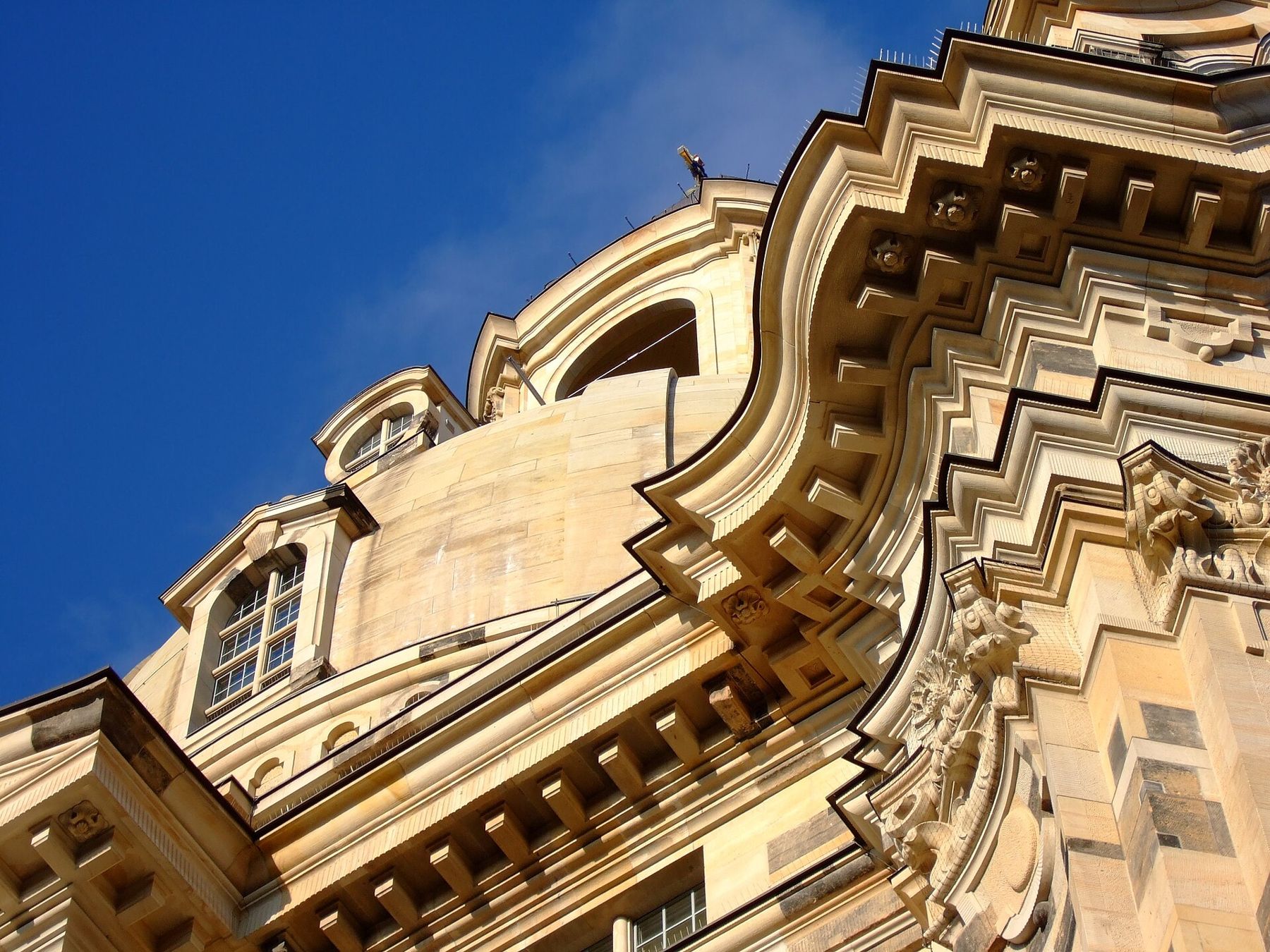
His design was bold. Instead of a timber dome covered in copper, the usual answer north of the Alps, he raised a dome built entirely of sandstone, resting on eight slender piers. Its outline swells out and then curves in again towards the lantern, and Dresdeners soon called it the Steinerne Glocke, the stone bell. Inside, the plan is close to a circle, with tiers of galleries rising around the altar like the boxes of a theatre, so that a large congregation can see and hear the preacher.
The dome was much admired, and painters recording the city put it at the centre of their views. It also survived a test: during the Seven Years' War, when Prussian guns bombarded Dresden in 1760, cannonballs are said to have bounced off it. For almost two centuries it stood as the defining shape of the Dresden skyline.
February 1945
The Allied air raids on Dresden began on the night of 13 February 1945. The Frauenkirche came through the first night still standing, but the fires burning in and around it heated the stone of the piers until they gave way. On the morning of 15 February, two days after the raids began, the dome collapsed and the church fell in on itself. What remained was a mound of blackened rubble with two jagged fragments of wall standing out of it.
The wider story of those days, and of how the city was rebuilt, is told in our guide to February 1945 and the rebuilding.
A ruin kept as a memorial
In the GDR years the ruins were cleared from much of the old town, but the heap of the Frauenkirche was left where it lay. Plans to rebuild were discussed and postponed, and over time the rubble became a memorial in its own right, a reminder of the war in the middle of the city. In the 1980s it became a place where people gathered quietly with candles on the anniversary of the raids, and those gatherings are remembered as part of the peaceful protest that preceded the fall of the Berlin Wall.
Neustadt · and nearbyThe courtyards and street art of the Äußere NeustadtAfter German reunification a citizens' initiative called for the church to be rebuilt as it had been, and gathered support and donations from across Germany and abroad.
Rebuilding with the old stones
Work began in 1994 with an archaeological dig through the rubble. Every stone that could be recovered was measured, numbered and stored, and its position in the old building worked out from photographs, old plans and the shape of the stone itself. Where an original stone could be used again, it went back into its old place; where it could not, new sandstone was cut to match.
The result is easy to read once you know how. The new stone is pale and honey-coloured. The recovered stones, weathered and scorched, are dark, almost black, and they are scattered across the walls like patches on a quilt. Weathering will gradually even out the difference, but for now the walls show plainly which parts survived.
The recovered stones, weathered and scorched, are dark, almost black, and they are scattered across the walls like patches on a quilt.
The cross and golden orb on top of the lantern are new. They were made in Britain by a British goldsmith, whose father had flown in the bombing raids, and were given as a sign of reconciliation. The original cross, twisted by the fall, is kept inside the church. The rebuilt Frauenkirche was consecrated on 30 October 2005, and the square around it has since been filled with reconstructed townhouses.
Under the stone dome
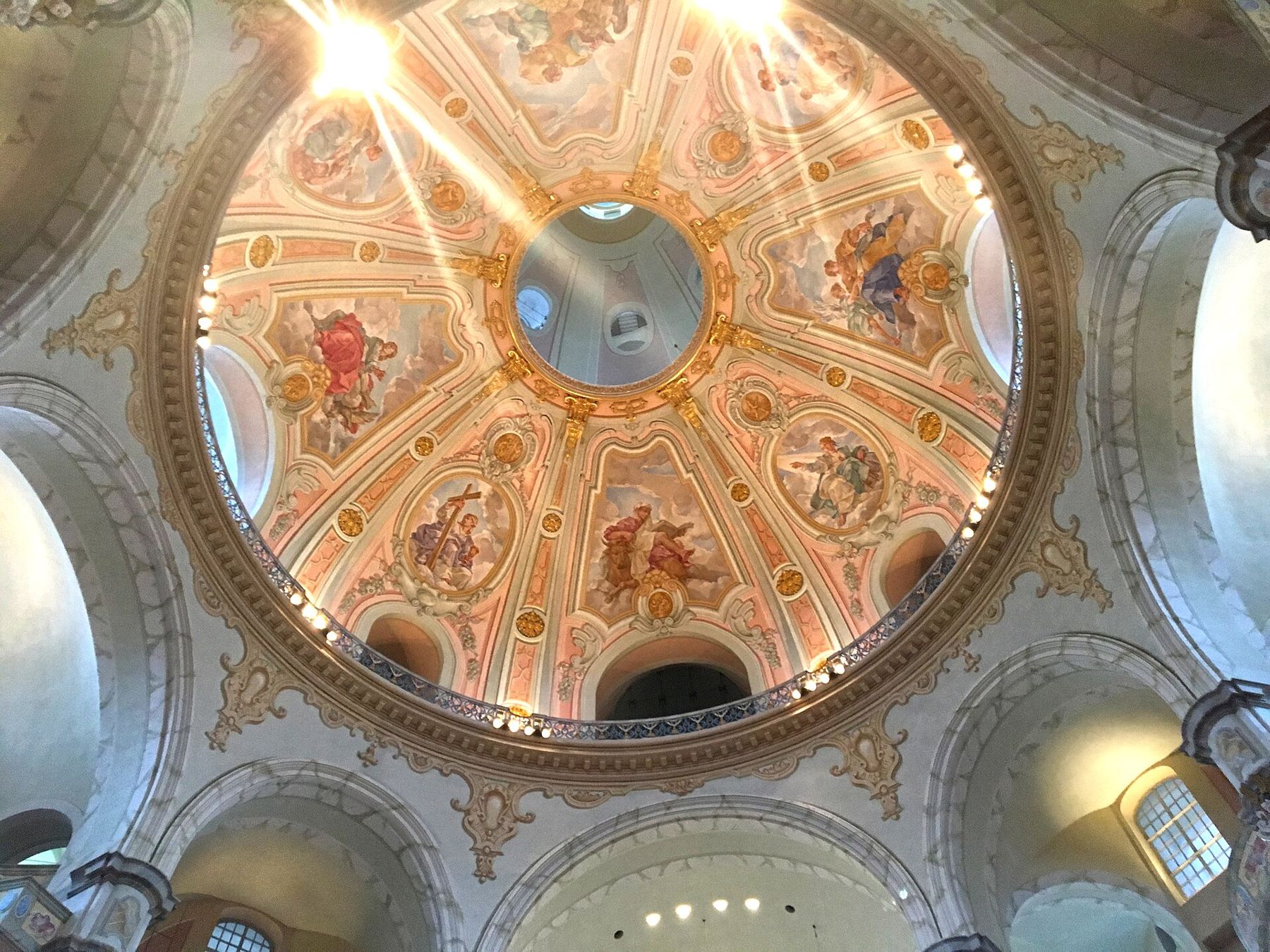
Coming in from the square, you find a bright interior in white, grey, pink and gold, much lighter than the outside suggests. The galleries curve around the central space, and above them the inner dome is painted with figures among clouds, lit by a ring of windows.
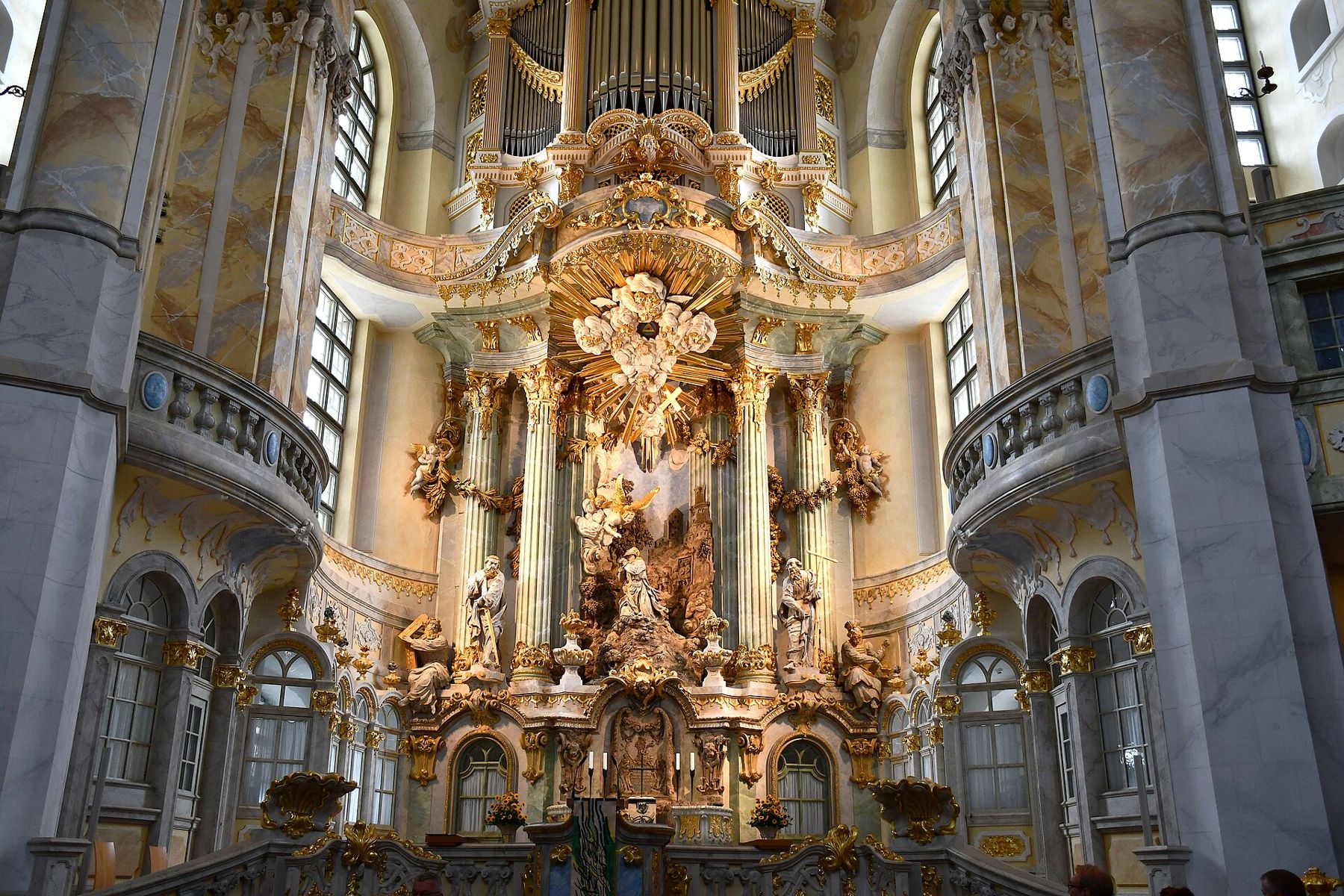
The altar, with its scene of Christ praying on the Mount of Olives, was pieced together from fragments recovered from the rubble and carefully restored. Above it rises the organ, built new for the rebuilt church in the spirit of the original instrument. Services follow the Lutheran calendar, and the church is used for concerts through the year, from organ recitals to choral works; the acoustics are a large part of the experience. Visiting hours are fitted around services and rehearsals, so check before you go.
Climbing the dome
The dome can be climbed by a separate entrance, for a fee. A route of ramps and stairs winds up between the inner and outer shells of the dome to an open platform around the lantern. The way up is long but gradual, with the last section steeper; it is not suitable for anyone who dislikes heights or tight spaces.
The view from the top takes in the whole of the old town: the roofs of the Neumarkt, the Residenzschloss and the court church, the river curving away under its bridges, and the Neustadt on the far bank. On clear days you can see the hills of Saxon Switzerland upstream. Opening times for the climb change with the season and the weather, so check before you go, and expect a queue on summer afternoons.
Around the Neumarkt
Outside, a nineteenth-century statue of Martin Luther stands in front of the church. The townhouses around the square were rebuilt from the 2000s onwards, some with their original baroque facades reconstructed, others as modern buildings in the old outlines. From the north side of the square a short walk leads to Brühl's Terrace above the river, and in the other direction the shopping streets lead to the Altmarkt, where the Striezelmarkt fills the square before Christmas. Come early in the morning, before the tour groups, or in the evening when the stone glows in the floodlights.