
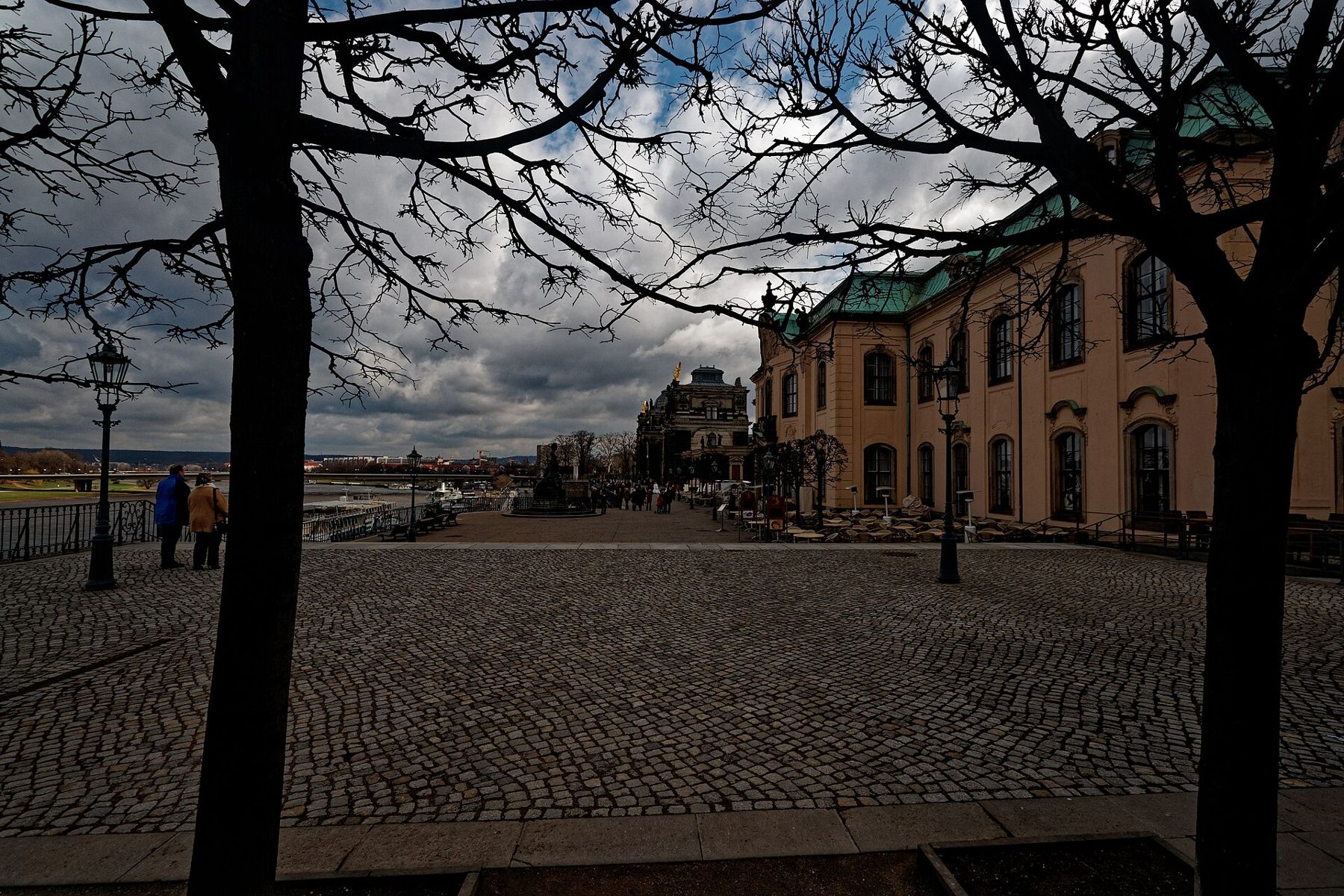
On the river The terrace sits on the old fortress walls directly above the Elbe's south bank; paddle steamers moor below it, and the view runs across the river to the Neustadt and the meadows.
Brühl's Terrace (Brühlsche Terrasse) runs along the top of the old city walls on the south bank of the Elbe, from Schlossplatz in the west to the Albertinum in the east. It is about half a kilometre of broad promenade, raised well above the riverbank, with the old town at your back and the river spread out in front. Since the nineteenth century it has been known as the balcony of Europe, and on a clear evening, with the light low over the water, the name does not feel like an exaggeration.
From fortress wall to private garden
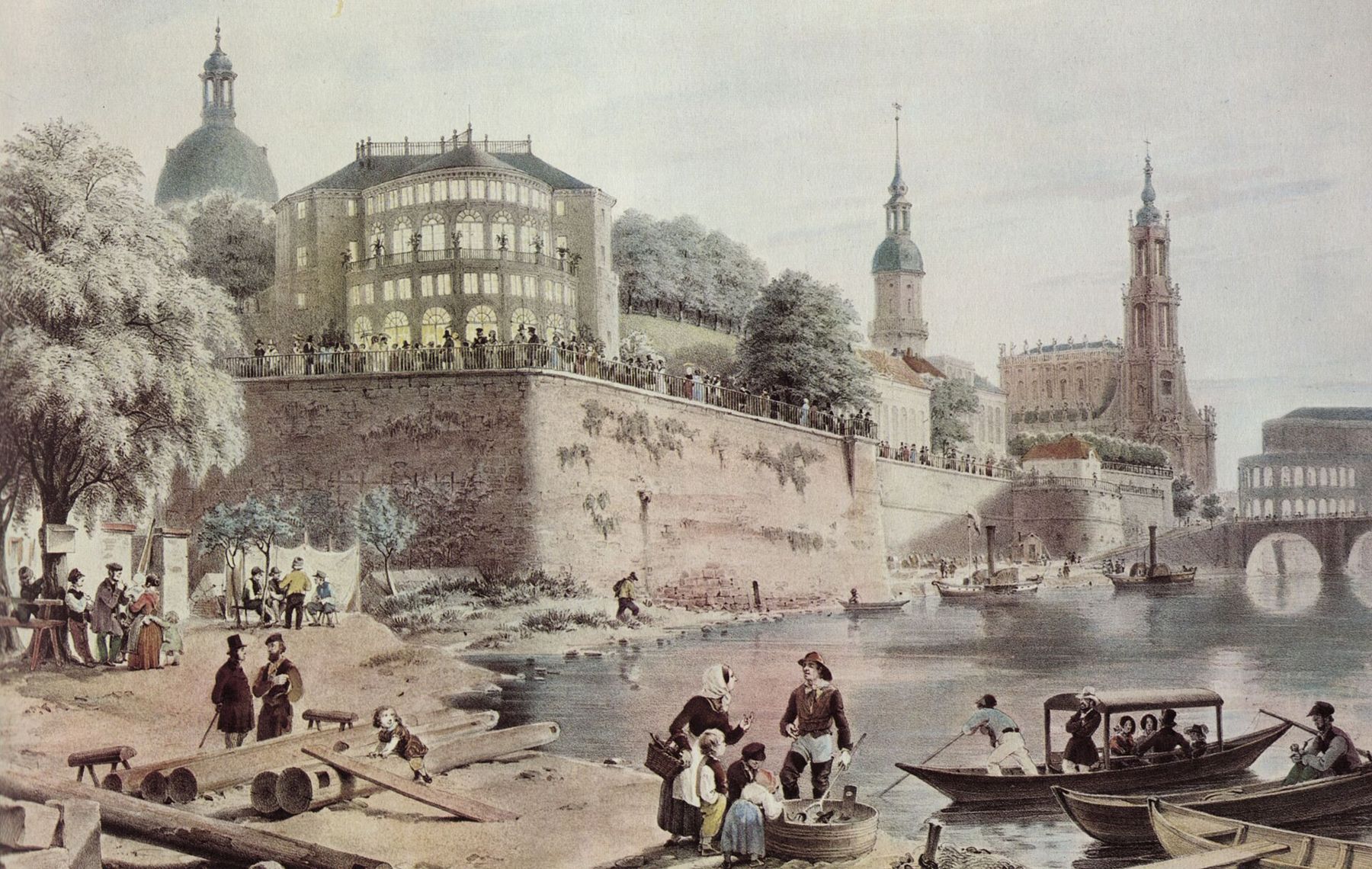
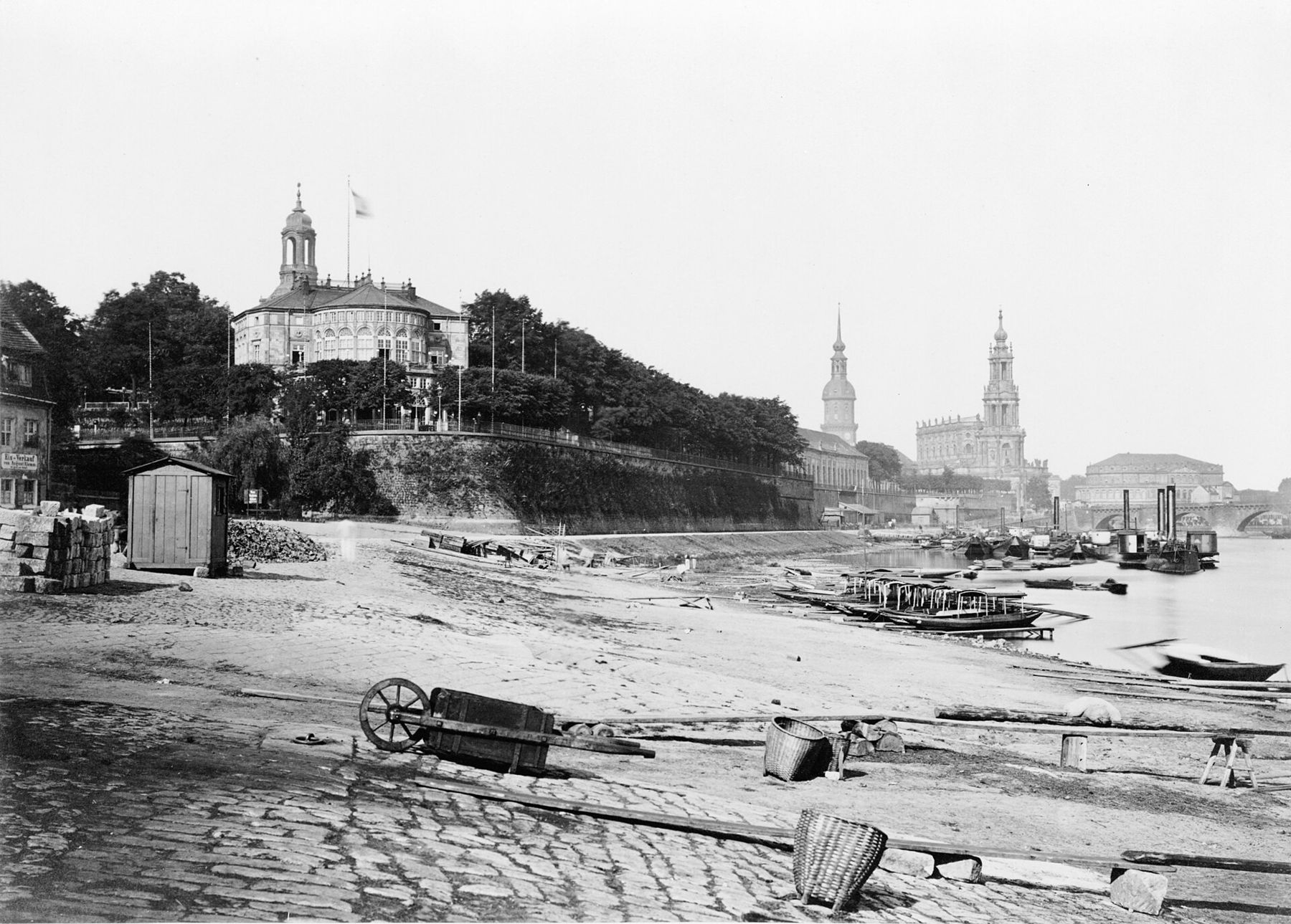
The terrace began as part of Dresden's fortifications, a bastioned wall built to defend the city along the river. In the eighteenth century, as the walls lost their military purpose, Elector Frederick Augustus II, who also ruled Poland as Augustus III, gave this stretch to his powerful minister, Count Heinrich von Brühl. Brühl laid out a private garden on top of the rampart and built a palace, a library, a picture gallery and a pleasure pavilion, the Belvedere, along it.
For decades the terrace was a private world, reserved for the count and his guests. Brühl fell from favour after the Seven Years' War, his buildings changed hands and several were later demolished or replaced. In the early nineteenth century the terrace was opened to the public, and a grand flight of steps was built up from the square by the palace. From then on it became the place where all of Dresden came to walk, meet and be seen.
Up the steps from Schlossplatz
The best way to arrive is from Schlossplatz, the square beside the Residenzschloss and the cathedral. A wide staircase leads up to the terrace, lined with sculptures representing the times of day. At the top you turn east and the whole promenade opens up before you, shaded by trees, with benches along the river side and grand buildings along the other.
The walk itself is the point. Take it slowly. The paving, the lamps and the line of trees give it the feel of a long open-air salon, and the river below sets the pace. Children run ahead to the balustrade, couples stop to photograph each other against the water, and street musicians sometimes play near the top of the steps. Stop at the balustrade to look down at the river traffic and across to the far bank. Turn round now and then to look at the façades on the town side. The pace is unhurried, and on a fine day you will share it with families, students from the art academy and people simply taking the air.
The Elbe · and nearbyPaddle steamers on the ElbeThe lemon squeezer
About halfway along stands the Academy of Fine Arts, a grand building from the late nineteenth century with a ribbed glass dome on top. The dome, crowned by a gilded figure of Fame, is the one locals have long called the lemon squeezer (Zitronenpresse), and once you have heard the nickname you cannot see it any other way. The dome lights up softly in the evening and is one of the landmarks of the Dresden skyline from across the river.
Next to it, the Lipsius building holds temporary art exhibitions, and at the eastern end of the terrace stands the Albertinum, home to the Galerie Neue Meister, the collection of painting from the Romantic era onwards, together with sculpture. Check opening times before you go.
The view across the Elbe
From the balustrade you look straight across the Elbe to the Neustadt. The broad river curves gently past, with the green meadows of the far bank, the government buildings and the gilded dome of the old cigarette factory rising behind. Downstream are the arches of the Augustus Bridge. Upstream the river bends away towards Loschwitz and the hills beyond. In the evening, the whole far bank turns golden.
Below the terrace, the Terrassenufer is the riverside landing where the old paddle steamers tie up between trips. Watching one of them back out from the quay, paddles churning, is part of the scene. If you want to see the terrace from the other side, cross the bridge and walk out onto the Elbe meadows, where the view back to the old town is the one painters have recorded for centuries.
Under the terrace
The terrace still rests on the old fortress walls, and parts of the casemates and passages inside them survive. A museum underground lets you walk through vaulted chambers and see the stonework of the Renaissance fortifications, a cool and quiet contrast to the open promenade above. It is a good option on a hot afternoon or a wet one. Opening times vary by season, so check before you go.
At the eastern end, steps lead down to the riverside and to the Neumarkt behind, so you can easily combine the terrace with the Frauenkirche and the Procession of Princes on Augustusstraße, which runs parallel to the terrace one block inland.
Seasons that suit it
- Early morning, when the river mist lifts and the terrace is nearly empty.
- Late afternoon and sunset, for the light on the Neustadt bank.
- After dark, when the dome and the bridges are lit.
- In winter the terrace is bare and windswept but rarely crowded.
Whatever the hour, give yourself time to stop. The terrace was built for strolling, not for hurrying through on the way somewhere else, and Dresden still uses it that way.