
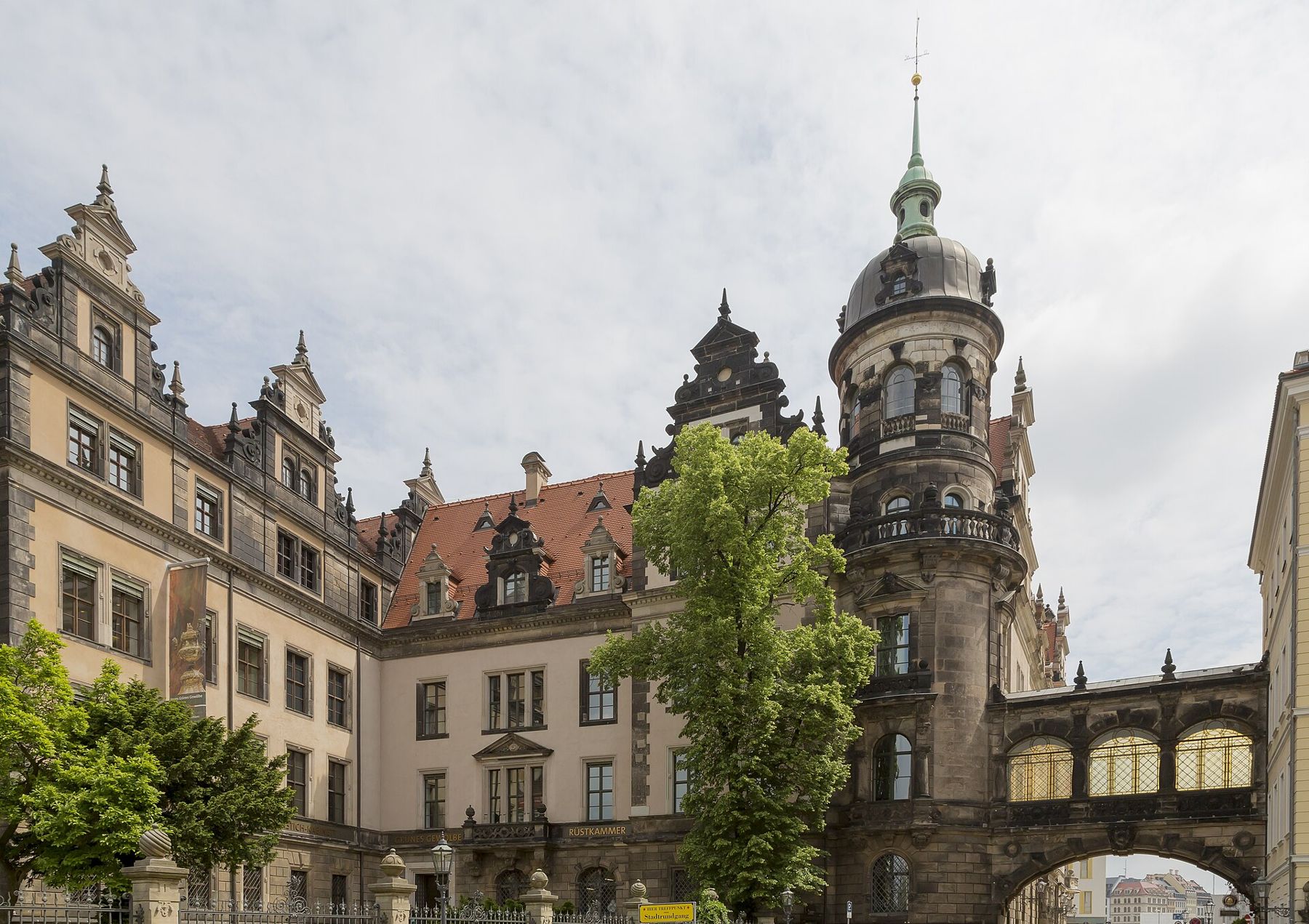
On the river The palace stands a short walk back from the river, beside the Augustus Bridge; from the top of the Hausmannsturm you look straight down the Elbe towards the Neustadt bank.
For four centuries the Residenzschloss was where Saxony was governed. Dukes, then electors, then kings of the House of Wettin lived and ruled here, and each generation rebuilt a wing, added a tower or redecorated a hall to suit the taste of the day. What you see from the street is mostly a Renaissance palace with later layers on top: steep gables, dark sandstone, a ring of courtyards and, rising above them all, the Hausmannsturm with its lantern and spire.
The palace sits in the middle of the old town, between Theaterplatz and the Neumarkt, so you will pass it more than once whatever else you see. The cathedral is its neighbour to the north, the Zwinger lies a few minutes to the west, and the long porcelain mural of the Fürstenzug runs along the outer wall of its stable court. Most visitors come for one thing, though: the treasure rooms of the Green Vault.
A palace burnt and slowly rebuilt
The raids of 13 to 15 February 1945 left the Residenzschloss a roofless shell. Floors had collapsed, the interiors were gone, and for years the ruin simply stood, its walls blackened and its courtyards full of rubble. The collections had largely been moved out of the city before the bombing, which is why so much of the treasure survives; the building that held it did not.
Securing the ruin began in the decades after the war, but real reconstruction came late, gathering pace from the mid-1980s and continuing long after reunification. It was done wing by wing, with old photographs, surviving fragments and the stubborn work of masons and plasterers. Some rooms were restored to their historic state, others were given plain modern interiors to serve as galleries. Work on the palace has gone on for so long that many people in Dresden grew up with scaffolding as part of its face. The story of the city's wider rebuilding is told in our guide to February 1945 and the rebuilding years.
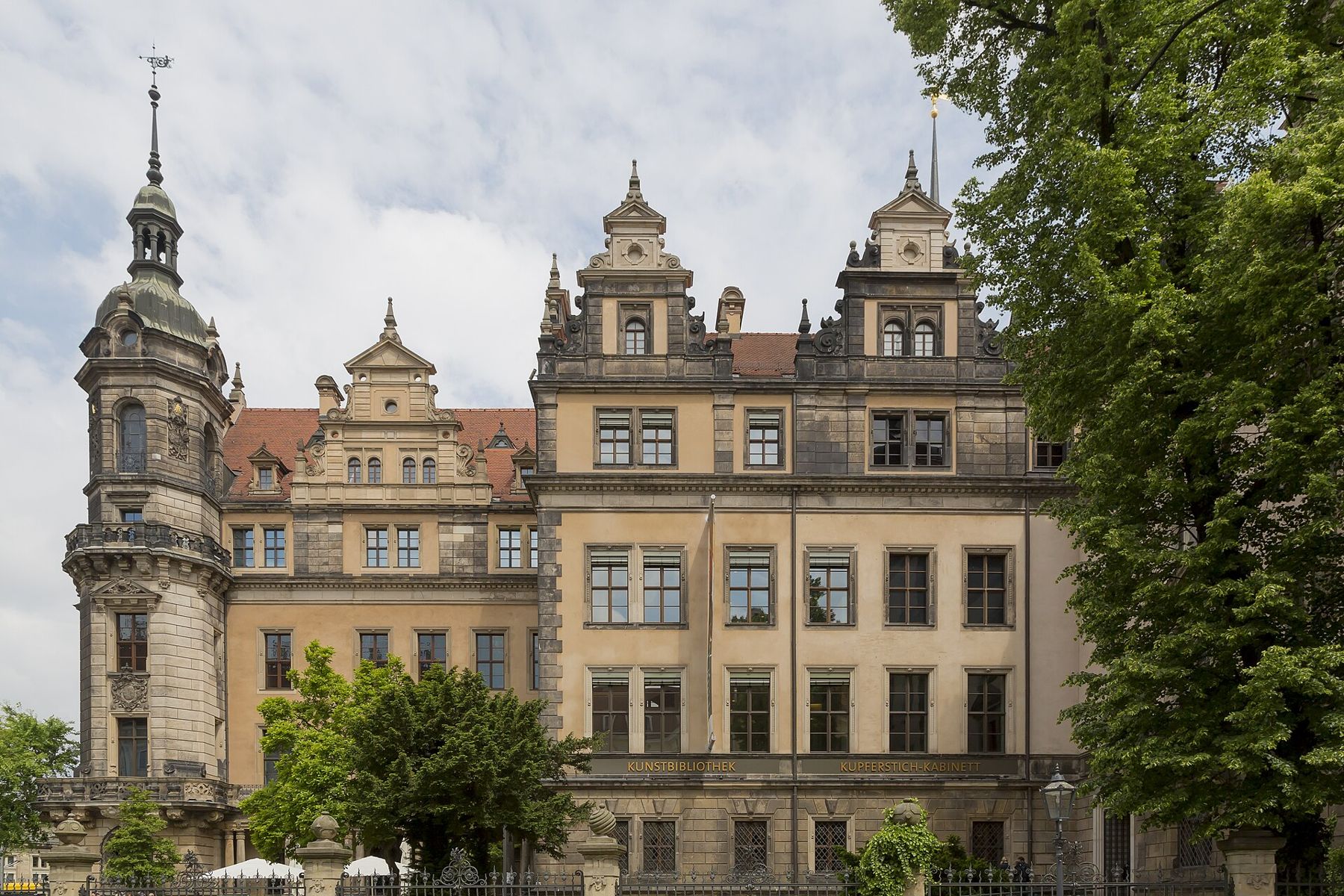
Walk around the outside before you go in. The western front, facing the Taschenberg, has the main entrance to the museums. The northern side faces the cathedral and the river. The courtyards are reached through gateways, and the small inner courtyard now has a lattice roof of glass and steel over it, turning it into a covered entrance hall. The contrast between that light modern roof and the old sandstone is deliberate, and it works.
The Historic Green Vault
The Green Vault takes its name from the green-painted rooms on the ground floor of the palace where the electors kept their valuables. Augustus the Strong, elector of Saxony and king of Poland, turned these vaulted rooms into a treasure chamber designed to dazzle, in the early decades of the eighteenth century. He meant it to be seen. Mirrors, gilding and wall consoles packed with objects made each room more extravagant than the last, and selected visitors were shown through them even in his day.
The rooms were destroyed in 1945. After decades of research and craftwork they were rebuilt as they had been, and the Historic Green Vault reopened in 2006. Walking through it is the closest you will come to seeing a baroque prince's idea of splendour as he intended it. Cases are kept to a minimum, objects stand on gilded brackets against mirrored walls, and the sequence of rooms builds from amber and ivory to silver, gilt and finally jewels.
Walking through it is the closest you will come to seeing a baroque prince's idea of splendour as he intended it.
Entry to the historic rooms is by timed ticket, and numbers in each slot are limited to protect the interiors. Book ahead, especially at weekends, in summer and during the Christmas market weeks. There is a climate lock at the entrance and bags and coats go into lockers. Prices, slot lengths and opening days change, so check before you go.
Altstadt · and nearbyThe Procession of Princes on Meissen tilesThe New Green Vault
One floor up, the New Green Vault shows many of the finest single pieces in a modern setting. Here the lighting is careful, the cases are glass and you can walk round objects and look closely at the workmanship. Among the best known are the court jeweller Johann Melchior Dinglinger's elaborate set pieces, including a miniature court of the Great Mogul crowded with tiny gold and enamel figures, and the Dresden Green, a large natural green diamond. Cherry stones carved with dozens of faces, ivory turned into impossibly fine towers, and drinking vessels made from ostrich eggs and nautilus shells show how far court craftsmen could push their materials.
Entry to the New Green Vault is generally less restricted, and you can usually combine it with the historic rooms on the same day. Allow at least an hour for each. If you only have time for one, the historic rooms give you the atmosphere and the new rooms give you the detail.
The 2019 theft, briefly
In November 2019 thieves broke into the Historic Green Vault through a window and smashed a case in the Jewel Room, taking diamond-set pieces from the eighteenth-century jewellery sets. The break-in made headlines around the world. After a long investigation and trial, most of the stolen pieces were recovered in 2022 and 2023, some of them damaged, and they have returned to the collection. A few items are still missing. Security in the rooms is visibly tighter now, which is part of why entry takes a little longer than it once did.
More under one roof
The Green Vault is only part of what the palace holds. The Armoury (Rüstkammer) shows ceremonial weapons, armour for men and horses, and tournament equipment from the days when the courtyards were used for jousting. The Turkish Chamber gathers textiles, weapons and a full-size Ottoman tent collected by the Saxon court during its long fascination with the East. The Coin Cabinet, the Print Room and the art library also have their homes here, and temporary exhibitions take over other halls.
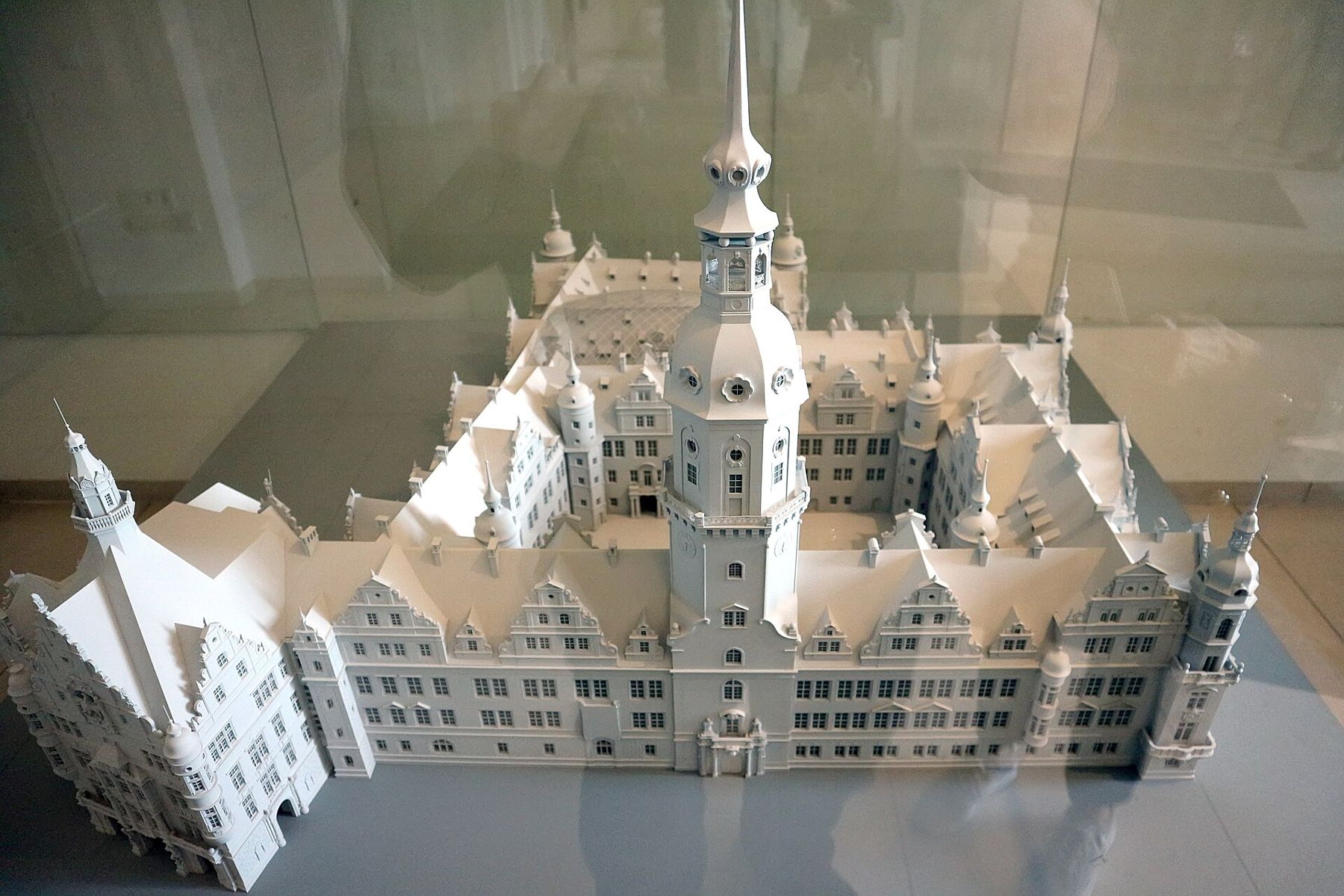
A scale model inside the palace helps make sense of the building's plan, with its wings closing round the large courtyard and the smaller covered one. It is worth finding before you set off through the galleries, because the layout is easy to lose once you are inside.
Up the Hausmannsturm
The Hausmannsturm is the palace's main tower and one of the tallest structures in the old town. In the warmer months you can usually climb it by a long staircase to a viewing gallery below the lantern. From the top, the old town falls into place: the dome of the Frauenkirche to the south-east, the towers of the cathedral just below you, the green copper of the Zwinger roofs to the west, and the river curving away under its bridges. Opening of the tower is seasonal and weather dependent, so check before you go.
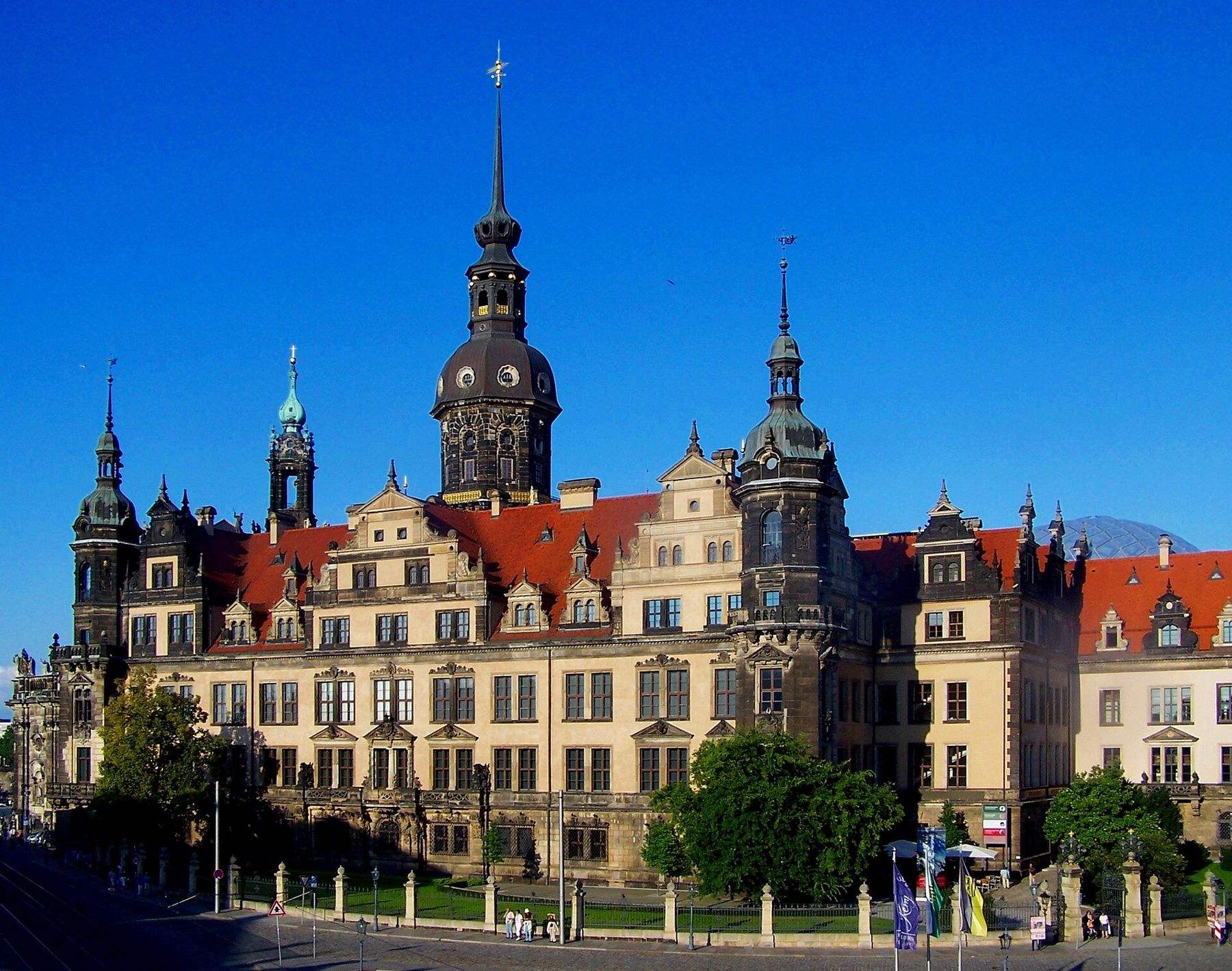
When you come down, walk out by the Georgentor, the gate that faces the Augustus Bridge, and turn towards Schlossplatz. The steps up to Brühl's Terrace are a few minutes away, and from the top you can look back at the palace towers rising over the rooftops. Across the square the Zwinger and the opera house complete the circle of the rebuilt royal quarter.
Before the ticket desk
- Buy timed tickets for the Historic Green Vault in advance; same-day slots often sell out.
- Go early in the day or late in the afternoon to avoid the busiest hours.
- Combination tickets for several palace museums are usually available; check what each includes.
- Expect a security check and lockers for bags and coats.
- The palace museums close on one weekday; check the current opening days before you go.
Pair the palace with the Frauenkirche across the Neumarkt for a full day in the Altstadt, or save it for a grey winter afternoon, when the glitter of the Green Vault is at its most welcome.