
On the river The Zwinger lies just back from the river behind the opera house; from the gallery walk on its roofs you can see across Theaterplatz towards the Elbe and the Neustadt.
The Zwinger was never a palace in the ordinary sense. Nobody lived in it. It was built as a stage: a huge enclosed courtyard where Augustus the Strong, elector of Saxony and king of Poland, could hold festivals, tournaments and court celebrations, framed by galleries for orange trees and pavilions for his collections. Its name comes from the old fortifications, the strip of ground between the inner and outer town walls where it was laid out.
The architect was Matthäus Daniel Pöppelmann and the sculptor was Balthasar Permoser, and between 1710 and 1728 they produced one of the most exuberant baroque buildings in Europe. The stone seems to move: columns turn into figures, garlands spill over windows, satyrs and nymphs hold up balconies. Spend half a day here and you will start to read the decoration as a language of its own.
A courtyard made for spectacle
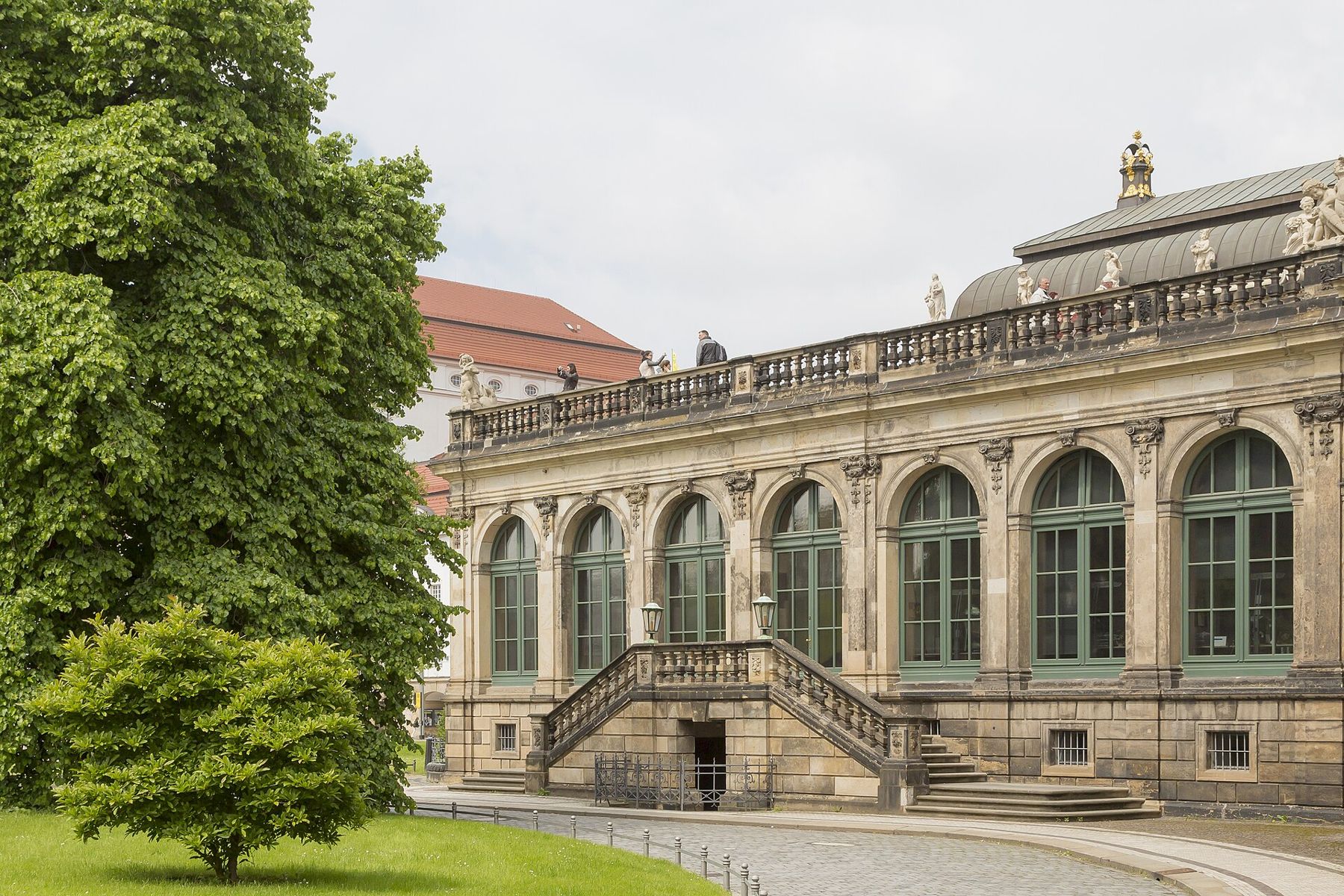
The main courtyard is vast, with lawns, fountains and gravel paths laid out in a formal pattern. On three sides it is enclosed by single-storey galleries with curved ends, broken by tall pavilions at the corners and the centres. On the fourth side, towards Theaterplatz, stands the Semper building, added in the nineteenth century to close the open end. The courtyard itself is usually free to enter, and on a fine day it is one of the best places in the city simply to walk and look.
The galleries carry a terrace walk on their roofs. Climb up by one of the staircases and you can circle much of the complex at roof level, between balustrades lined with statues and stone vases. From up there the geometry of the courtyard becomes clear, and you see the towers of the Residenzschloss and the cathedral rising just beyond the walls.
The Crown Gate and the Wall Pavilion
The Crown Gate (Kronentor) stands in the middle of the long gallery opposite the Semper building, facing the moat. It is a tall gateway topped by an onion-shaped dome and a gilded crown carried by four eagles, a reminder that Augustus wore the crown of Poland as well as ruling Saxony. Seen from the bridge over the moat, with water below and the gate reflected in it, it is the image of the Zwinger that most people carry home.
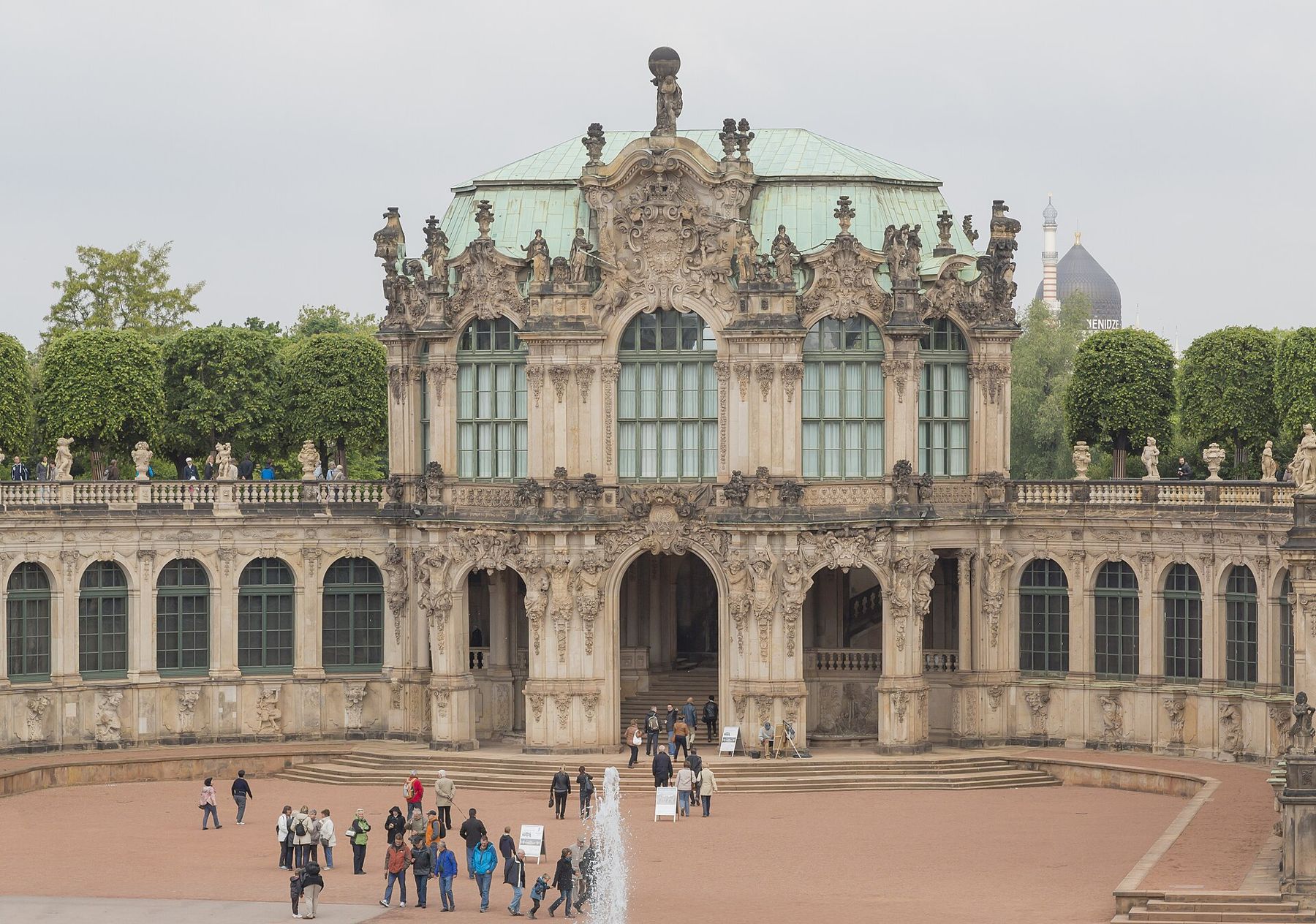
On the north-western curve of the courtyard stands the Wall Pavilion (Wallpavillon), the most exuberant of all. It rises above a sweeping staircase, its whole front a mass of sculpture, and at the very top a figure of Hercules carries the globe on his shoulders. Permoser's carvings here are at their wildest: twisting herms support the arches, and every surface carries ornament. Walk up the stairs inside and out onto the terrace for a view back across the courtyard.
The Nymphs' Bath
Close to the Wall Pavilion, tucked away behind the galleries, is the Nymphs' Bath (Nymphenbad). It is easy to miss, and that is part of its appeal. Water falls down a cascade into a sunken pool surrounded by grotto-like walls, and in niches all around stand graceful stone nymphs, many of them careful copies of the eighteenth-century originals. It feels secret and cool after the open courtyard, and in summer, when the fountains are running, it is the quietest corner of the whole complex.
Altstadt · and nearbyTheaterplatz and the Semper opera houseThe carillon pavilion
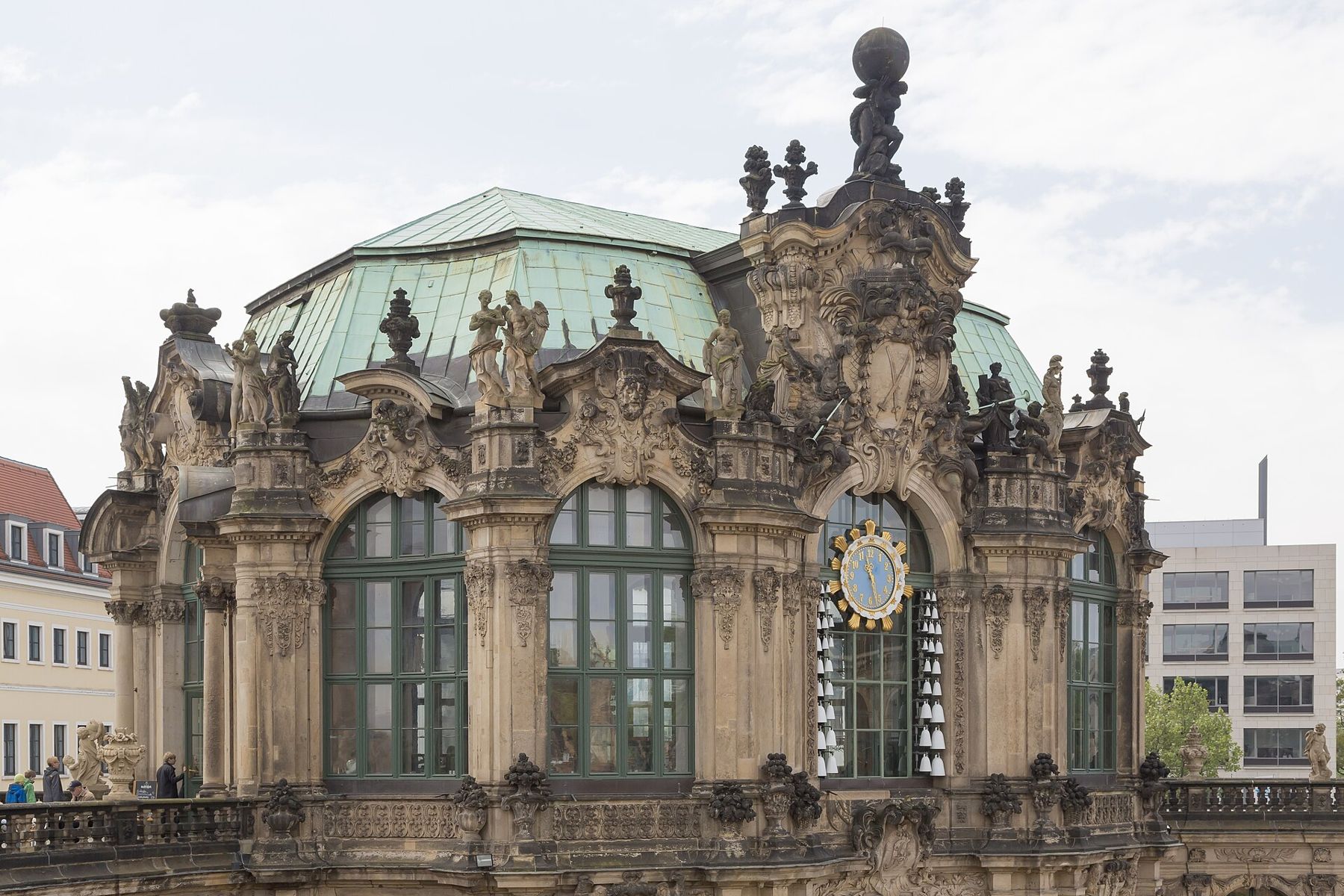
The Glockenspiel Pavilion, facing the Wall Pavilion across the courtyard, has something no other baroque building can boast: a carillon of bells made of Meissen porcelain. They hang in two rows beside a gilded clock face, white against the dark sandstone, and they play short melodies at intervals through the day. Porcelain bells are hard to make, and the sound is softer and more delicate than bronze. Stand in the courtyard when they ring and listen for the light, slightly glassy tone. It is a fitting touch for a city whose rulers founded Europe's first porcelain manufactory at Meissen in 1710.
Inside: the museums
The galleries and pavilions hold three major collections, each ticketed separately or with a combined ticket. The Old Masters Picture Gallery (Gemäldegalerie Alte Meister) fills the Semper building. Its most famous work is Raphael's Sistine Madonna, with the two bored-looking cherubs at the bottom of the canvas that have since appeared on countless postcards and posters. The gallery also holds major works by Giorgione, Titian, Rembrandt, Vermeer, Rubens and Bernardo Bellotto, known as Canaletto, whose views of eighteenth-century Dresden show the city before its losses.
The Porcelain Collection gathers Chinese and Japanese porcelain collected by Augustus the Strong alongside early Meissen pieces, including large animal figures he commissioned. The Mathematical and Physical Salon displays clocks, globes, telescopes and scientific instruments in one of the corner pavilions. Each of the three can fill a couple of hours. Opening days and ticket options change, so check before you go.
Destruction and rebuilding
The Zwinger was badly damaged in the bombing of February 1945. The paintings had been evacuated, but the building itself was left gutted, with pavilions collapsed and sculpture shattered. Reconstruction began soon after the war and continued for years, carried out with great care by stonemasons and sculptors who replaced lost figures and repaired those that could be saved. Restoration of the sandstone has continued ever since, because the soft local stone weathers quickly. Some of the dark patches you see are old stone, and the paler ones are newer work.
Odds and ends for the day
- The courtyard is generally open daily and free; the museums charge admission.
- Arrive early to see the courtyard before tour groups gather.
- Combine the Zwinger with Theaterplatz and the opera house next door.
- Parts of the complex may be under scaffolding; check before you go.