
On the river The market fills the Altmarkt a few minutes' walk from the river; a winter walk along Brühl's Terrace above the Elbe makes a natural end to an evening among the stalls.
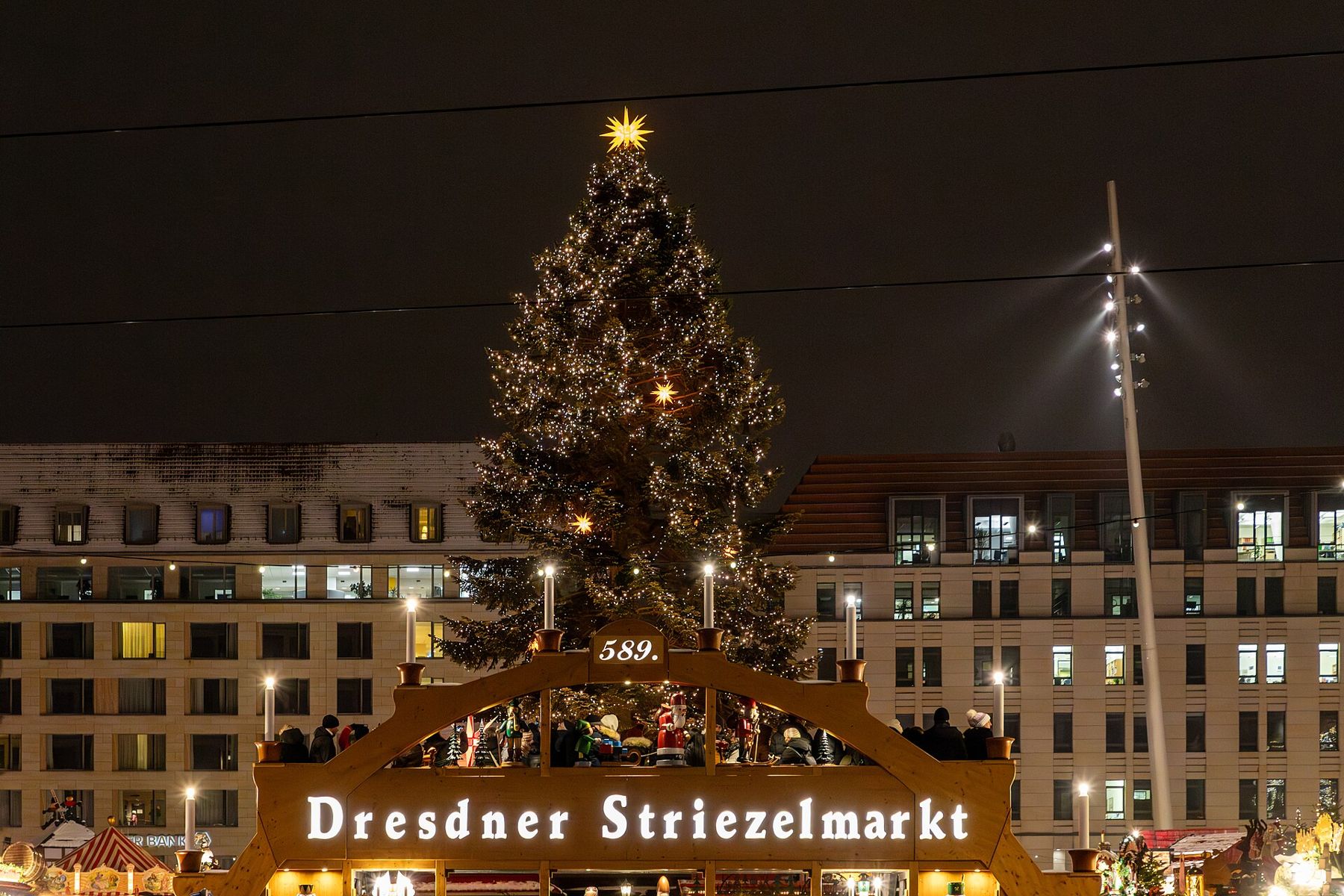
In late November the Altmarkt, the broad square at the heart of Dresden's old town, changes character. Wooden huts with pitched roofs fill it in rows, strings of lights go up between them, a great Christmas tree rises at one end and a wooden pyramid taller than a house turns slowly in the middle. This is the Striezelmarkt, Dresden's Christmas market and one of the oldest in Germany.
A market since 1434
The market's history is usually dated to 1434, when the ruler of Saxony granted the city the right to hold a one-day market before Christmas. It was a practical affair at first: a place for townspeople to buy meat for the Christmas feast and other goods for the winter. Over the centuries it grew longer and more festive, with toys, crafts and sweets joining the necessities, and it became a fixture of the Dresden year.
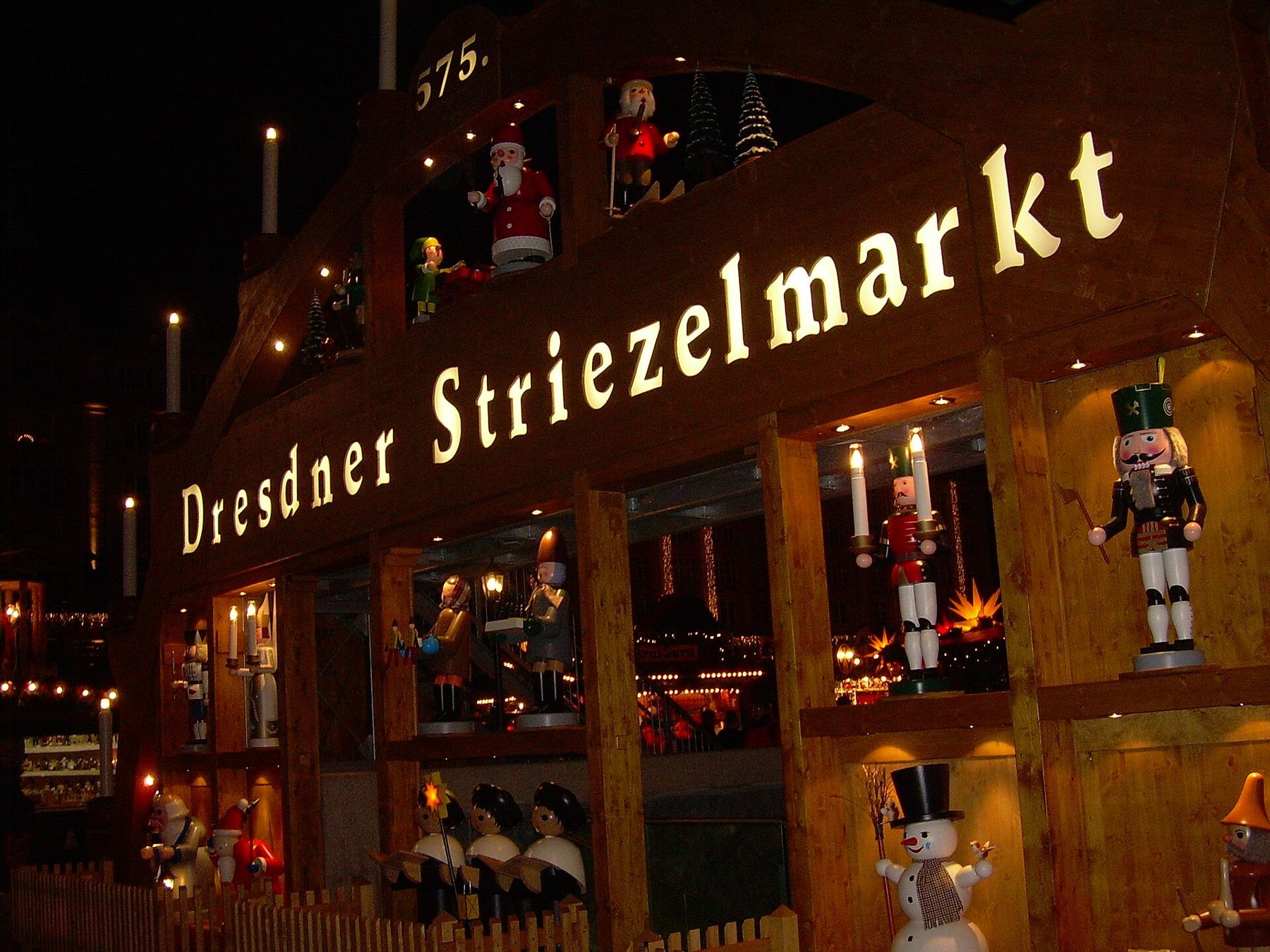
The market counts its editions, and the number is displayed on the great arch at the entrance: the 575th market was held in 2009, the 589th in 2023. Over its long life it has moved within the old town, been interrupted in hard times and changed its character many times, but it has kept its name and its place on the Altmarkt.
Why it is called the Striezelmarkt
The name comes from the Striezel, the old Dresden word for the long loaf now known as Stollen. Dresden Stollen is a heavy, buttery fruit bread with raisins, candied peel and almonds, covered in melted butter and a thick coat of sugar. Its folded shape is said to recall the Christ child wrapped in swaddling clothes. It keeps well and is often made weeks before Christmas, then left to mature.
Stollen has been baked in Dresden for centuries, and the city's bakers guard the tradition closely. Real Dresden Stollen is made by bakers in and around the city to a set recipe and carries a seal to show it. At the market you can buy it by the slice or the whole loaf, and many people take one home.
Arriving · and nearbyArriving at the Hauptbahnhof and Prager StrasseThe pyramid and the arch
The market's centrepiece is a giant Christmas pyramid, a version of the turning wooden pyramids made in the Erzgebirge, the Ore Mountains south of Dresden. In the traditional household version, candles heat the air, which turns a fan at the top and sets tiers of carved figures revolving. The Striezelmarkt's pyramid is the same idea on an enormous scale, with several storeys of figures turning above the crowds.
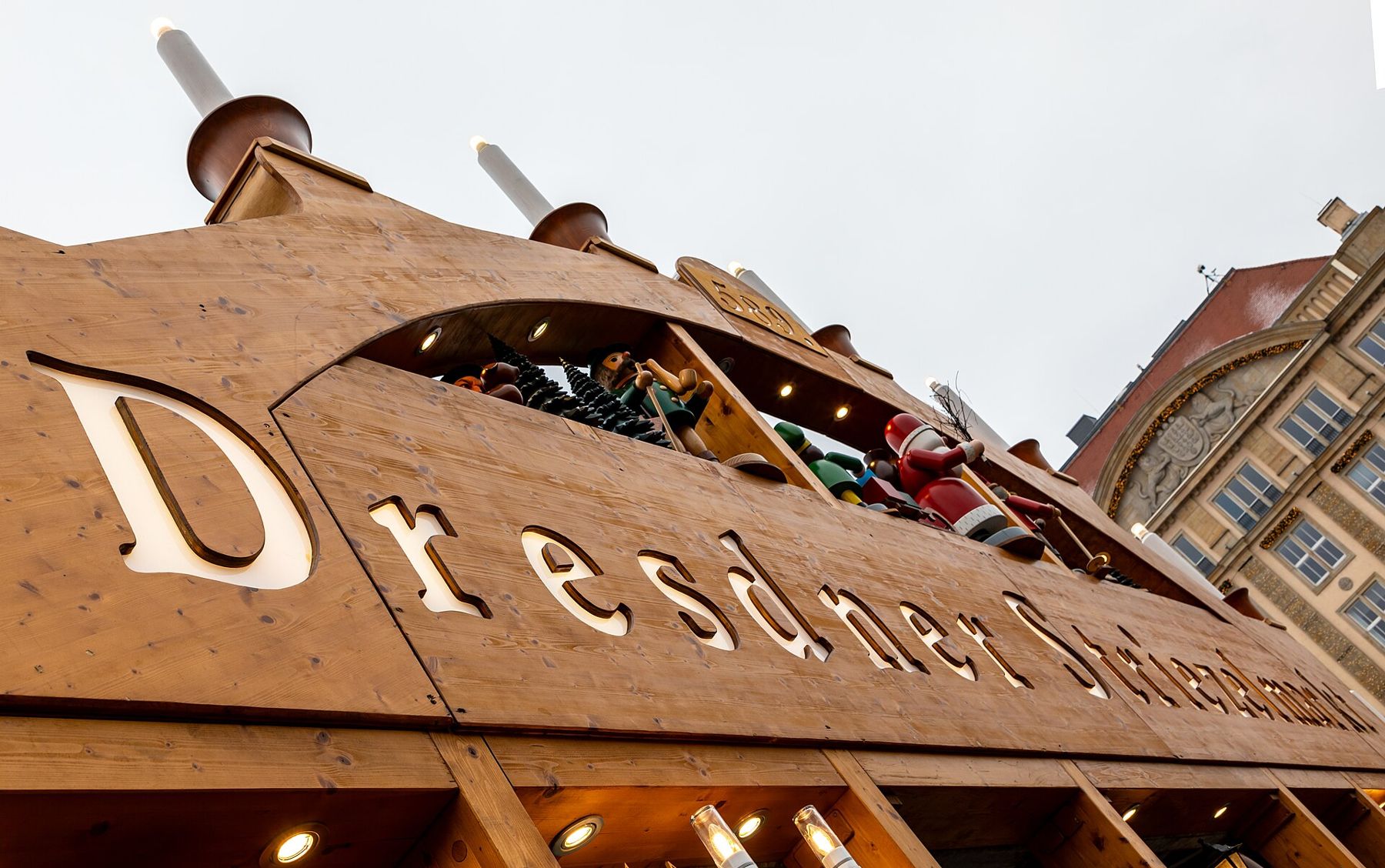
The entrance is marked by a large wooden arch in the shape of a Schwibbogen, the candle arch from the same mountain craft tradition, with wooden candles and carved figures set into it. Across the market you see more of that tradition: nutcrackers, smoking men that puff incense through their mouths, angels and miners, carved and painted by hand. Look too for the Pflaumentoffel, little figures made of dried prunes on sticks, an old Dresden market figure that has become a symbol of the place.
Food on the way
Most people come as much for the food as the crafts. Mulled wine is served in mugs that change design each year, and there is hot punch for anyone who wants something without alcohol. Gingerbread from Pulsnitz, a small town in Saxony known for it for centuries, is sold in shapes and sizes, along with roasted almonds, potato pancakes, sausages and other winter food. The quality varies from hut to hut; look at what local families are buying.
The Stollen festival
On a Saturday in early December, Dresden holds its Stollen festival. A giant Stollen, baked in sections by the city's bakers and assembled into a single loaf weighing several tonnes, is paraded through the old town on a cart with bakers, a Stollen girl and a band. At the market it is cut with a huge ceremonial knife and sold in portions, with the proceeds going to good causes. The date, route and timings are announced each year, so check before you go if you want to see it. The streets along the route are crowded.
Other markets around the old town
The Striezelmarkt is the largest and oldest, but Dresden has many Christmas markets in December. There are markets around the Frauenkirche on the Neumarkt, in the courtyard of the Residenzschloss, and across the river along Hauptstrasse in the Neustadt, near the Golden Rider. Each has its own character, and many people make an evening of walking between them.
The smaller markets tend to have fewer huts and more room to move, and some lean towards crafts, others towards food or music. A good plan is to start at the Striezelmarkt in the late afternoon, while there is still some daylight on the square, then drift towards the Neumarkt as the lights come on and the dome of the church is floodlit above the stalls. Crossing the Augustus Bridge to the Neustadt afterwards gives you a view back over the lit-up old town from the river.
Odds and ends for the day
The Striezelmarkt usually opens in late November and runs until Christmas Eve, with shorter hours on the last day, but the exact opening and closing days shift each year, so look them up before planning a trip around them. It is busiest on weekend evenings, when the square can be packed; weekday afternoons are calmer, and the lights come on early in the short December days. Dress warmly, since you will spend hours on your feet outdoors, and carry some cash for smaller huts. When you have had enough of the crowds, walk the few minutes to Brühl's Terrace and look out over the dark river.
More from arriving, history and the year · all five quarters