
On the river The opera house stands a few steps from the Elbe bank beside the Augustus Bridge; in the August 2002 flood the river reached its lower floors, and the cellars were pumped out afterwards.
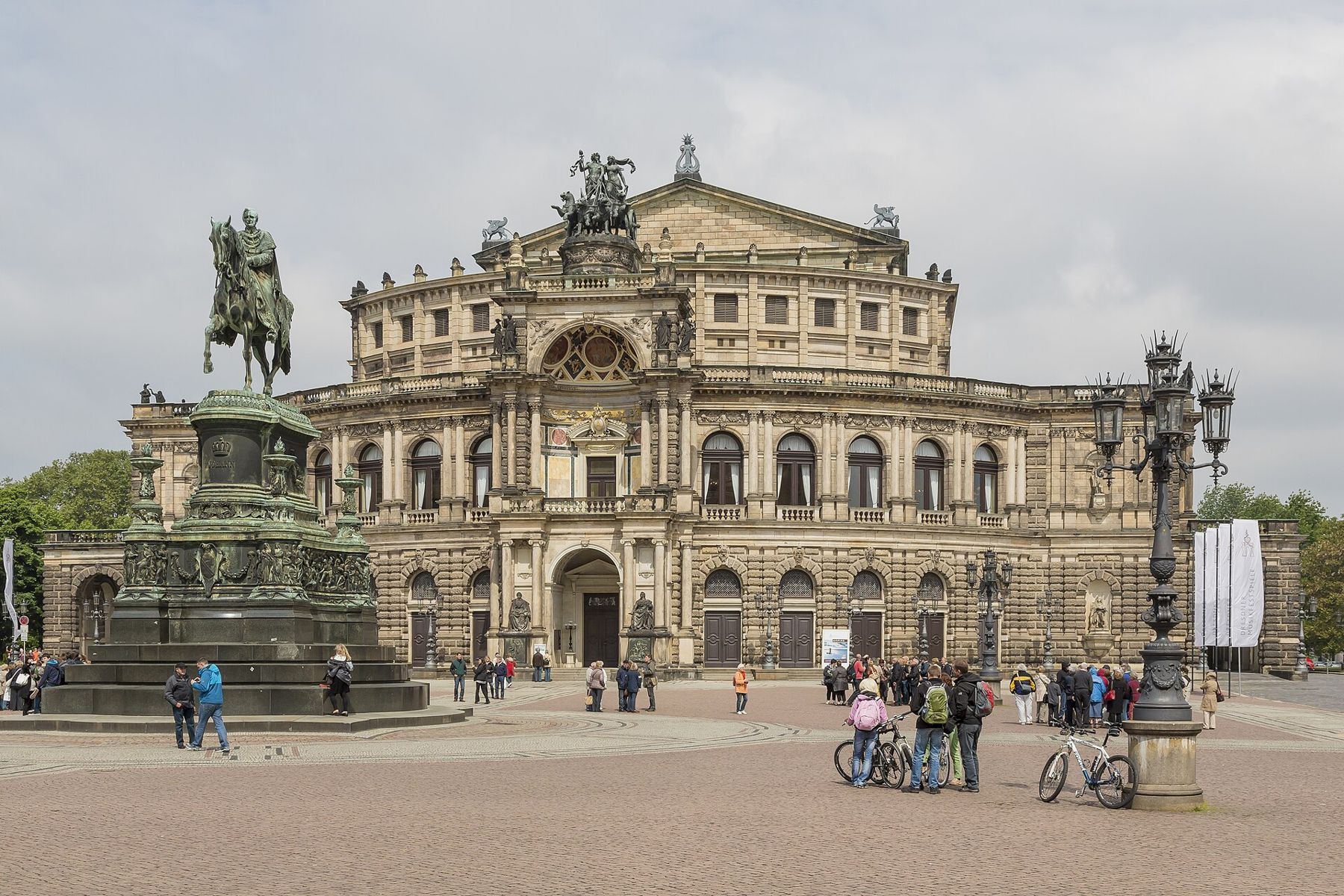
Theaterplatz is the largest open square in the old town, and for once in Dresden it is genuinely open: a broad sweep of pale paving with no trees and no traffic, closed on its western side by the curved front of the opera house. Most people simply call the building the Semperoper, after the architect who designed it, Gottfried Semper. It is the third stage to carry that association, and the story of how it came to be standing here is a fair summary of the city's last two hundred years.
The square is framed by some of the best-known buildings in Dresden. To the south is the Residenzschloss, the royal palace, whose treasure rooms are described in our guide to the royal palace and the Green Vault. To the east rises the Catholic court church, the Hofkirche, with its open-work tower. Between the opera and the palace runs the long north wing of the Zwinger, the gallery building that Semper also designed. Stand in the middle of the square and you can turn a slow circle and see three centuries of court building at once.
Semper's first theatre, and the fire
Gottfried Semper was a professor of architecture in Dresden when he was asked to design a new court theatre. His first opera house opened in 1841, a rounded building whose curved front followed the shape of the auditorium inside, an idea that was unusual at the time and that he carried into its successor. Within a few years it had seen premieres of early operas by Richard Wagner, then the court conductor in Dresden, including Rienzi, The Flying Dutchman and Tannhäuser.
That first building burned down in 1869. By then Semper was living in exile: he had taken part in the uprising of May 1849 in Dresden and had had to leave Saxony. Even so, the city turned to him again for the new opera house. He drew the plans from abroad, and the work on site was directed by his son, Manfred Semper. The second opera house was completed in 1878, and this is the design you see today.
The building that stands now
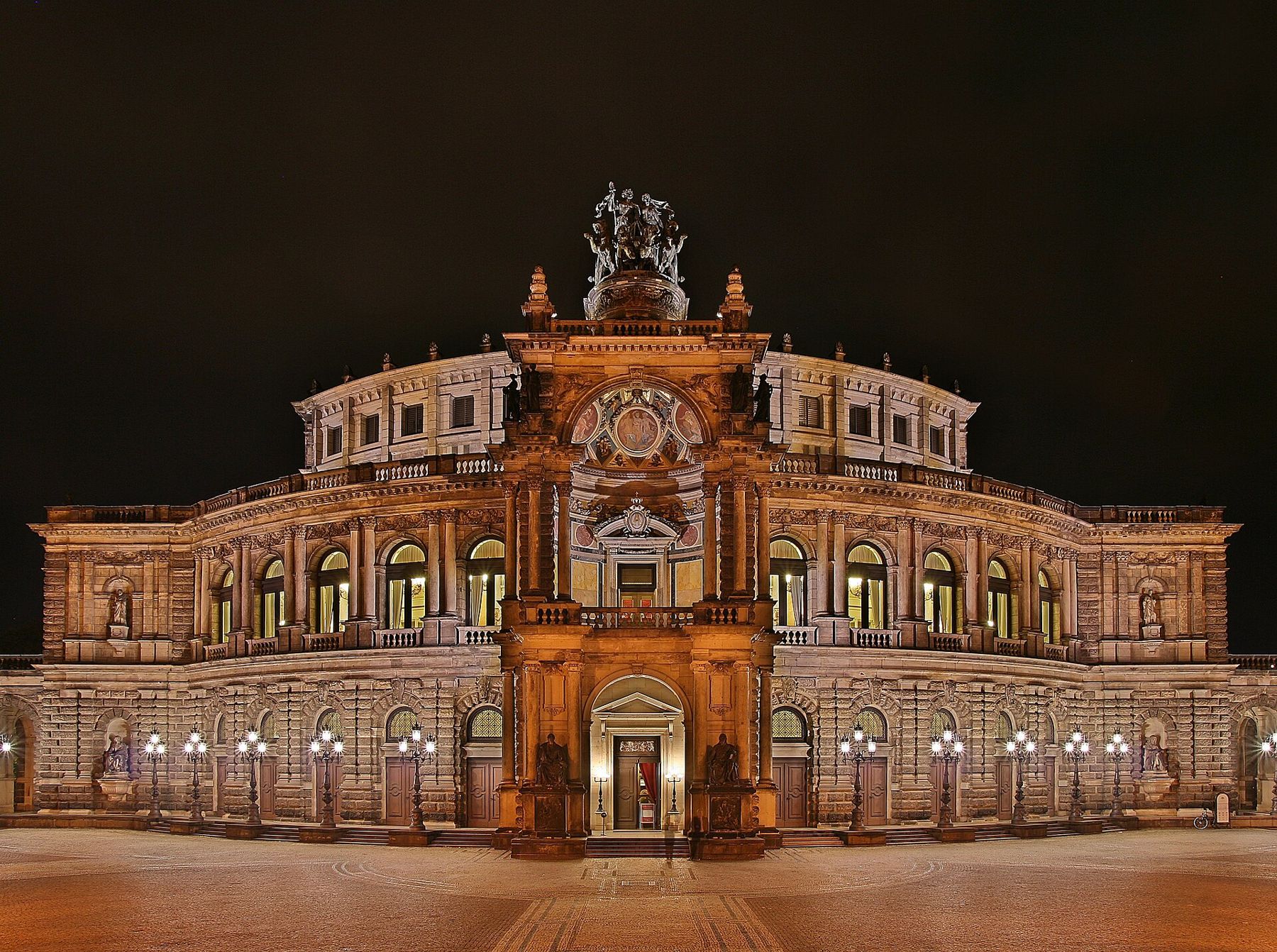
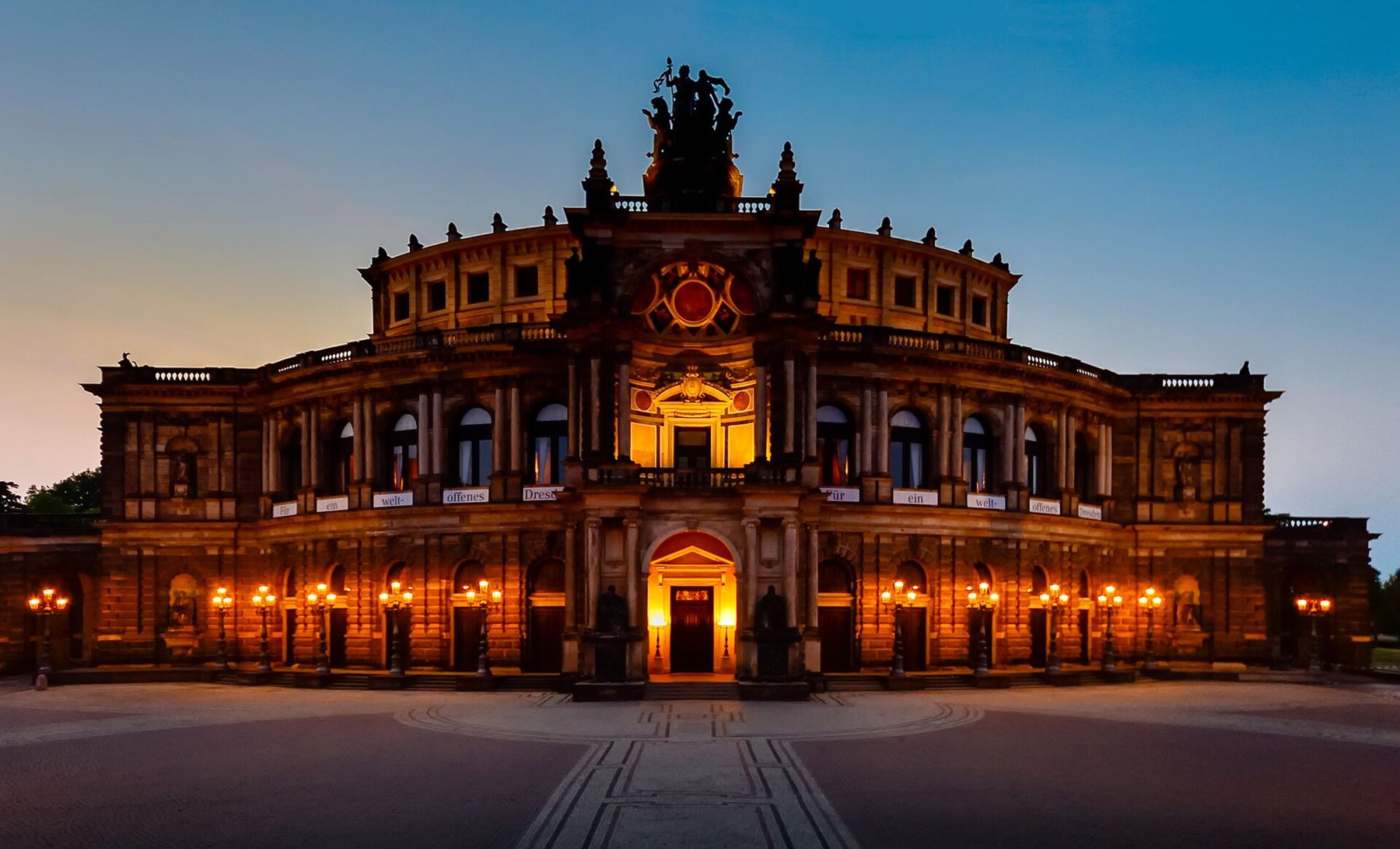
The front is a tall arched entrance set in the middle of a curved, two-storey arcade, with the auditorium rising behind it and a stage house behind that. On top of the entrance arch stands a bronze group of Dionysus and Ariadne riding in a chariot drawn by panthers, a reminder that theatre began as a festival of the wine god. Seated figures of Goethe and Schiller flank the doorway, and statues of playwrights and composers fill the niches along the walls.
Inside, the foyers and staircases are richly coloured: painted ceilings, marbled columns, gilding and patterned walls. Much of what looks like marble is in fact skilfully painted plaster, which was the fashion of the time and is part of the building's craft rather than a cheap substitute. The auditorium is horseshoe-shaped, with tiers of boxes and a large painted curtain.
February 1945 and the second rebuilding
On the night of 13 February 1945 the opera house was hit in the first air raid on Dresden and burnt out. Only the outer walls were left standing. For decades the ruin sat on the edge of the square while the city around it was cleared and partly rebuilt; the wider history is told in our guide to February 1945 and the rebuilding of the city.
Reconstruction began in the GDR years, and the work aimed at a faithful copy of Semper's design inside and out, using old drawings, photographs and surviving fragments. The stage and backstage areas were modernised, but the halls the public sees were restored to their nineteenth-century appearance. The opera house reopened on 13 February 1985, forty years to the day after the raid that destroyed it, with a performance of Der Freischütz by Carl Maria von Weber, himself once a court conductor in Dresden.
Altstadt · and nearbyThe Frauenkirche, rebuilt stone by stoneWho plays here
The Semperoper is the home of the Saxon State Opera and of the Staatskapelle Dresden, one of the oldest orchestras in the world, which traces its history back to a court ensemble founded in 1548. Weber and Wagner both led it, and Richard Strauss gave it the premieres of several of his operas in the twentieth century, among them Salome, Elektra and Der Rosenkavalier. The orchestra plays in the pit for the opera and gives its own symphony concerts on the same stage.
The season runs roughly from late summer to early summer, with a break in high summer. Popular performances sell out early, so if you have a particular evening in mind, book ahead through the opera house itself. Some cheaper seats have limited views, and there are occasionally standing places or late returns on the day; check the current arrangements before you go. Dress is whatever you feel comfortable in, though many people still make an evening of it.
Seeing inside without a ticket
If you do not catch a performance, guided tours of the building run on many days when rehearsals allow. They take you through the foyers and into the auditorium and tell the story of the three buildings in more detail. Tour times change with the stage schedule and are sometimes cancelled at short notice, and tickets are sold in limited numbers, so check the times and book ahead where you can. A tour takes about an hour.
Around Theaterplatz
In the middle of the square stands the equestrian statue of King John of Saxony, unveiled in 1889. John was a scholarly king who translated Dante's Divine Comedy into German under a pen name, and the reliefs around the pedestal reflect his interests. The statue is a convenient meeting point, and the steps of its base fill with people on warm evenings.
From the square it is a short walk into the courtyard of the Zwinger and its pavilions, through the arch in the Semper wing. On the other side, the Hofkirche is open to visitors outside services, and a few minutes beyond it the steps climb to the river promenade of Brühl's Terrace. A walk that takes in the opera house, the palace and the rebuilt Frauenkirche covers the heart of the old town in an afternoon.
Come back after dark if you can. The front of the opera house is lit at night, and from the middle of the empty square, with the lamps burning along the arcade and the bronze panthers outlined against the sky, it is easy to see why Dresden puts this building on so many of its postcards.