
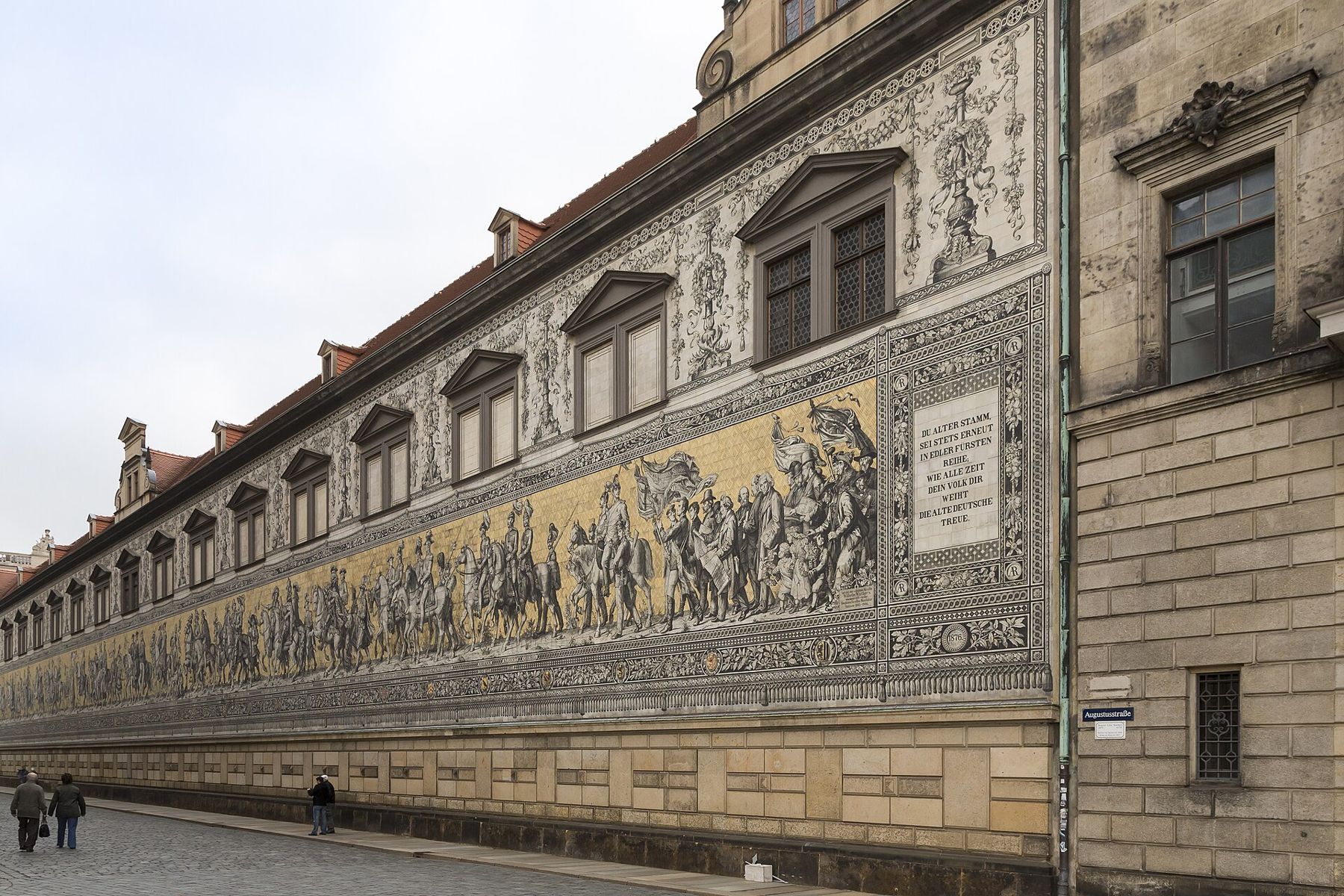
On the river Augustusstraße runs from Schlossplatz, beside the Augustus Bridge over the Elbe, to the Neumarkt; the river lies just behind you as you start walking along the mural.
The Fürstenzug, the Procession of Princes, is one of those things you can walk past almost without noticing, and then cannot stop looking at. It runs along the outer wall of the Stallhof, the old stable court of the royal palace, on Augustusstraße, a narrow lane that leads from Schlossplatz to the Neumarkt. For about 102 metres the wall is covered in a single mural: a parade of mounted rulers and their attendants moving from left to right against a golden ground.
What makes it remarkable is the material. The mural is made of roughly 23,000 tiles of Meissen porcelain, each painted and fired, then fitted together so precisely that from a few paces away the joints almost disappear. It is often described as the largest porcelain artwork in the world, and standing at one end looking down the length of the lane, it is easy to believe.
From sgraffito to porcelain
The design came first. In the 1870s the painter Wilhelm Walther created the procession as a sgraffito, a technique in which layers of coloured plaster are scratched through to make an image. It was a fine piece of work, but plaster on an outside wall in the Saxon climate did not last. Within a couple of decades the picture was fading and flaking.
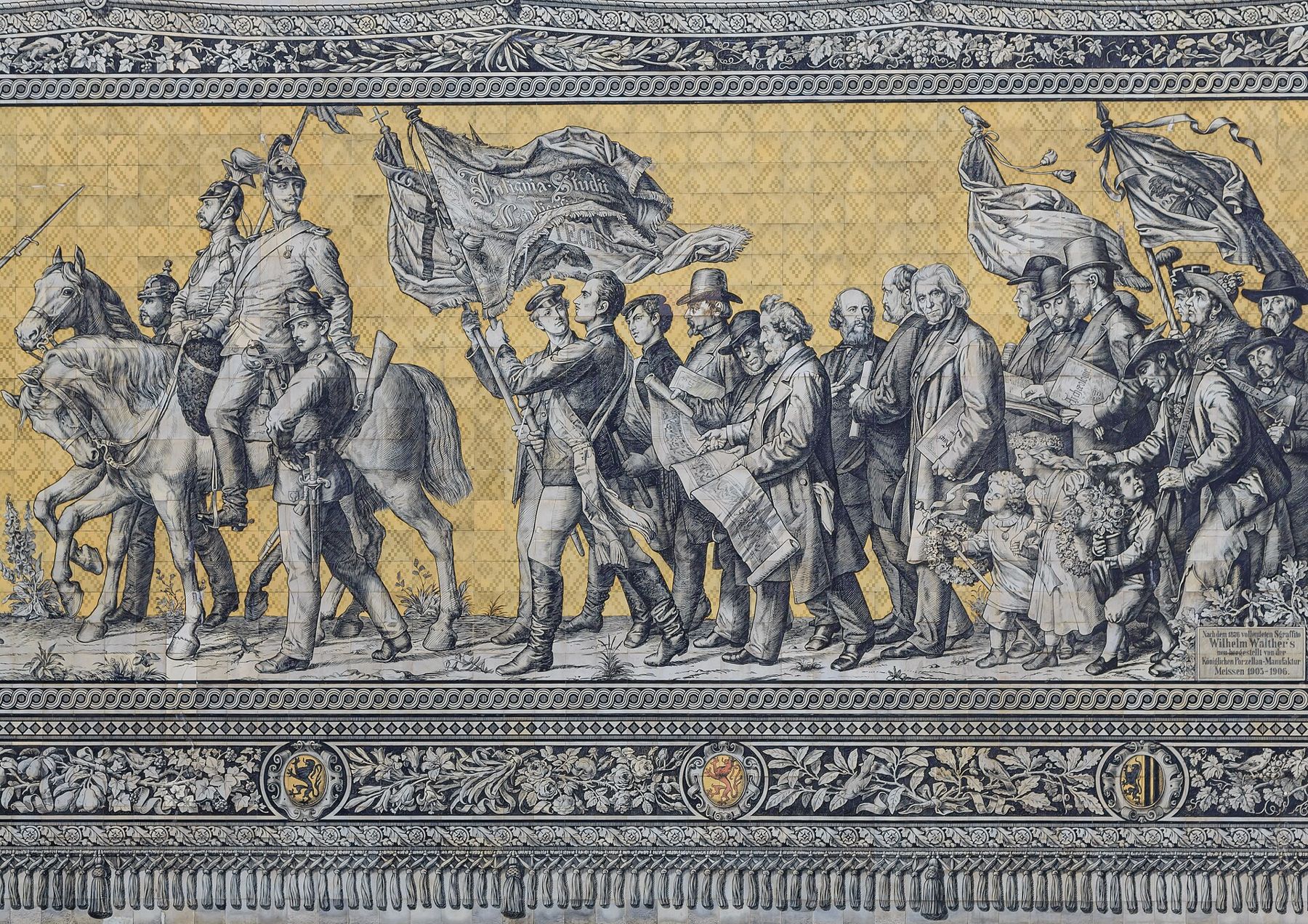
The solution was to transfer Walther's design onto something that could stand up to the weather. Between 1904 and 1907 the porcelain manufactory at Meissen painted and fired the tiles, reproducing the original design closely, and they were set onto the wall in place of the plaster. A small panel at the end of the procession records the original sgraffito and its translation into porcelain. Look for it near the lower right corner of the last section.
Who rides in the procession
The mural shows the rulers of the House of Wettin, the dynasty that governed Saxony for some eight hundred years. Margraves, dukes, electors and kings ride one after another, each named in an inscription below, from the medieval margraves of Meissen to the kings of the early twentieth century. Some three dozen rulers appear, most on horseback, dressed in the armour or court costume of their age, so the procession also works as a walk through the history of fashion.
You can spot Augustus the Strong, who built the Zwinger, by his name and his imposing figure. Further along, the kings of the nineteenth century ride in uniform. Then, at the end, the horses give way to people on foot: scientists, artists, craftsmen, students and children, representing the people of Saxony. Walther included himself among them. Behind them an inscription panel carries a verse pledging the old loyalty of the people to the line of princes, a sentiment very much of its time.
How it survived 1945
In the raids of 13 to 15 February 1945 almost everything around the Fürstenzug burned. The buildings of the Neumarkt collapsed, the palace became a shell and the Frauenkirche fell. The porcelain wall came through largely intact. Fired porcelain resists heat far better than plaster or paint, and the tiles were damaged in relatively few places. Those that cracked or fell were later replaced with new ones, and you would be hard pressed to pick them out today.
That survival gives the mural a particular weight in Dresden. For decades after the war, while the Neumarkt lay empty, the procession was one of the few complete works of art in the heart of the old town. To walk along it is to see something that the city's people saw through the whole period of ruin and rebuilding.
Reading the details
Most people walk the length of the procession once, quickly. It rewards a slower second walk. Look at the horses, which change in gait and harness from one ruler to the next. Look at the banners, the coats of arms in the frieze below, the decorative borders of fruit and foliage, and the windows set into the upper wall, framed in painted ornament of their own. The colour scheme is restrained, mostly black and grey on gold and white, which keeps the whole composition readable from a distance.
A zoom lens or a pair of binoculars helps with the faces of the riders and the small figures at the end. The wall is high and the lane narrow, so the upper part is best seen from the far side of the street.
The kindest months
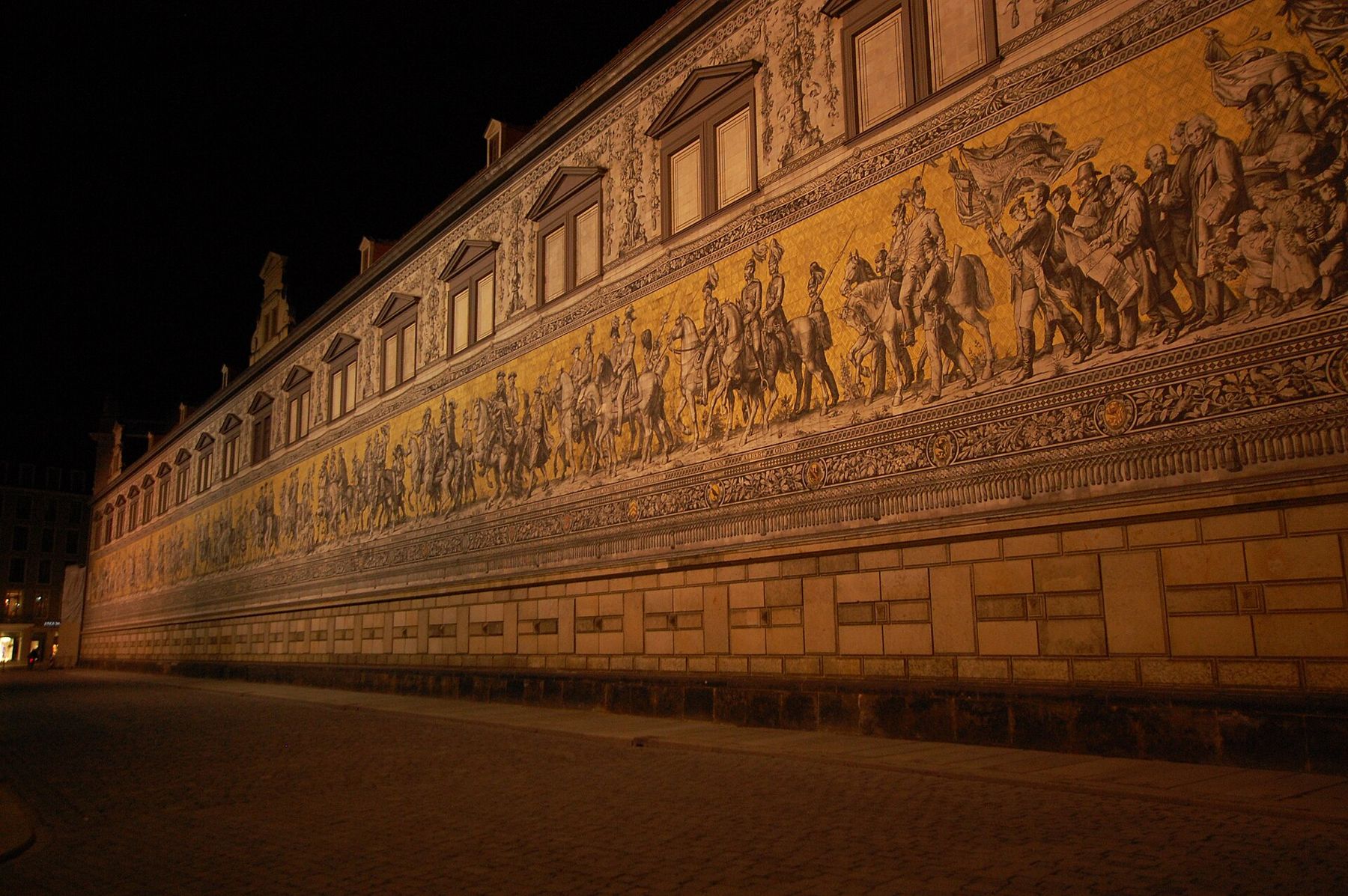
Augustusstraße is a public street, so there is no ticket and no closing time. Early morning is the best time to see the mural without crowds, when the lane is quiet and the light falls evenly. In the middle of the day, especially in summer, groups gather along the wall and it can be hard to step back far enough to take it in. After dark, lamps light the tiles and the gold background glows warmly, a sight worth coming back for if you are staying in the old town.
Around the Fürstenzug
- The Stallhof behind the wall, the old tournament ground, is reached through a gateway and hosts a seasonal market in winter.
- Schlossplatz at the western end leads up the steps to Brühl's Terrace.
- The Neumarkt and the Frauenkirche lie at the eastern end of the lane.
- The palace museums are just round the corner; check opening times before you go.