
On the river The quarter lies about fifteen minutes on foot north of the river; walk down through Albertplatz and the Hauptstrasse and you come out on the Elbe meadows opposite the old town skyline.
Most visitors to Dresden see the city through its baroque and nineteenth-century monuments, nearly all of them rebuilt. The Äußere Neustadt, the Outer New Town, offers something different: ordinary streets of tenement houses that were never destroyed, where people have lived continuously for more than a century. It lies north of the Elbe, beyond Albertplatz, and it is the part of the city where you are most likely to find painted walls, small galleries, studios and people sitting out on the pavement late into a summer night.
The name needs a word of explanation. The Neustadt as a whole is the town on the right bank of the river, which was largely rebuilt after a fire in 1685 and later given its name, the New Town. The Innere Neustadt, the Inner New Town, is the older baroque core near the river, around the Golden Rider and the Hauptstrasse. The Äußere Neustadt grew up outside the old town walls, and most of what stands there now was built in the second half of the nineteenth century.
A quarter that survived
The raids of February 1945 concentrated on the old town and the districts to the south and east. The Äußere Neustadt was hit, but far less heavily, and most of its streets came through standing. That is why it looks the way it does: block after block of four- and five-storey houses with stucco fronts, iron balconies and deep courtyards behind carriage entrances. The story of the city that was lost is told in our guide to February 1945 and the rebuilding, and walking here afterwards gives you an idea of what large parts of Dresden were once like.
Surviving the war did not mean being cared for. In the GDR years the old housing was neglected in favour of new building elsewhere, and by 1990 many houses were in poor repair and some stood empty. Students, artists and young people moved in, some of them without asking, and the quarter gained a reputation for being independent and a little unruly. In 1990 its residents even declared a tongue-in-cheek republic of their own, an idea that lives on in a large street festival held in the district each summer. Much of the housing has since been restored, but the mood of those years has not entirely gone.
The Kunsthofpassage
The best-known sight in the quarter is the Kunsthofpassage, a chain of five linked courtyards running through the block between Alaunstraße and Görlitzer Straße. From about 2001 the old back yards were remade by artists and architects as a public passage, each courtyard with its own theme and its own way of decorating the plain rear walls of the houses. Small studios and workshops open onto them, and the passage is free to walk through during the day.
The courtyards carry names such as the Courtyard of the Elements, the Courtyard of Animals, the Courtyard of Mythical Creatures, the Courtyard of Light and the Courtyard of Metamorphoses. They are small, and you can pass through all five in a few minutes, but they reward slower attention: sculptures set into walls, unusual windows and balconies, tiled surfaces and odd details hidden above eye level.
Neustadt · and nearbyThe Golden Rider and the HauptstrasseThe wall that plays the rain
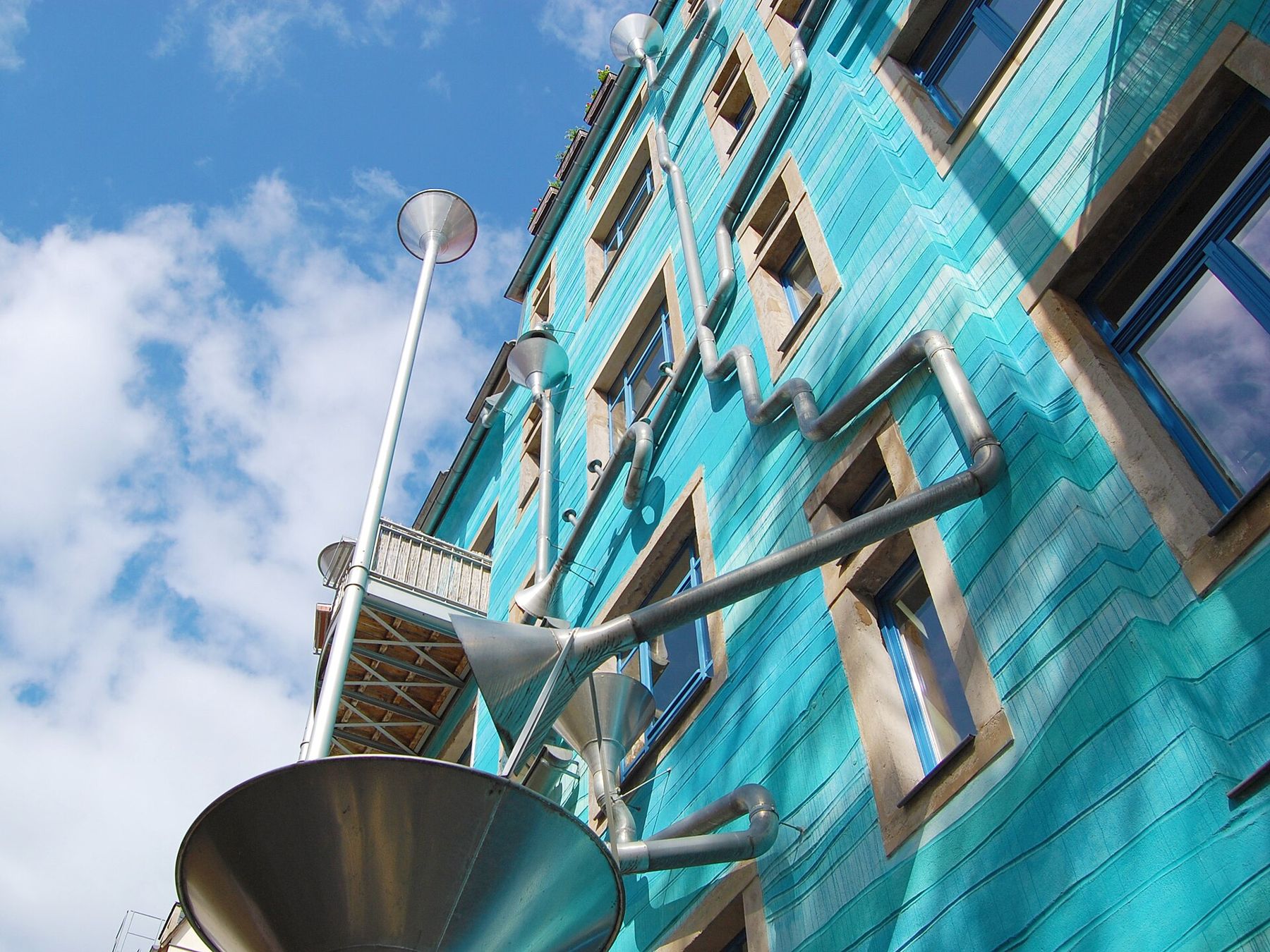
The courtyard most people come to see is the Courtyard of the Elements. One of its walls is painted a strong turquoise and carries a sprawling system of metal funnels and drainpipes that zigzag down the facade between the windows. When it rains, water collects in the funnels and runs through the pipes, and the different shapes and lengths make the falling water sound in different tones, so that the whole wall becomes a kind of instrument.
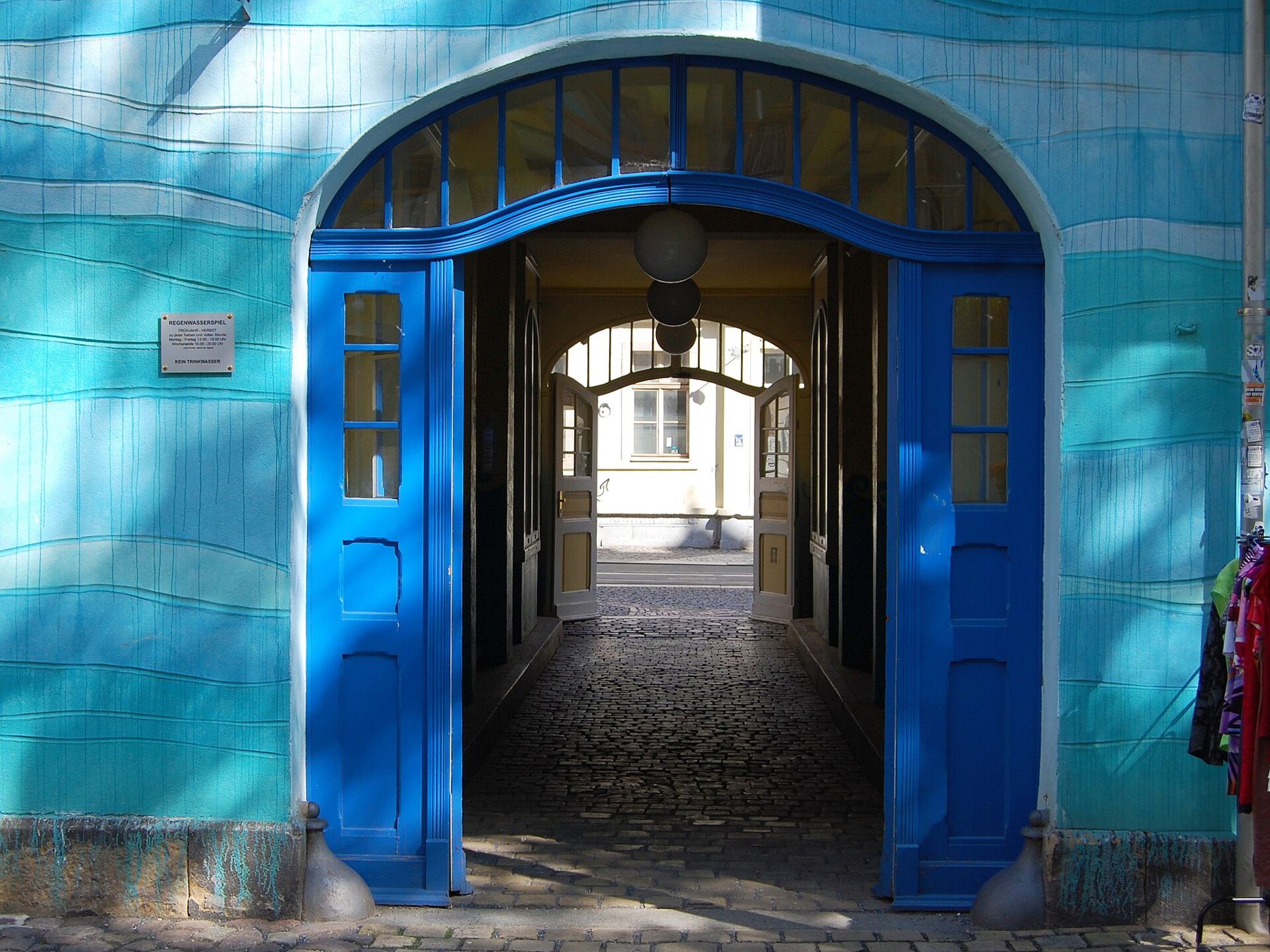
You do not have to wait for bad weather. In the warmer months water is sometimes fed through the pipes at set times, and a small plaque by the entrance explains when. Check the times on the day, and remember that the water is not for drinking. Even when the wall is silent, the funnels and pipes against the blue are worth seeing.
Painted walls and street art
Outside the passage, the quarter is a gallery in its own right. Murals cover the end walls of houses, gateways are painted and repainted, and stencils, paste-ups and small sculptures turn up on doors, drainpipes and electricity boxes. Some pieces are commissioned and stay for years; others vanish within weeks under new layers. Wander the streets between Alaunstraße, Louisenstraße, Rothenburger Straße and Görlitzer Straße and look up as well as along.
A few simple courtesies help. Many of the courtyards behind the street doors are private homes, so look in from the entrance rather than walking through unless a passage is clearly public. People living here are used to cameras, but they are not exhibits.
Evenings in the Neustadt
As the light goes, the quarter changes character. The Äußere Neustadt has a dense mix of small bars, late kitchens and music venues, many of them run by people who live in the district, and on warm nights the corners of the main streets fill with people standing outside with a drink. It is busy and loud on summer weekends and quieter during the week and in winter. For a gentler evening, the green of Alaunpark, on the northern edge of the quarter, is a good place to sit as the sun sets.
Respect for the neighbours matters here, as the area is still largely residential. Keep the noise down in side streets late at night, and use the trams to get back across the river rather than a car.
Reaching it and moving on
Trams run from the old town across the Elbe to Albertplatz and through the quarter, and Dresden-Neustadt station lies on its western edge, which makes it an easy first or last stop if you are arriving by train. On foot, the walk from the old town over the Augustus Bridge and up the Hauptstrasse takes about twenty minutes. Afterwards, the riverbank of the Elbe meadows is the natural place to finish, with the old town skyline across the water.