
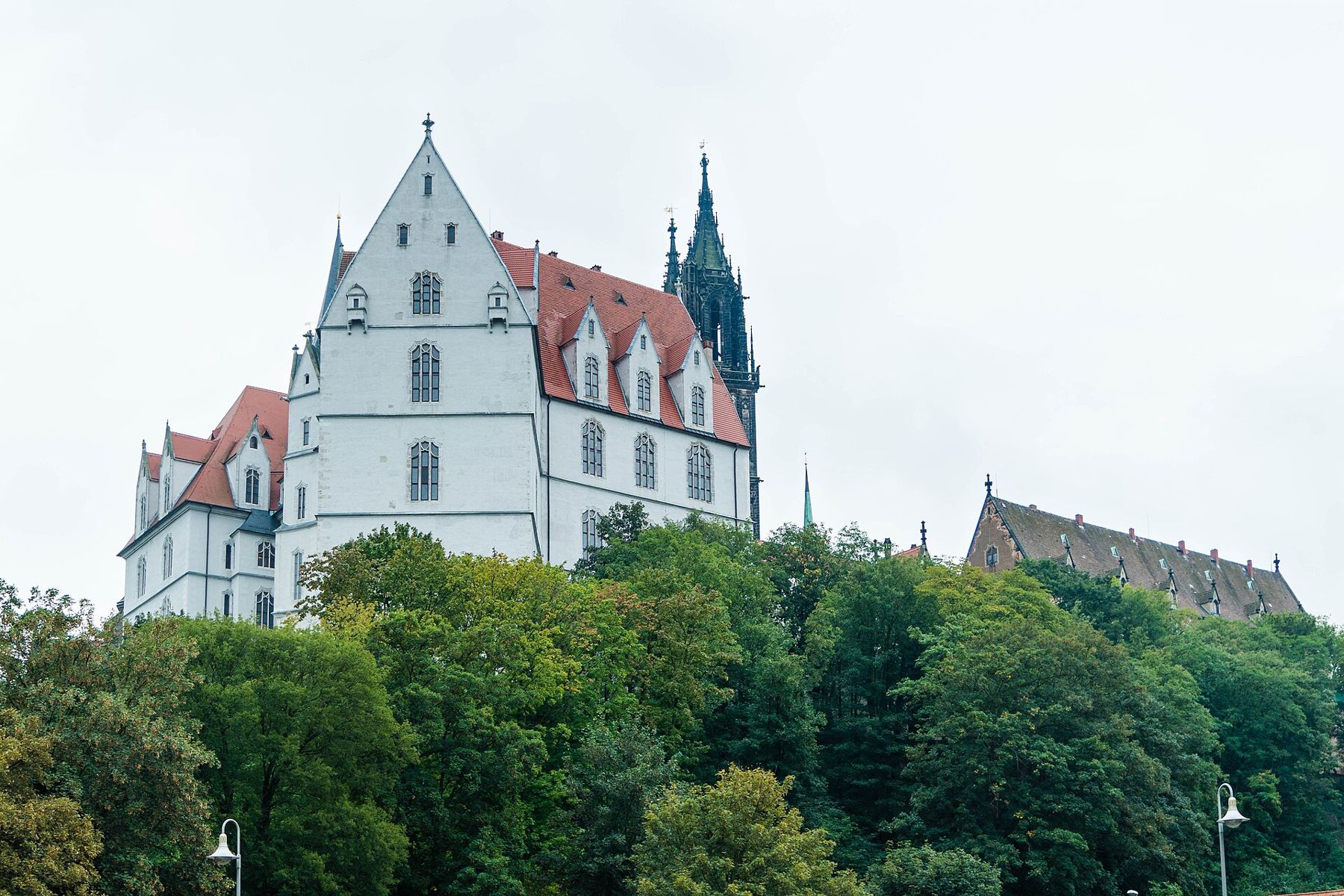
On the river The castle and cathedral crown a rock on the left bank of the Elbe; from the river bridge and the far bank you see the whole hill rise above the water.
Meissen is older than Dresden. A thousand years ago this was the seat of the margraves who ruled the region, and the hill above the Elbe has carried a fortress and a church for most of that time. Today the town is best known for one word that became a product, but the reason to come is the place itself: a steep old town of tiled roofs and narrow lanes, climbing to a castle and a cathedral that stand shoulder to shoulder on the rock.
It is an easy day out from the city, close enough to reach by train in under an hour, and quiet enough after Dresden to feel like another country.
The Albrechtsburg
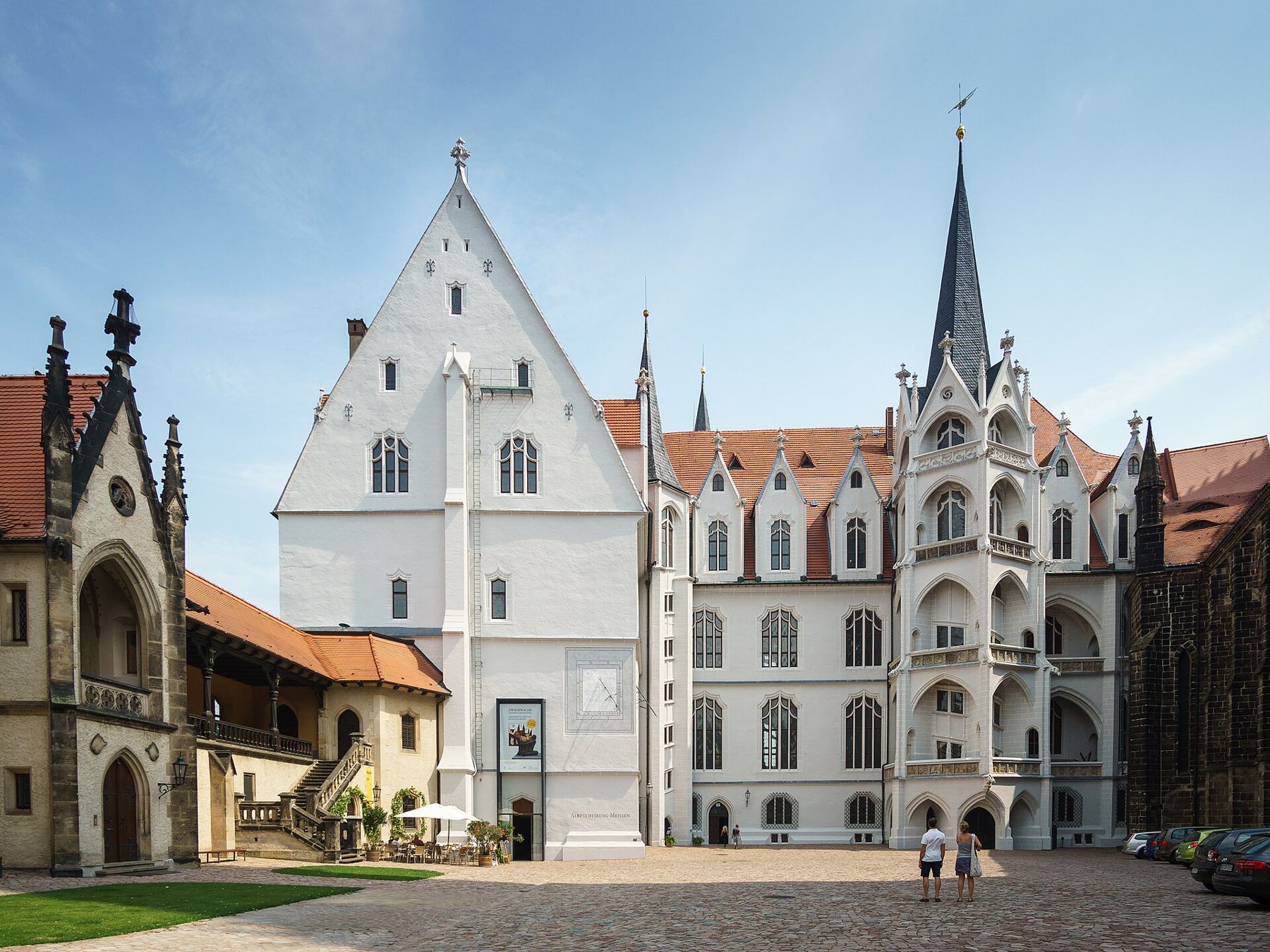
The castle on the hill, the Albrechtsburg, was begun in the 1470s for two brothers who ruled Saxony together, Ernst and Albrecht. It is often described as the first true palace in German lands: a residence designed for comfort and display rather than a fortress built for defence, even though it sits on a defensive site. The style is late Gothic, with steep roofs, rows of dormer gables and wide windows that let light into the halls.
Inside, look for the vaulted ceilings, which spread across the rooms in intricate patterns of ribs and cells, a speciality of the master builder who designed the castle. The largest staircase, the Großer Wendelstein (the great spiral stair), climbs the courtyard front in an open tower of stone galleries and is one of the masterpieces of its period. In the nineteenth century the main halls were painted with large murals of scenes from Saxon history, which still fill the walls.
The cathedral on the same rock
Right beside the castle, so close that the two buildings almost touch, stands Meissen Cathedral. Building began in the thirteenth century, and most of what you see is Gothic: a tall, narrow nave, fine stone carving, and medieval figures of the founders, the emperor Otto the Great and his wife, set inside the choir. The two openwork western spires that dominate the skyline came much later, finished only in the early twentieth century to complete the medieval design.
The cathedral and the castle together form the Domplatz, the cathedral square, a cobbled space on the hilltop with views over the roofs below. From the edge of the hill you look down onto the river, the bridges and the vineyards on the slopes across the water.
Porcelain from 1710
In the early eighteenth century porcelain was one of the most coveted luxuries in Europe. It came from China and Japan, and no European workshop knew how to make it. Augustus the Strong, the Saxon ruler who built the summer palace at Pillnitz, collected it obsessively and wanted a source of his own.
Saxony · and nearbyMoritzburg Castle on its lakeThe breakthrough came in Dresden in the first decade of the century, through the work of the alchemist Johann Friedrich Böttger and the scholar Ehrenfried Walther von Tschirnhaus, and in 1710 Augustus founded a porcelain manufactory to produce it. The work was moved here, into the Albrechtsburg, where the castle walls helped to keep the recipe secret. That made Meissen the birthplace of Europe's first true hard-paste porcelain. Production stayed in the castle for well over a century before moving to new buildings in the valley below the town in the nineteenth century.
You meet the result all over Dresden. The porcelain collection in the Zwinger shows what Augustus gathered from East Asia and what the new manufactory made in answer, and the long mural of the Procession of Princes is covered in tiles fired in Meissen. In the town itself the porcelain manufactory has its own museum and workshops open to visitors; check times before you go.
The streets below the castle
Below the hill, the Altstadt spreads around the Markt, the market square, with the town hall and the Frauenkirche, the town's own Church of Our Lady. Its tower holds a carillon with bells made of porcelain, which plays at set times through the day. From the square, lanes and stairways climb steeply towards the castle, and the walk up is part of the visit: worn steps, small courtyards, and sudden views between the houses.
Meissen also sits in the middle of the small Saxon wine region along the Elbe, one of the most northerly in Europe. Vineyards cover the sunny slopes around the town, and in autumn the harvest brings wine festivals to the streets; dates vary from year to year.
Getting there from Dresden
The S1 line of the Dresden S-Bahn runs from the main station through the Neustadt and along the river to Meissen, taking under an hour. The main Meissen station lies on the right bank; for the old town it is usually easier to stay on to the Meißen Altstadt stop on the left bank, close to the market square.
In the sailing season paddle steamers also run downriver from Dresden to Meissen, a slow and scenic trip with the current. Cyclists can follow the Elbe cycle route out of the city past the Elbe meadows and the vineyards of Radebeul; the ride is flat and makes a pleasant day, with the train as an easy way back.
Odds and ends for the day
- The climb to the castle is steep, on stairways and cobbled lanes from the old town; take it slowly and wear shoes with grip.
- Allow a full day if you want to see the castle, the cathedral and the porcelain museum without rushing.
- Castle and cathedral sell separate tickets; combined options and opening times change, so check in advance.
- Weekdays outside the summer holidays are quieter in the lanes and on the hilltop.