
On the river Moritzburg lies away from the river, but the narrow-gauge railway begins in Radebeul on the Elbe, climbing from the vineyard slopes of the valley up through the Lößnitzgrund.
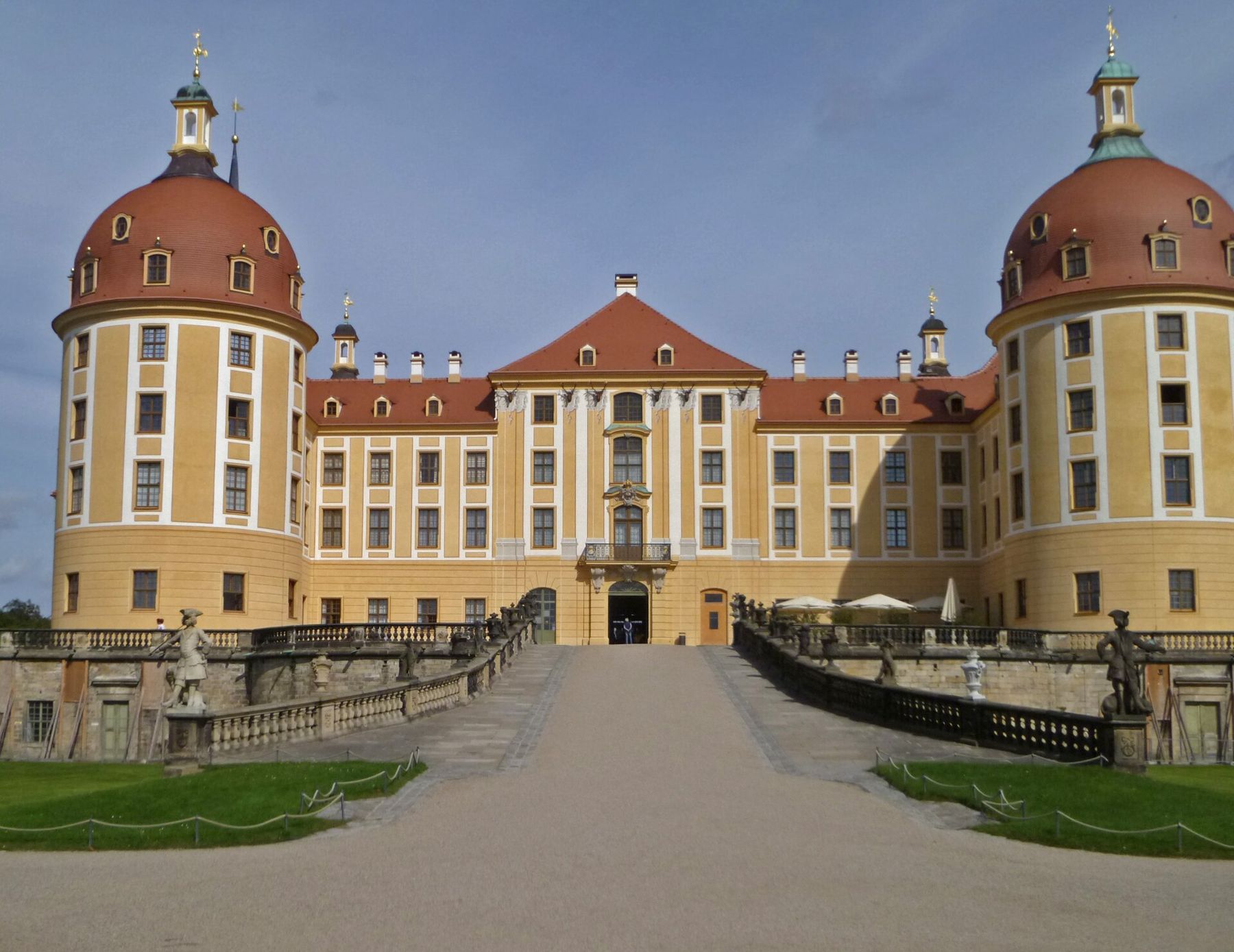
About 14 kilometres north-west of Dresden, beyond the vineyards of Radebeul, the land flattens into woods, fields and a chain of fishponds. In the middle of the largest pond, on an island of its own, stands Schloss Moritzburg: a broad yellow palace with a red roof and a fat round tower at each corner, approached along a causeway lined with stone figures. It is one of the most photographed buildings in Saxony, and it looks, from the end of the causeway, almost too symmetrical to be real.
From hunting lodge to baroque palace
The first building here was a hunting lodge of the sixteenth century, built for Duke Moritz of Saxony, from whom the place takes its name. The forests around it were rich in game, and the electors of Saxony came here to hunt for generations.
The palace you see is the work of Augustus the Strong, Elector of Saxony and King of Poland, who had the old lodge rebuilt from 1723 on a grand scale. The architects of his court, who also worked on the Zwinger in Dresden, kept the four corner towers of the old building and wrapped them in a new baroque palace. At the same time the ground around it was dug out and flooded, so that the palace now rises straight from the water on its artificial island, with terraces and balustrades on every side.
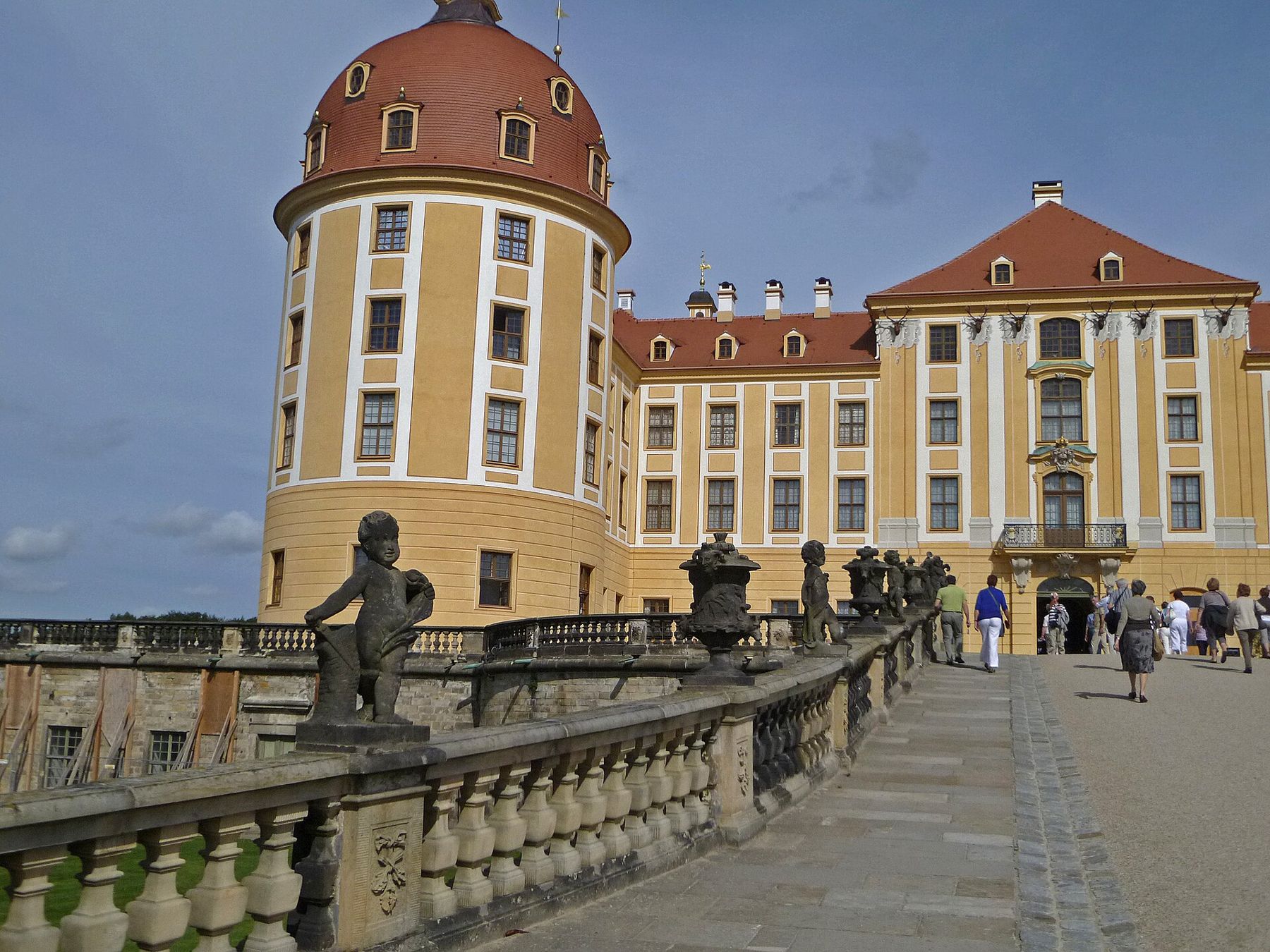
Augustus wanted a setting for great hunts and festivities, and he got one. The courtyards and terraces were used for court celebrations, and the lakes for mock sea battles and water spectacles watched from the palace windows.
Inside: antlers and leather
The palace interiors are a museum, and their theme is the hunt. Halls and corridors are hung with hundreds of sets of antlers, some of them enormous and of great age, gathered over centuries by the Saxon court. The walls of many rooms are covered not with fabric but with gilded and painted leather hangings, a costly baroque fashion, and Moritzburg has one of the largest collections of them to survive.
The best known room holds a state bed and wall hangings made from millions of small, brightly coloured feathers, arranged in patterns. The work was made in the eighteenth century, decayed badly over time, and was restored over many years. It is kept in low light to protect it.
Opening times, the rooms on show and the route through the palace change with the season, and some parts can be seen only on guided tours. Check before you go, and expect timed tickets on busy days.
The Little Pheasant Castle
A pleasant walk of about half an hour east through the park and along the water brings you to the Fasanenschlösschen, the Little Pheasant Castle. It is the opposite of the main palace: a small, delicate rococo building of the later eighteenth century, built for the next generation of the Saxon court, with a little roof topped by a Chinese-style figure. Pheasants were bred in the grounds around it, which gave it its name.
The Elbe · and nearbyPillnitz Palace and its gardensNearby, on the shore of the lake, stand a stone jetty and a small lighthouse, built as part of the setting for the water festivals of the court, an inland harbour far from any sea. The interiors of the pheasant castle are small and fragile and open only at certain times, so check before you plan around them. The walk out and back, with views across the water to the main palace, is reason enough to come this way.
A fairy-tale setting
For many visitors, especially from Germany, the Czech Republic and Norway, Moritzburg is the castle from a film. In 1973 a Czech and East German studio made Three Hazelnuts for Cinderella, a version of the fairy tale set in a snowy winter landscape, and the palace stood in for the royal castle. The scene in which Cinderella loses her shoe on the broad outdoor staircase was filmed here.
The film became a fixture of Christmas television in several countries, and the palace has embraced the connection: in winter it often hosts an exhibition about the film, with costumes and props. The calendar shifts a little every year, so confirm it before you travel. A visit on a cold, clear day, with frost on the causeway and ice on the lake, has a particular appeal.
The steam railway from Radebeul
The most enjoyable way to arrive is by the Lößnitzgrundbahn, a narrow-gauge steam railway that runs from Radebeul Ost on the Elbe through Moritzburg to Radeburg. The line opened in the 1880s and still runs with steam locomotives pulling small carriages. From Radebeul it climbs through the Lößnitzgrund, a wooded valley with a stream, then out across the fields and ponds to Moritzburg station, a walk from the palace.
You reach Radebeul Ost easily from Dresden by S-Bahn, and the train ride is short enough to fit into a half-day trip. The railway does not run every hour, and the timetable differs between seasons and days of the week, so check it before you set out. Buses also run from Dresden Neustadt to Moritzburg if the trains do not suit.
Radebeul itself, with its vineyards on the slopes above the Elbe, makes a natural pairing, as does Meissen further down the river.
Odds and ends for the day
The palace island, the causeway and the park around the lakes can be walked freely; you pay only for the interiors. Moritzburg is also home to the Saxon state stud, whose horses can sometimes be seen in the village, and to a wildlife park in the woods nearby. Bring something to eat for the lakeside or plan around the village, and allow longer than you expect: the walk around the water takes time, and the light on the yellow walls changes all afternoon. If you have a day in Dresden to spare after the Frauenkirche and the museums, this is one of the most rewarding ways to spend it.