
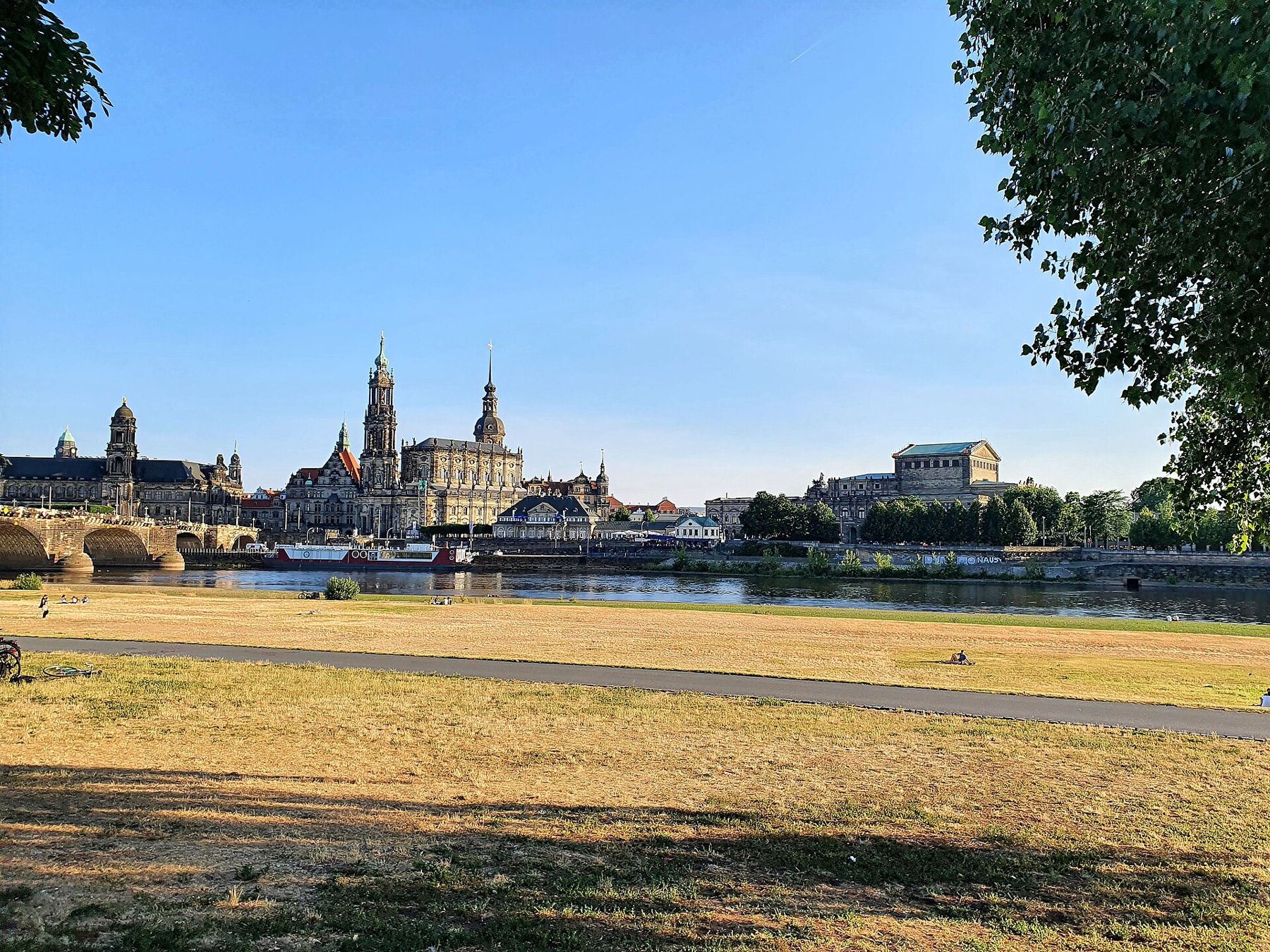
On the river The meadows are the river's own flood plain, kept open on both banks so high water can spread out; the cycle path runs along them and the Altstadt faces you across the water.
Most European cities pushed their rivers into stone channels and built right up to the edge. Dresden did not, or not everywhere. Through the middle of the city the Elbe runs between wide strips of grass, the Elbwiesen or Elbe meadows, which on the Neustadt side are often a hundred metres deep or more. They are not parkland in the formal sense. They are flood plain, mown and walked on and cycled across, and they exist because the river needs somewhere to go when it rises.
The result is one of the most generous open spaces in any German city, and it gives Dresden the view it is best known for. Stand on the north bank, below the Neustadt, and the whole baroque skyline of the old town is laid out across the water.
Why the banks stayed open
The Elbe is a restless river. It rises fast with snowmelt from the Bohemian mountains upstream and with heavy summer rain, and for centuries Dresden lived with regular floods. Rather than build on the low ground, the city kept the meadows free as a natural overflow, and the habit held through the nineteenth and twentieth centuries. Building on them has long been restricted, and the stretches you walk today are largely the same shape they have been for generations.
That restraint has a practical payoff. When the river comes over its banks, the water spreads across grass rather than through houses. The meadows also kept the riverside from being cut off by roads and warehouses, so the Elbe in Dresden still feels like a landscape rather than a canal.
The Canaletto view
In 1747 the Venetian painter Bernardo Bellotto arrived in Dresden as court painter to the Elector of Saxony. Bellotto was the nephew and pupil of Antonio Canal, the famous Canaletto, and he often signed his own pictures with the same name, which is why Dresden still calls him Canaletto. Over the following years he painted the city in a series of large, precise views, and the best known of them shows the old town from the Neustadt bank: the Augustus Bridge on the left, the tower of the Catholic court church, the palace, and the dome of the Frauenkirche rising behind the river front.
That painting now hangs in the Old Masters gallery in the Zwinger, and the spot it was painted from is known as the Canaletto-Blick, the Canaletto view. A red steel frame on an easel stands on the Königsufer, the stretch of bank below the government buildings of the Neustadt, so that you can line the real skyline up inside it. A panel beside it shows the painting for comparison.
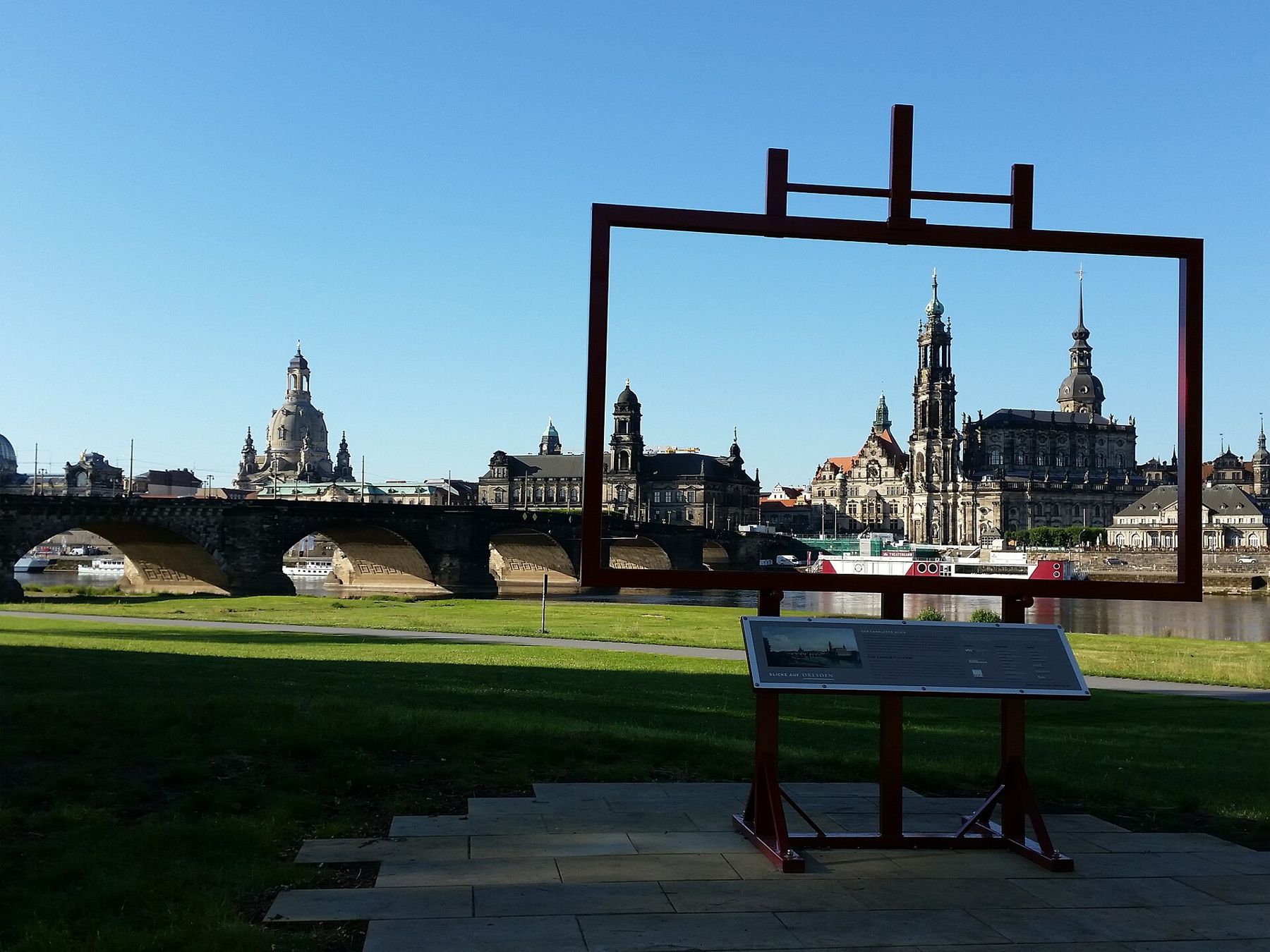
What strikes most people is how much of the picture is still there, and how much of it was rebuilt. Bellotto's city was badly damaged in the Seven Years' War a few years after he painted it, and again, far more severely, in February 1945. The Frauenkirche you see behind the bridge was raised again only in the 1990s and 2000s; the story is told in our guide to the rebuilt Frauenkirche. Bellotto's views, with their careful architectural detail, were among the many records used when the old town was reconstructed.
Walking and cycling the banks
The meadows are crossed by paths on both sides of the river, and along them runs the Elberadweg, the Elbe cycle route, a long-distance path that follows the river from the Czech border down to the North Sea. In Dresden it is a flat, well-surfaced ride and a popular commute, so keep to the right and listen for bells.
Arriving · and nearbyFebruary 1945 and the rebuildingFrom the Augustus Bridge you can follow the north bank upstream past the Albert Bridge and out into greener country, where the meadows widen and the villas of Loschwitz appear on the far hillside. The ride or walk to the Blue Wonder bridge at Blasewitz takes you along some of the best of the riverbank. Downstream the path leads under the Marienbrücke towards Radebeul and, eventually, Meissen. On the south bank, a path below Brühl's Terrace gives you the reverse view, looking across to the Neustadt.
On warm evenings the grass fills with people: picnics, ball games, groups watching the light go down behind the bridges. There is no formal arrangement to any of this, and that is much of the pleasure.
Summer nights by the river
In summer a stretch of the Neustadt bank becomes an open-air venue, with a large screen and stage set up facing the river so that the old town forms the backdrop. Films and concerts run on many evenings through the warmer months. Programmes, dates and ticket arrangements change from year to year, so check before you go. Even without a ticket, the sound and the lit skyline make the meadows an easy place to spend an evening.
Flood marks
The meadows are a reminder that the river has its own plans. In August 2002 the Elbe reached its highest recorded level in Dresden, flooding the old town, the main station and much of the riverside. In June 2013 it rose again, not quite as high but high enough to cover the meadows from bank to bank. Marked heights on walls and posts around the city record these and older floods, and once you start looking you find them on bridge piers, house fronts and the walls along the Terrassenufer. Standing on dry grass and looking up at a mark above your head is a sobering way to understand why the meadows were left open.
The bridge and the lost listing
In 2004 the Dresden Elbe Valley, the river landscape running right through the city, was added to the UNESCO World Heritage list. The city then went ahead with a new road crossing, the Waldschlösschen Bridge, across the meadows east of the centre, after a local vote in favour. UNESCO judged that the bridge damaged the landscape it had listed, and in 2009 the valley was removed from the list. The bridge opened in 2013 and now carries traffic over the meadows between Johannstadt and the Radeberger Vorstadt. Whatever your view of the decision, the river landscape itself is still there, and the meadows on either side are as open as ever.
Odds and ends for the day
The easiest way to reach the Canaletto view is to cross the Augustus Bridge from the old town and turn right down the steps to the Königsufer, or to take a tram to Neustädter Markt and walk down past the Golden Rider. Early morning brings the best light on the Altstadt front, which faces north-west across the water; late afternoon and evening light falls on it from the side. The grass can be dry and dusty in high summer and wet underfoot in spring, and after a flood the paths may be closed for a time while mud is cleared.