
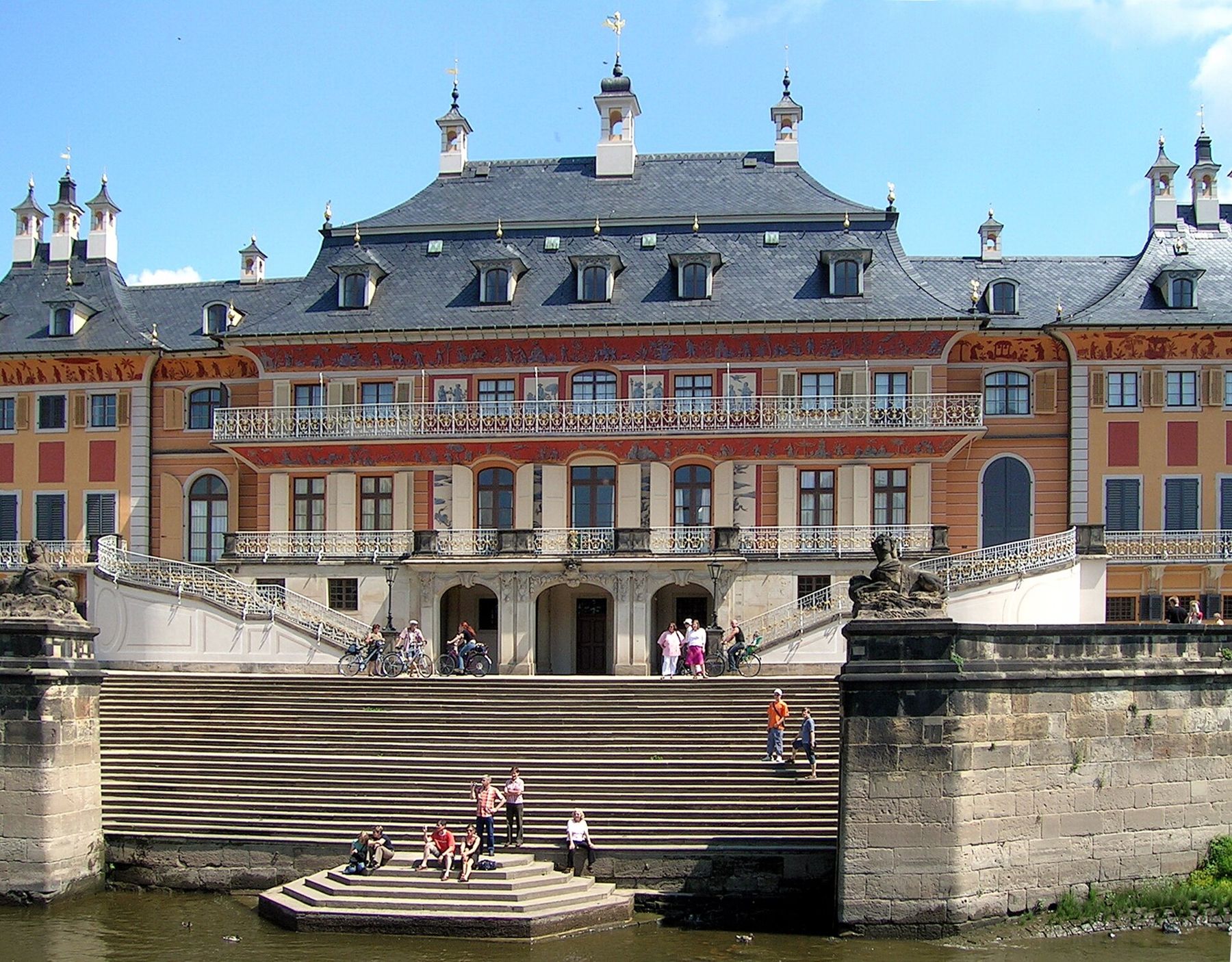
On the river The Water Palace stands right on the bank, its stone stairs running down to the water where the court once stepped from gondolas; steamers still call at the landing nearby.
The Saxon court did not spend its summers in the city. When the heat settled over Dresden, the household moved a few kilometres up the Elbe to Pillnitz, a riverside estate where Augustus the Strong set out to build something lighter than the stone palaces of the Altstadt. What his architects made there in the 1720s is one of the oddest and most likeable ensembles in Saxony: baroque buildings dressed up as an eighteenth-century European idea of China.
Pillnitz is still a place you reach slowly, by water or along the river path, and it rewards an unhurried visit. The palaces hold museum rooms, but most people come for the whole composition: river, steps, roofs, garden and the long green park behind.
Three palaces and a pleasure garden
The estate is built around a formal garden, the Lustgarten, framed on three sides by palaces. Facing the river is the Wasserpalais, the Water Palace. Facing it across the garden, on the landward side, is its near twin, the Bergpalais or Hill Palace. Matthäus Daniel Pöppelmann, the architect of the Zwinger in Dresden, was among the designers who worked on them, and you can see a family likeness in the playful roofs and the sense of a stage set.
The third side is closed by the Neues Palais, the New Palace. It was built in the early nineteenth century after a fire destroyed the older Renaissance house on the site, and it is plainer and more classical than its neighbours. Inside is a domed hall and a palace chapel; the rooms are opened for exhibitions and the palace museum, so check before you go what is on.
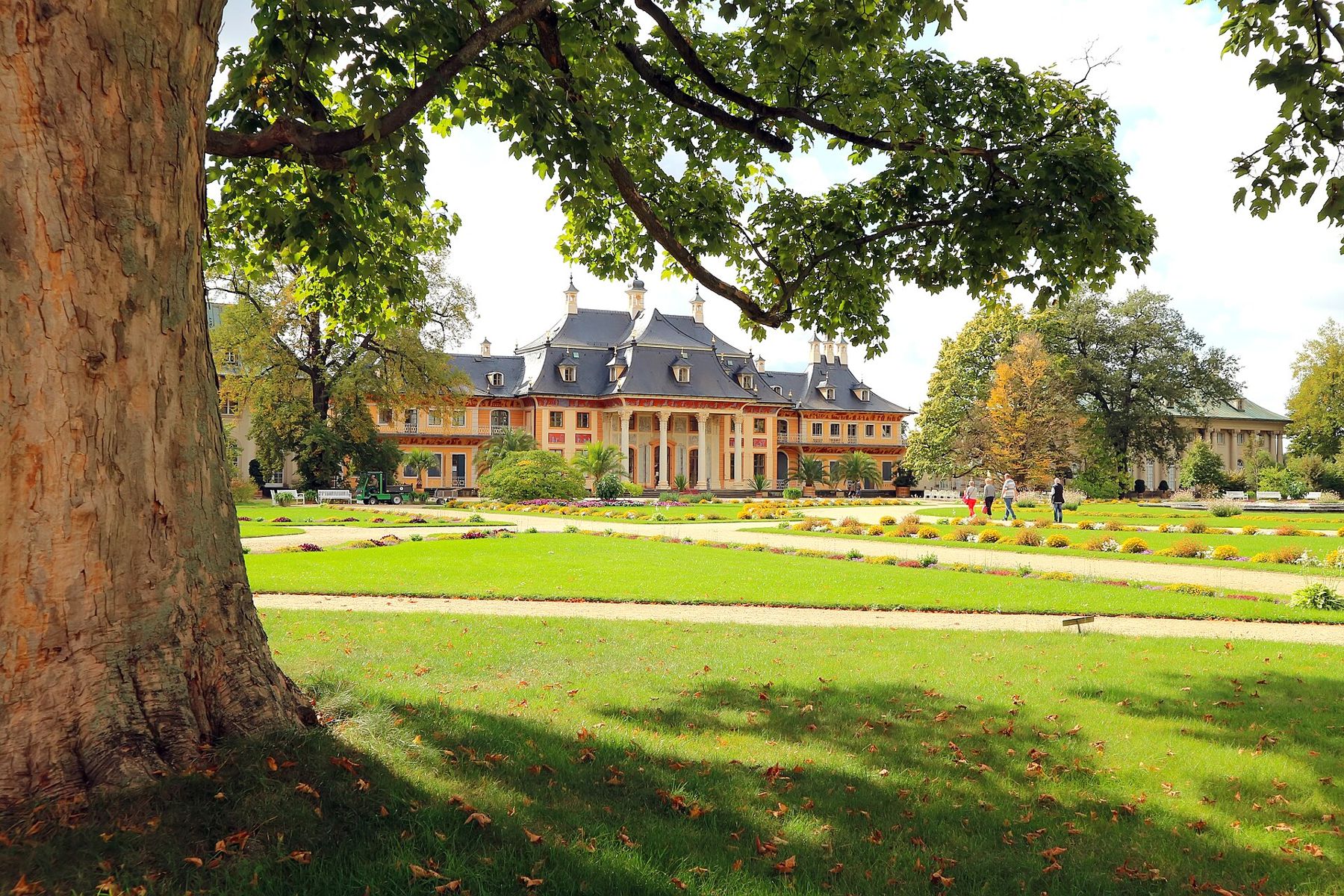
The Water and Hill Palaces house parts of the state collection of decorative arts, shown in rooms that keep something of their summer-palace scale. Opening is seasonal for some of the interiors, and the park keeps longer hours than the museum, so plan the day around whichever matters more to you.
Roofs that point east
Look up first. The roofs of the Water and Hill Palaces swing outward at the eaves in a concave curve, the way roofs do in Chinese temple architecture, and small lantern-like chimneys and turrets stand along the ridges. Under the cornice runs a painted frieze of figures in invented oriental dress: fishermen, musicians, scholars and courtiers, all imagined by European painters who had never been to Asia.
This was chinoiserie, the fashion that swept European courts in the early eighteenth century, and Augustus was deeply caught up in it. The same enthusiasm drove his collecting of East Asian porcelain and his support for the search for a European porcelain of its own, which succeeded at Meissen, downriver, in 1710. Pillnitz is that obsession turned into architecture, built for pleasure rather than for state, and the decoration is meant to amuse rather than impress.
Pillnitz is that obsession turned into architecture, built for pleasure rather than for state, and the decoration is meant to amuse rather than impress.
On the river front the Water Palace opens onto a broad staircase that runs straight down into the Elbe. It was a landing stage: the court came upriver by boat, sometimes in gondolas, and stepped out at the foot of the stairs. Two stone sphinxes guard the top. On a warm afternoon the lower steps are still where people sit to watch the water.
The old camellia
In the park behind the palaces grows the estate's most famous resident. It is a Japanese camellia, brought to Saxony in the late eighteenth century and planted at Pillnitz, by long tradition around 1801. It has since grown into a dense evergreen dome several metres high and much wider than it is tall, one of the oldest camellias growing outdoors north of the Alps.
The Elbe · and nearbyTwo old railways up the Loschwitz hillsA plant like this would not survive a Saxon winter unprotected. For generations it was sheltered each year in a wooden house built around it. Today it has a movable glasshouse: a tall steel and glass structure on rails that is rolled over the tree in autumn, heated and ventilated through the cold months, and rolled away again in spring. In summer you see the glasshouse parked beside the tree, which gives a good idea of the scale of the operation.
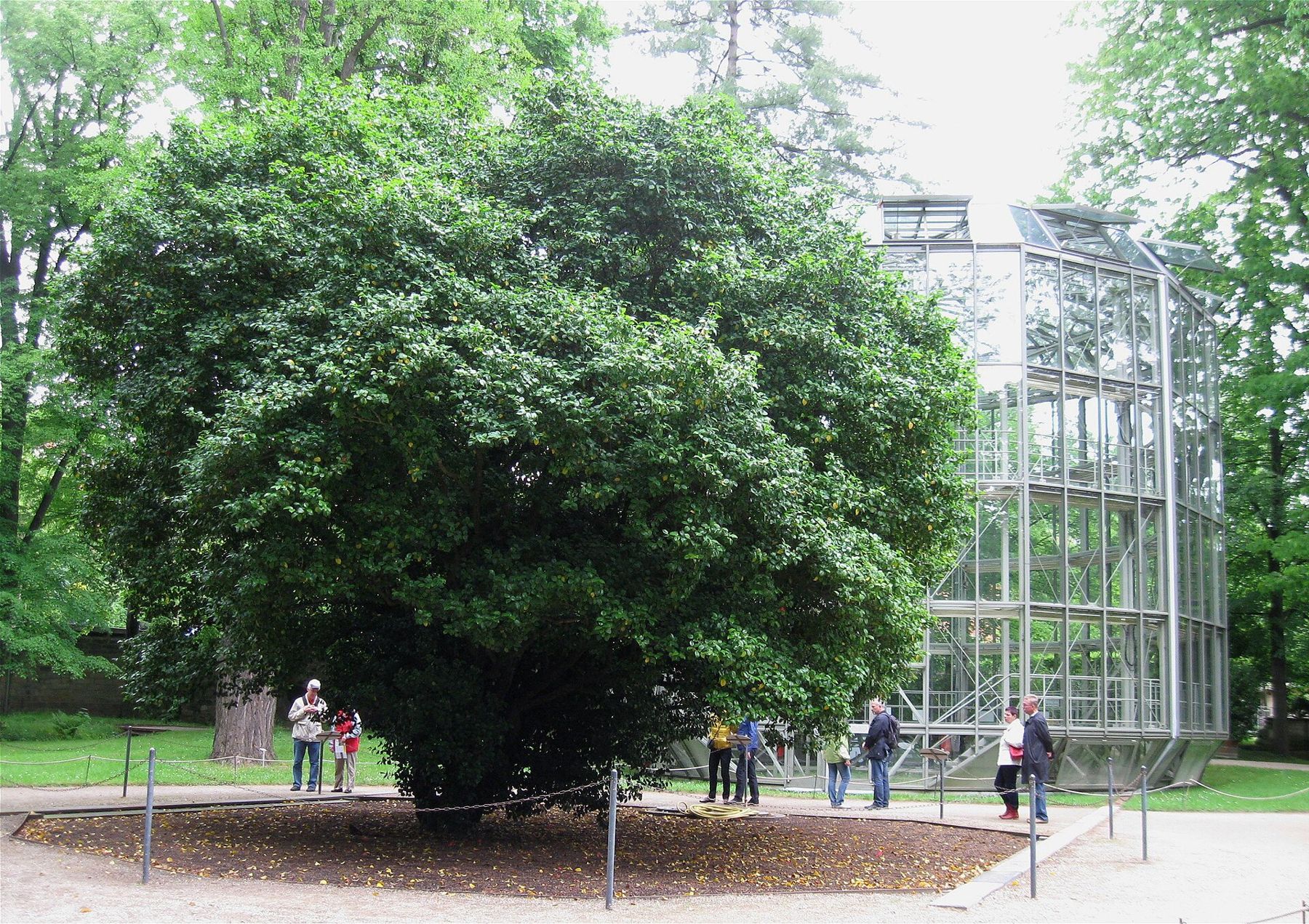
The camellia flowers roughly from February to April, when it carries thousands of red blossoms. During that season the glasshouse is in place and you look at the tree from inside it or through the panes; access and times can change from year to year, so check before you go if the flowering is the reason for your visit.
A walk through the grounds
Beyond the formal garden, the grounds open into a mixture of styles laid out over more than a century. There is an English-style landscape garden with a pond and winding paths, a Chinese pavilion added later in the same spirit as the palaces, a long hornbeam alley, and conifers and specimen trees collected from many parts of the world. A large nineteenth-century palm house stands at the edge of the grounds.
From the air the plan is easy to read: the river, the Water Palace on its terrace, the round fountain at the centre of the pleasure garden, the Hill Palace behind it and the long avenues of the park reaching back towards the vineyard slopes. On the ground you take it in piece by piece, and an hour or two of walking is enough to see the main parts.
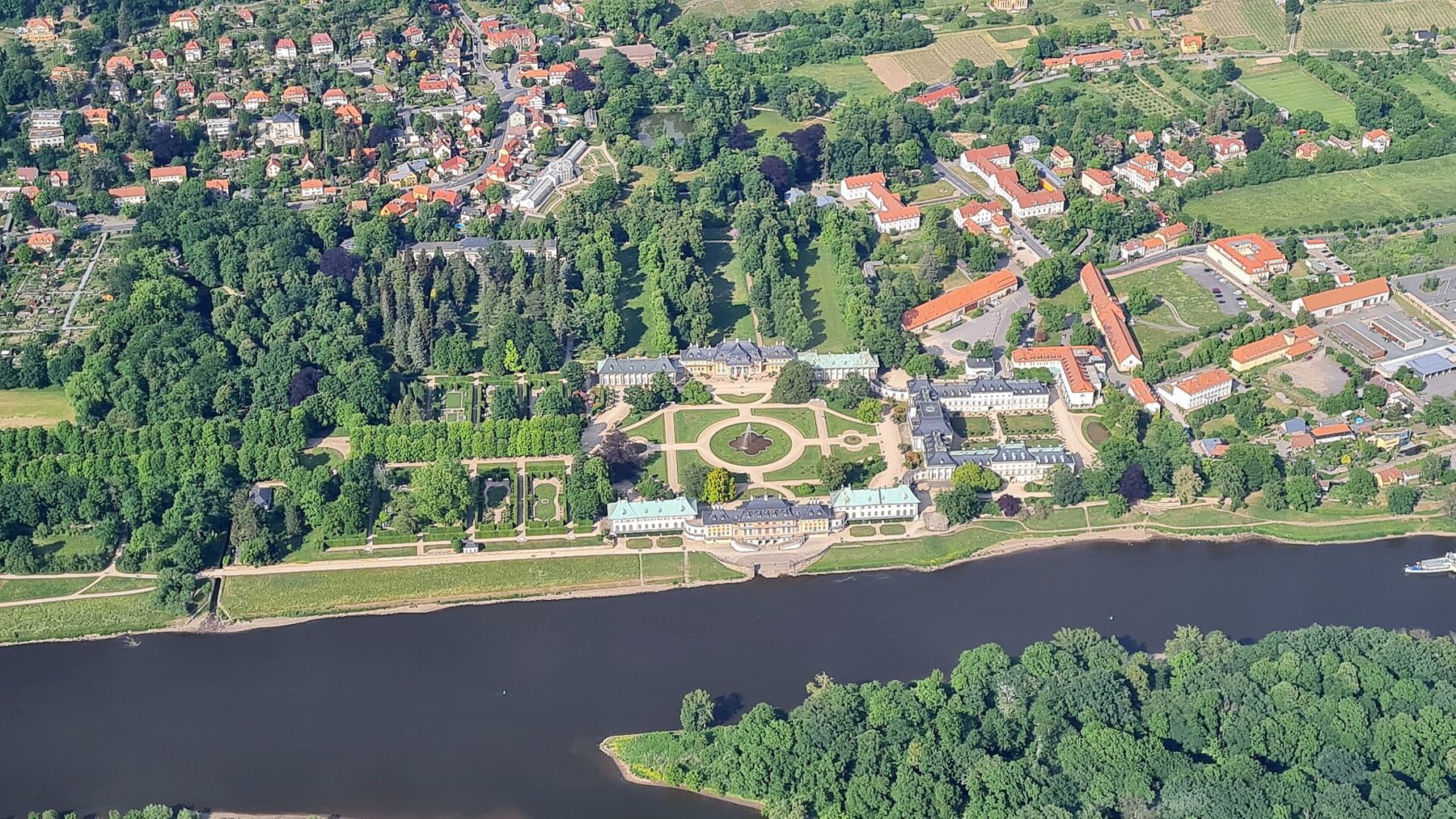
Above the village, the slopes are planted with vines, part of the small Saxon wine region that runs along the Elbe valley. Paths climb through them to viewpoints over the river, and on a clear day the walk makes a good second half to a morning in the park.
Getting there by boat, bus or bike
The most memorable way to arrive is by water. In the sailing season the historic paddle steamers run upriver from the Terrassenufer in Dresden and call at Pillnitz, passing under the Blue Wonder bridge on the way. The trip upstream against the current takes longer than the return, and low water in dry summers can stop sailings altogether, so check the timetable before you plan around it.
By public transport, a city bus runs to Pillnitz from the eastern side of Dresden. Another route is to take the tram towards Kleinzschachwitz on the opposite bank and cross on the small foot ferry that shuttles over the river to the palace side. The crossing takes a few minutes and is part of the pleasure.
Cyclists have the easiest time of all. The Elbe cycle route follows the river out of the city, and the ride from the centre to Pillnitz is flat and mostly away from traffic, with meadows on one side and villas on the hills on the other. It makes a good morning out, with the palace garden as the place to stop and eat.
Odds and ends for the day
- The park opens all year; museum rooms in the palaces open seasonally. Check times and ticket arrangements before you go.
- Spring brings the camellia flowering, summer the full garden beds, and autumn colour in the park trees.
- Allow half a day if you come by boat, since the sailing itself takes a good part of it.
- Combine Pillnitz with a walk through the vineyards above the village, or a stop in Loschwitz on the way back.