
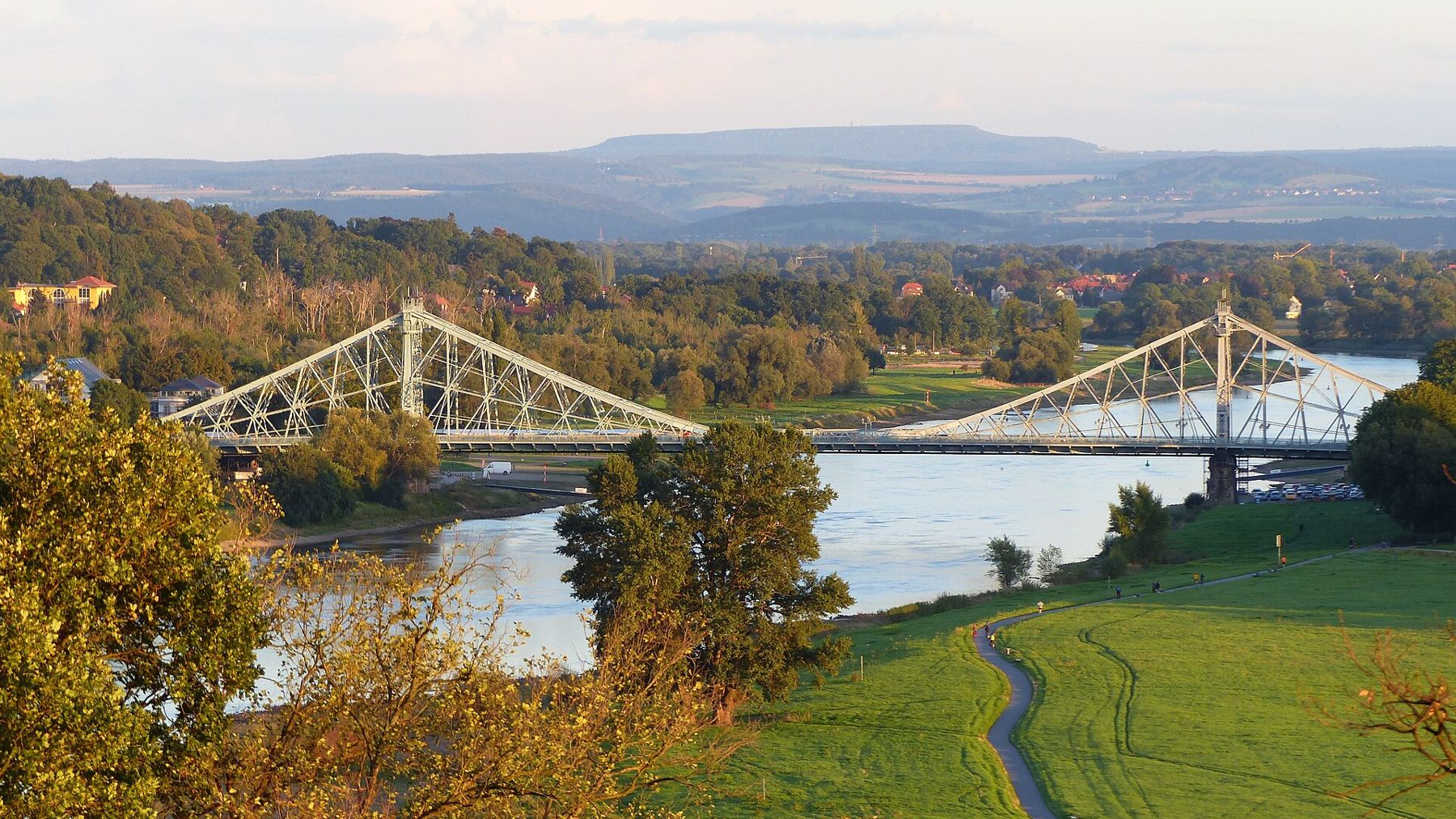
On the river The bridge crosses the Elbe in one long span east of the centre; paddle steamers pass beneath it, the cycle path runs under both ends, and the Loschwitz bank floods in high water.
Five kilometres or so upstream from the old town, the Elbe bends between two former villages that the city absorbed long ago: Blasewitz on the south bank, with its square of shops and tram stops, and Loschwitz on the north, a cluster of old houses at the foot of a steep wooded slope. Joining them is the Loschwitzer Brücke, a steel bridge that almost nobody calls by that name. To Dresden it is the Blaues Wunder, the Blue Wonder.
The nickname is a pun. In German, to experience a blue wonder is to get a nasty surprise, and the phrase was attached to the bridge early on, either for its colour, its daring or both. Whatever the origin, it has stuck for well over a century, and the bridge is now one of the best-loved structures in the city. Postcards, souvenir mugs and local festivals all borrow its outline.
How the bridge was built
Before the bridge, the only way across here was by ferry. Blasewitz and Loschwitz were both growing as villa suburbs in the late nineteenth century, and a fixed crossing was wanted that would leave the river clear for shipping. The answer, completed in 1893, was a cantilever truss bridge in riveted steel that crosses the main channel without a single pier in the water.
The design works by balance. Two great steel frames rise from stone piers on each bank, and from them long trusses reach out over the river and towards the shore, meeting in the middle. The shore ends are anchored down so that the arms over the water are held up like the beam of a scale. Seen from the side, the bridge has an outline like a pair of stretched-out wings; seen from the roadway, you walk through a lattice of riveted girders, with a high portal frame at each end.
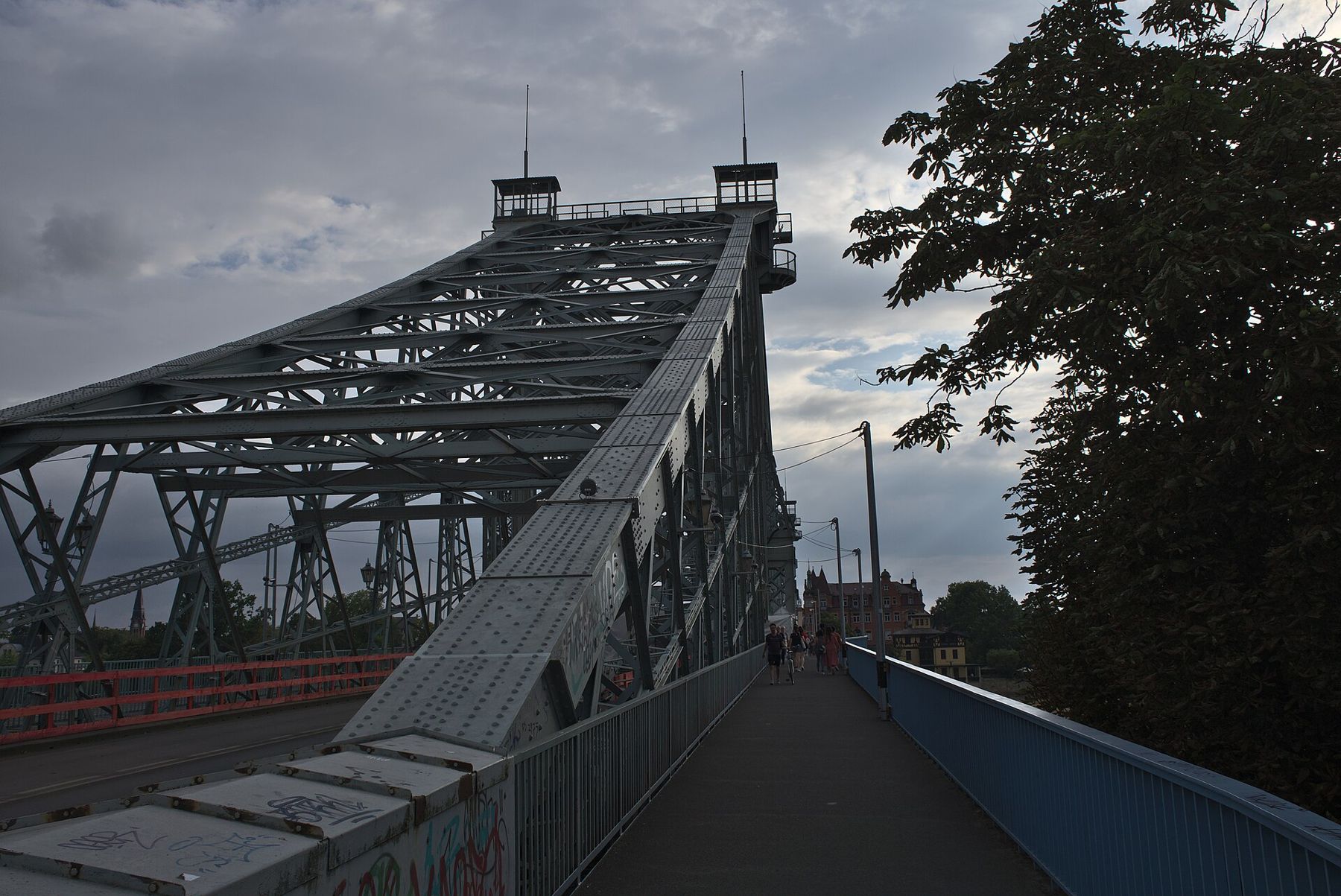
The steel is painted blue, and the bridge has been repainted many times since it opened. Up close you can see the layers of rivets, the bracing and the old lamp brackets; from a distance, especially from the hills, it reads as a single clean line across the valley.
Traffic still uses it, as it always has: cars on the roadway, walkers and cyclists on paths cantilevered out at the sides. Heavy vehicles are restricted, and the bridge has been repaired and strengthened at intervals. Check for roadworks before you plan to drive over it.
Surviving 1945
In the last days of the Second World War, retreating German forces prepared many bridges in Saxony for demolition to slow the advancing Soviet army. The Blue Wonder was among them. It is said that local people cut the cables to the explosives, or otherwise prevented the charges from being fired, and the bridge was left standing when the fighting moved on. Accounts differ on who did what, and the details have been told in many versions since.
What is certain is the result. The Augustus Bridge in the centre had been partly blown up, and several other Dresden crossings were damaged or destroyed. The Blue Wonder survived intact, and for a time it was one of the few ways across the Elbe in the city. It is a different survival story from the old town's, which you can read in our guide to February 1945 and the rebuilding, but it is one Dresden tells with some pride.
Neustadt · and nearbyThe Elbe meadows and the Canaletto viewLoschwitz below the hills
Cross to the north bank and you come down into Körnerplatz, a small, busy square that has been the heart of the village since long before the bridge. Around it and along the lanes behind are some of the oldest houses in Dresden that survived the war: low, steep-roofed buildings from the days when this was a village of vine growers, fishermen and boatmen. Some have half-timbered upper floors; many have small gardens behind walls.
The slope above was once covered in vineyards, and a few small plots are still worked on the hillside. In the nineteenth century the hill became fashionable, and merchants, artists and scientists built villas wherever there was a view. Today the whole hillside is a mix of old village, garden walls and grand houses, linked by steep lanes and stone stairways.
The most direct way up is not on foot. From near Körnerplatz two historic railways climb the hill: a funicular to the Weisser Hirsch quarter and a suspension railway to Oberloschwitz. Both are described in our guide to the two old railways up the Loschwitz hills.
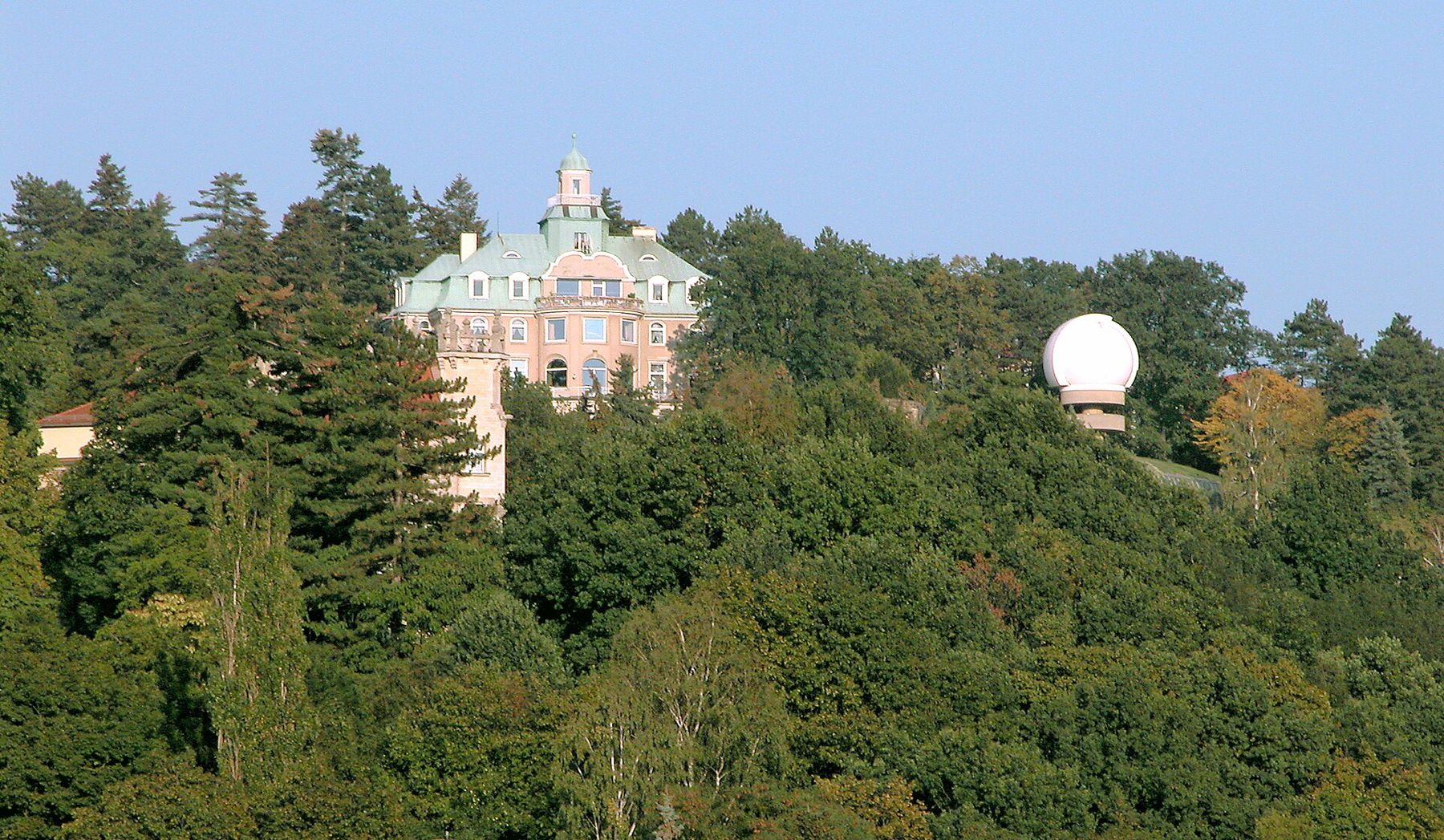
Near the top of the slope, on the Weisser Hirsch, stand some of the largest of the villas, including the house of the physicist Manfred von Ardenne with its copper-green roof and, beside it, a white observatory dome. You see them clearly from the river below, sitting above the trees like a backdrop to the bridge.
The river at Loschwitz
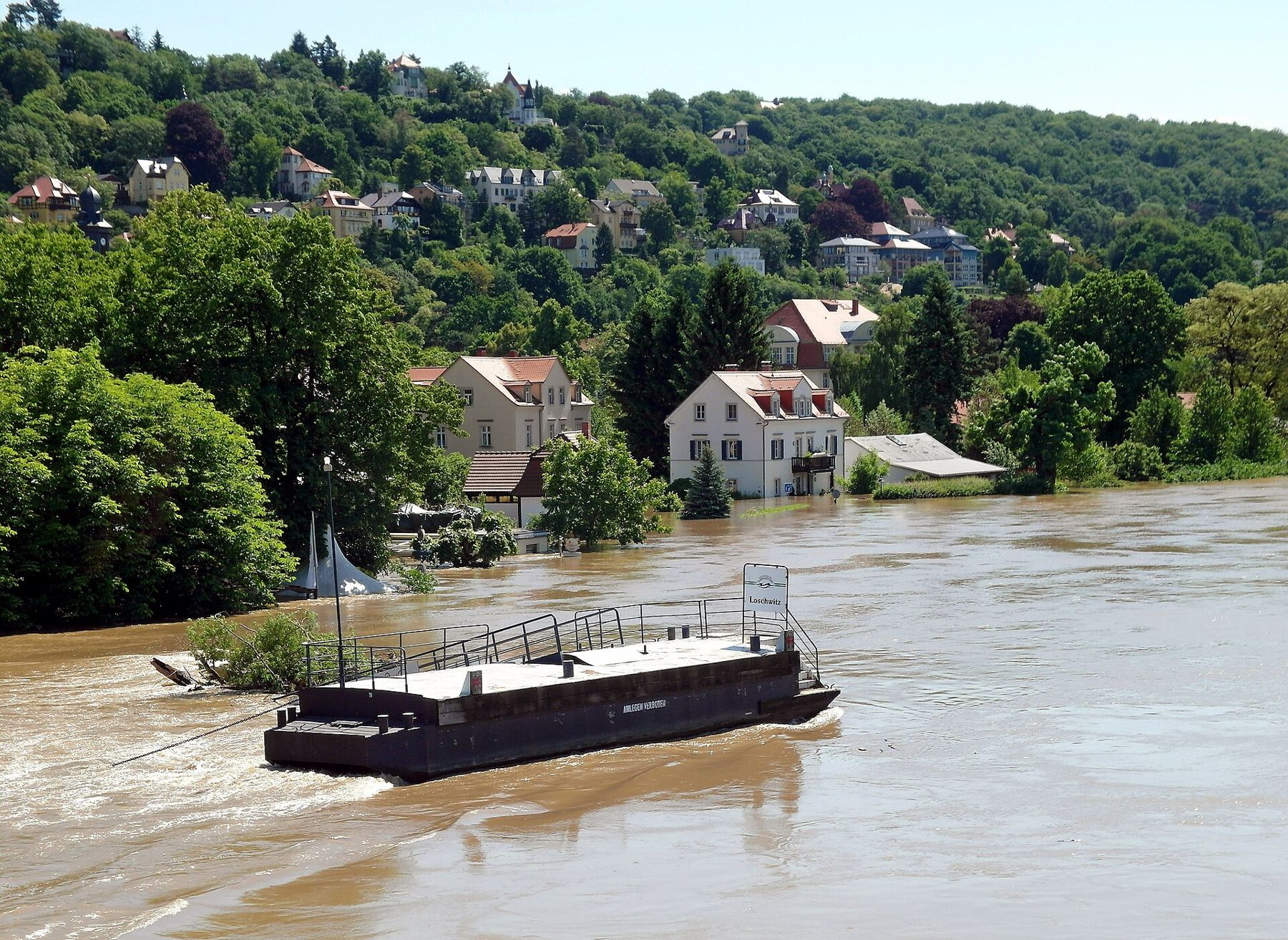
The Loschwitz bank lies low, and the village takes the brunt when the Elbe rises. In the floods of 2002 and June 2013 the water came up over the riverside road and into the ground floors of the houses nearest the bank, and the landing stage below the bridge was cut off from the shore. Marks on walls in the village record the levels.
In calmer times the river here is one of the most pleasant places in the city. The paddle steamers that run between the old town and Pillnitz stop at the landing stage, so you can come out by water and go back by tram, or the other way round; see our guide to paddle steamers on the Elbe. The Elbe cycle path runs along both banks and under the ends of the bridge, and on the Blasewitz side the meadows open out into a broad green flood plain.
Seen from the side, the bridge has an outline like a pair of stretched-out wings; seen from the roadway, you walk through a lattice of riveted girders, with a high portal frame at each end.
Stretching it into a day
A good plan is to take the tram to Schillerplatz in Blasewitz, walk across the bridge and look back at it from the Loschwitz side, then ride one of the hill railways up and walk down through the lanes. From the top, the bridge and the river valley spread out beneath you, with the old town on the horizon downstream and the hills of Saxon Switzerland upstream on a clear day. The views from the slopes above Loschwitz are especially good late in the afternoon, when the light comes along the valley.
If you have more time, continue upstream by bike, boat or bus to Pillnitz Palace, or walk back along the river meadows into the city. Either way, the Blue Wonder is the hinge of the day: the place where the city ends, the river opens up and the hills begin.