
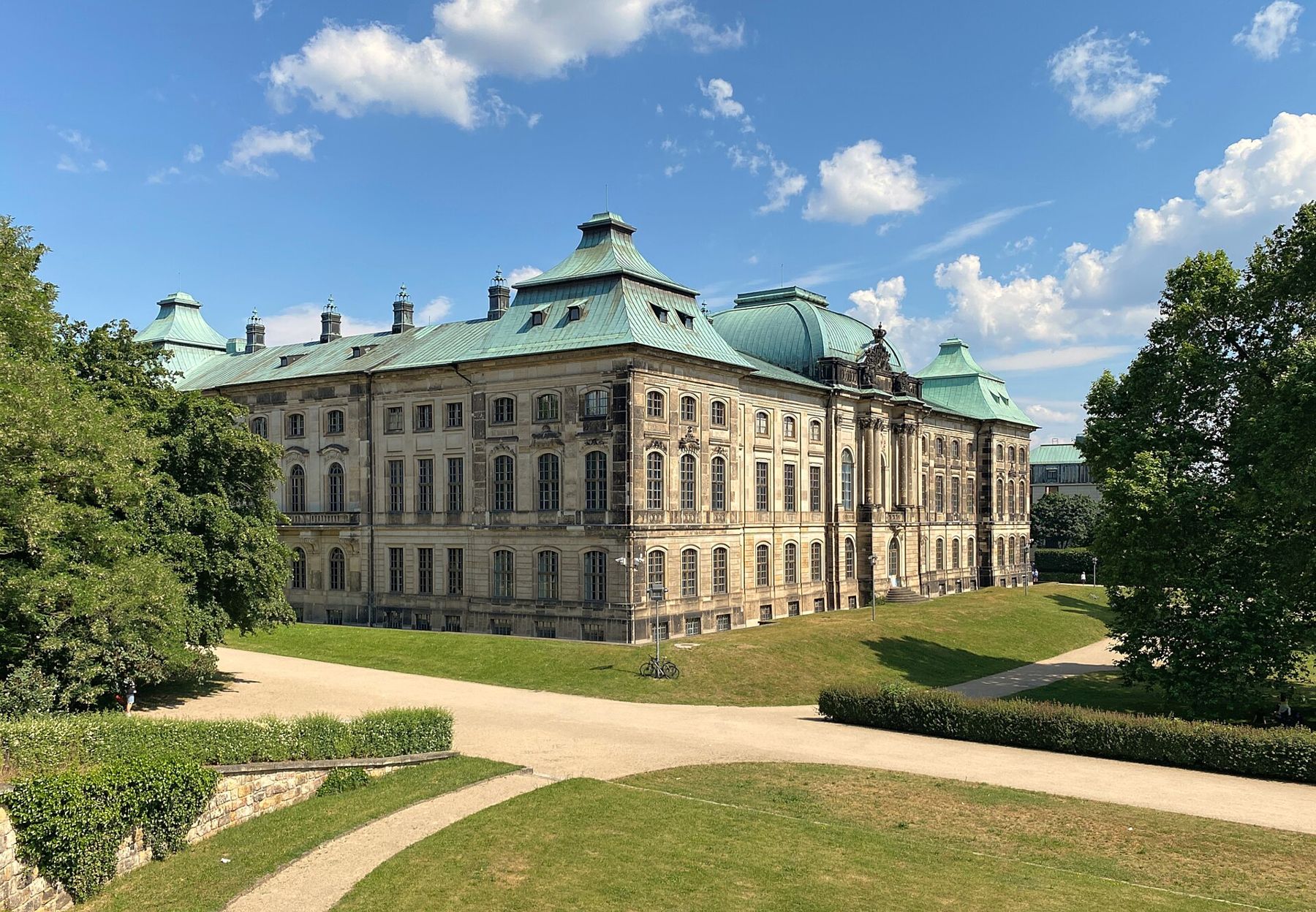
On the river The statue stands at the Neustadt end of the Augustus Bridge, a short walk from the water; the Japanese Palace garden slopes down to the Elbe meadows with a wide view of the old town.
Cross the Augustus Bridge from the old town and the first thing that catches your eye on the far side is a flash of gold. On a stone pedestal in the middle of the Neustädter Markt, the New Town market square, Augustus the Strong, Elector of Saxony and King of Poland, sits on a rearing horse, covered from crown to hooves in gold leaf. People in Dresden simply call the statue the Goldener Reiter, the Golden Rider, and it is one of the city's best-known landmarks.
The square marks the start of a quieter half of central Dresden. Behind the statue the Hauptstrasse, the main street of the Neustadt, runs north for about half a kilometre as a broad pedestrian avenue under plane trees, ending at Albertplatz. A few minutes downriver stands the Japanese Palace, built to show off a king's passion for porcelain. Together they make an easy walk of a couple of hours, and a good counterweight to the crowds on the other bank.
Augustus the Strong in gold
Augustus the Strong ruled Saxony from 1694 until his death in 1733, and much of baroque Dresden was built at his wish, from the Zwinger and its pavilions to the palaces along the river. He was known for his lavish court, his collections and the physical strength that gave him his nickname. After the great fire of 1685 the town on the right bank was rebuilt under his rule and later took the name Neustadt, the New Town, so it is fitting that he should stand at its entrance.
The statue was made by Ludwig Wiedemann, a court coppersmith, after a design by the French sculptor Jean-Joseph Vinache, and it was unveiled in 1736, three years after the king's death. It is made of hammered copper sheet rather than cast bronze and then gilded. Augustus is shown as a Roman-style hero, in armour, with a commander's baton in his hand, his horse rising on its hind legs above a stone base.
Restored and regilded
Unlike so much of the city, the Golden Rider was not destroyed in 1945: it had been taken down and stored away before the raids. It went back up on its pedestal in the 1950s, and its gilding has since been renewed more than once. The most recent full regilding took place in the 2000s, and in bright sun the effect is almost too much to look at straight on. The gold is real gold leaf, laid by hand in very thin sheets over the copper.
The best views are from the front, looking back towards the river, and from the bridge as you approach. Early morning and late afternoon light bring out the modelling of the horse and rider; at midday the statue mostly glares. The square around it is busy with trams, so take care crossing.
The Hauptstrasse
Behind the statue opens the Hauptstrasse, laid out as a grand avenue from the Neustädter Markt to Albertplatz. Today it is a pedestrian boulevard with a double row of plane trees down the middle, benches and fountains in their shade, and the traffic kept to the side. Much of the street was rebuilt after the war in a plain GDR style, so do not expect a baroque street from end to end, but a few older houses survive among the newer blocks.
Two buildings are worth a pause. The Dreikönigskirche, the Church of the Three Kings, stands on the eastern side of the street; burnt out in 1945, it was rebuilt in the GDR years and its interior now holds a long sandstone relief of the Dance of Death, carved in the sixteenth century. Further up, one of the old baroque houses holds a small museum devoted to Dresden's Romantic painters and writers. Check opening times for both before you go.
Neustadt · and nearbyThe courtyards and street art of the Äußere NeustadtAt the northern end, Albertplatz is a busy round square with two large fountains and a ring of tram tracks. Beyond it lies the Äußere Neustadt, with its street art and evening crowds; our guide to the courtyards and street art of that quarter picks up where this walk ends.
The Japanese Palace
From the Neustädter Markt it is a short walk west along the river, past the end of the Augustus Bridge, to Palaisplatz and the Japanese Palace, the Japanisches Palais. The building began as a smaller palace and was bought by Augustus the Strong, who had it rebuilt and enlarged in the late 1720s and early 1730s, with Matthäus Daniel Pöppelmann among the architects. The aim was to turn it into a palace of porcelain, filled with pieces from China and Japan and with the new white porcelain being made at Meissen, a few miles downriver.
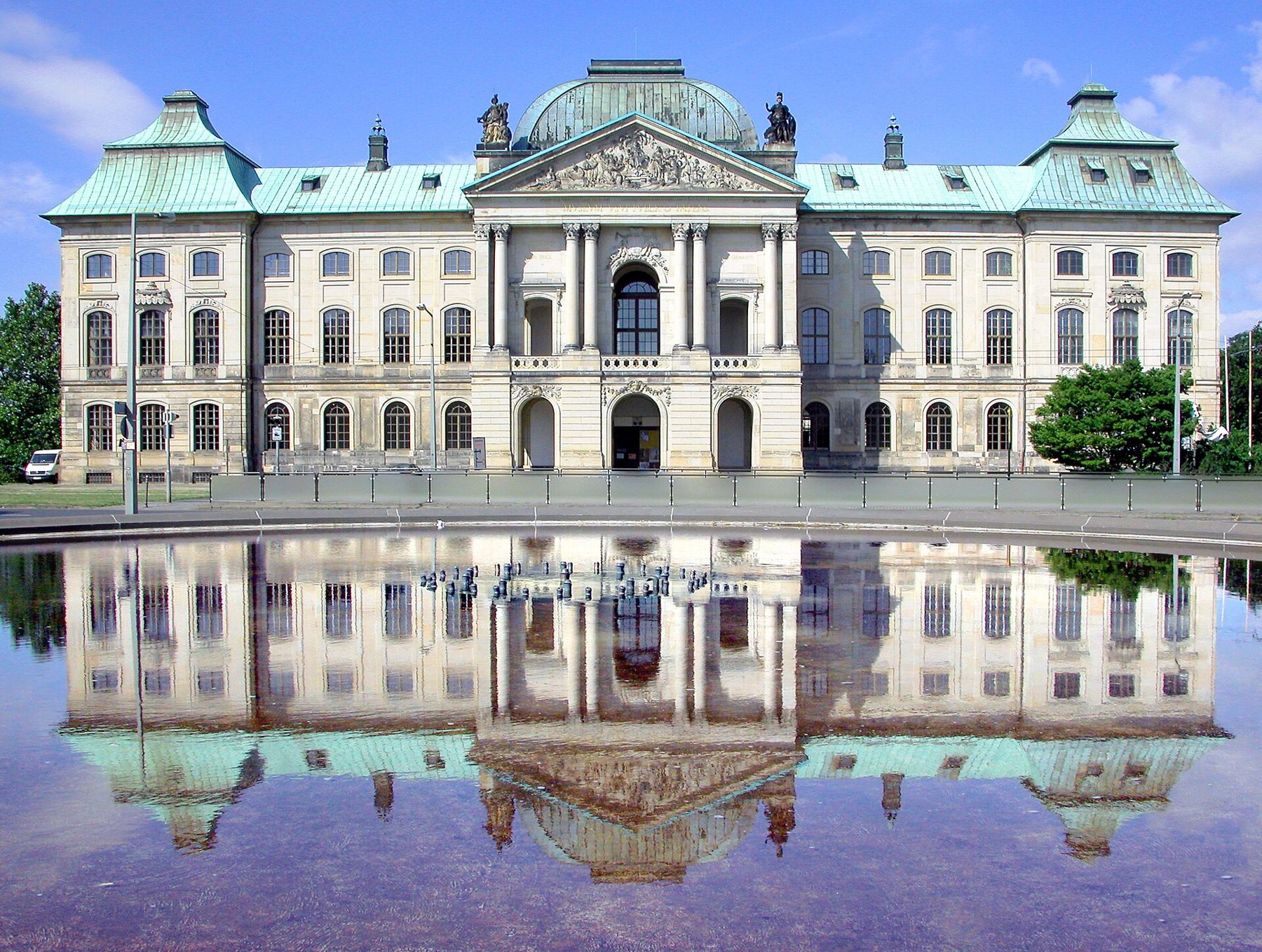
The king died before his scheme was complete, and the porcelain was later moved elsewhere. What remains of the idea is in the architecture: the curved, upswept copper roofs, which give the palace its oriental air, and the courtyard figures in an imagined Asian style. Over the centuries the building has served as a library and a museum, and it is still used for museum collections and changing exhibitions. What is on varies, so check before you go.
Steps down to the Elbe
Behind the palace, a formal garden runs down towards the Elbe, and from its lower edge you reach the open riverbank. This is one of the best places to see the old town skyline from across the water, with the Hofkirche tower, the palace and the dome of the Frauenkirche lined up on the far bank. Follow the path upstream along the Elbe meadows and you come back to the Augustus Bridge, close to where you started.
From here you can cross back to Theaterplatz, or stay on the right bank and drift north again for an evening in the Neustadt. Either way, look back once from the bridge: the gold of the rider catches the light long after the square has fallen into shade.