
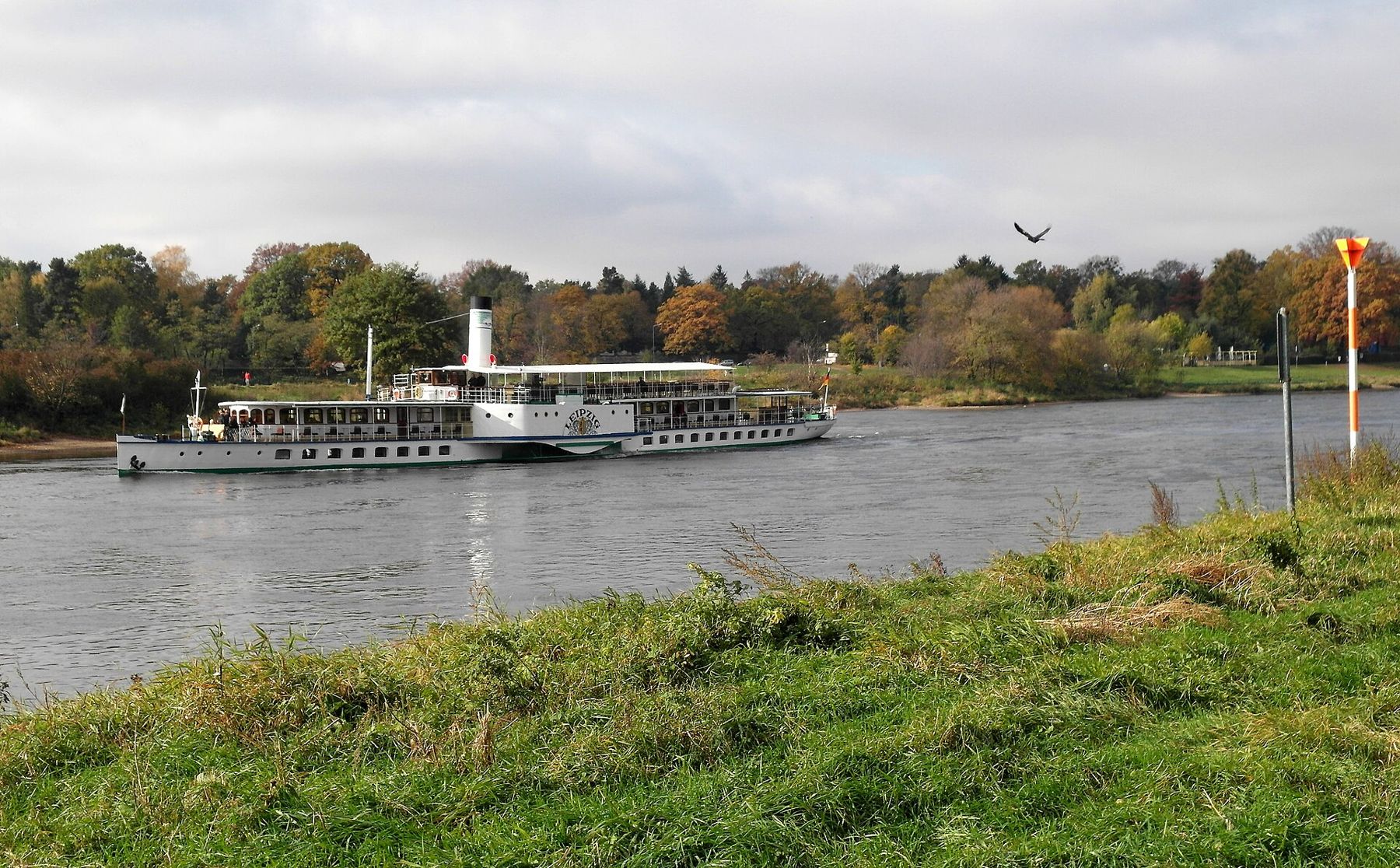
On the river The steamers berth on the Terrassenufer below Brühl's Terrace and work upstream and downstream from there, passing under the city's bridges and stopping at landing stages along both banks.
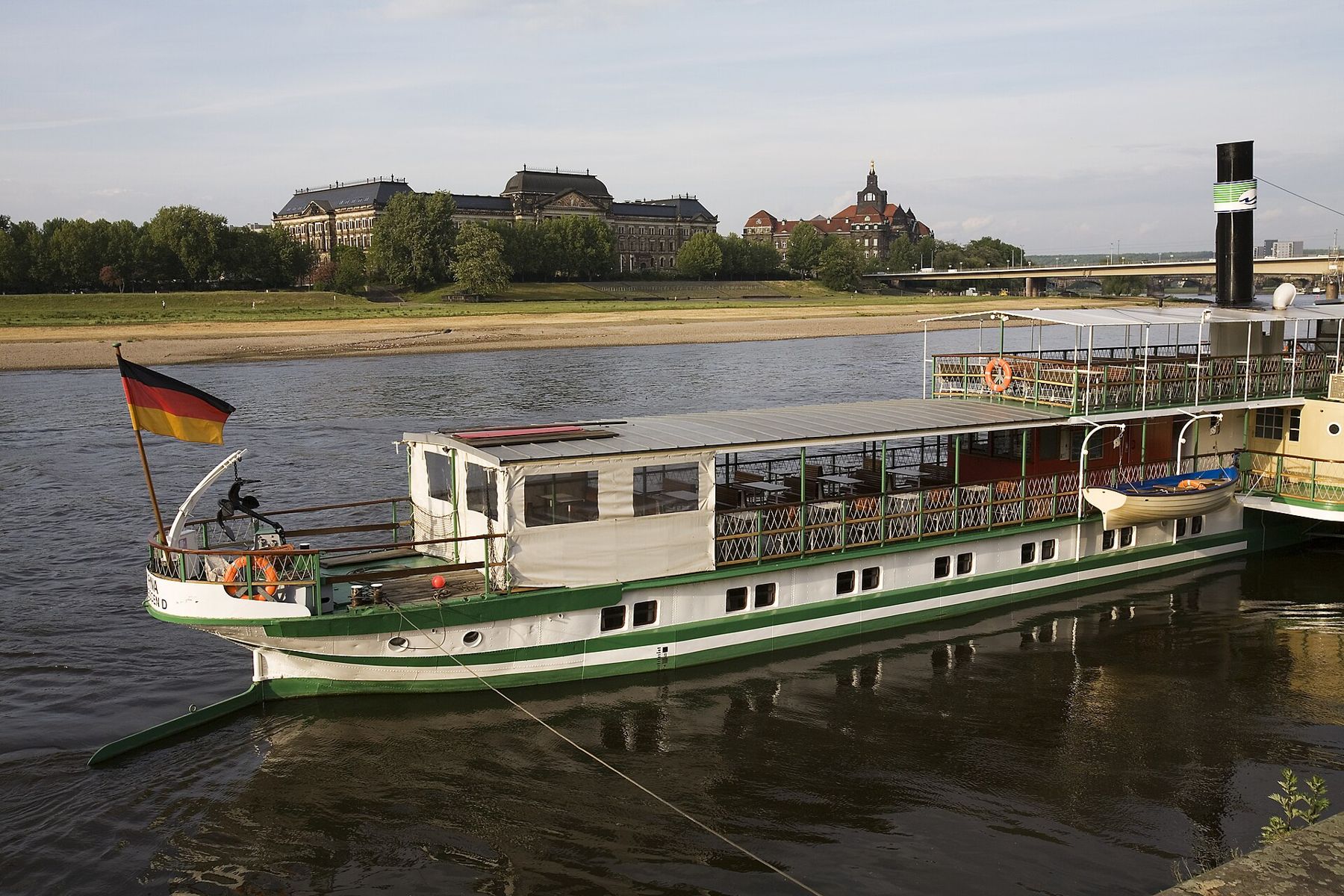
On a summer morning the Terrassenufer, the river front below Brühl's Terrace, is lined with white ships. They are long and narrow, trimmed in green, with a tall funnel amidships and a large semicircular box on each side covering the paddle wheels. They look old-fashioned because they are. Dresden's historic fleet of paddle steamers is among the oldest and largest in the world, and the ships still sail on regular routes up and down the Elbe.
An old fleet, still working
Steam navigation on the upper Elbe began in the nineteenth century, when the river was a working highway for passengers and goods between Bohemia, Saxony and the ports downstream. Paddle steamers suited it well: the Elbe here is shallow in places, with shifting gravel banks, and a flat-bottomed side-wheeler draws very little water.
The ships in the present fleet were built between the 1870s and the late 1920s. Most carry the names of towns along the river or of Saxon cities, painted on the paddle boxes: Dresden, Leipzig, Meissen, Pillnitz and others. Over the decades they have been rebuilt, re-boilered and refitted, but many still run on their original steam engines, and the older hulls have been carefully preserved through repeated overhauls.
On board you can usually look down into the engine room, where the polished cranks and connecting rods turn the great paddle shafts. It is worth doing at least once: the engines are slow, heavy and remarkably quiet, and watching them work is half the point of the trip.
Upstream to Pillnitz
The most popular short trip runs upstream from the old town to Pillnitz. The ship leaves the Terrassenufer, passes under the Albert Bridge and out past the open meadows of Johannstadt, and then the city thins out. The villas of Loschwitz appear on the north bank, the ship slides under the Blue Wonder, and the valley widens into a landscape of gardens, vineyards and small villages.
Saxony · and nearbyMeissen, castle hill and the birthplace of porcelainThe landing stage at Pillnitz lies right in front of the palace, where the summer residence of the Saxon court comes down to the river with a broad stair. The trip upstream takes longer than the return, because the ship is working against the current. A common plan is to sail one way and come back by bus or tram, or by bicycle along the river path; the palace and its gardens are described in our guide to Pillnitz Palace and its gardens.
Into Saxon Switzerland
Beyond Pillnitz the river passes Pirna and then enters the sandstone country of Saxon Switzerland, where the banks rise into cliffs and towers of rock. Longer trips continue into this landscape, with stops at towns and villages including Kurort Rathen, below the Bastei, and on towards Königstein and Bad Schandau. A full upstream journey is a day out in itself, and many people sail one way and take the S-Bahn back along the river.
This is the stretch where the paddle steamer makes most sense. The rock walls close in, the river bends, and the views change at every turn in a way you do not get from the train. For walking among the rocks themselves, see our guide to the Bastei and Saxon Switzerland.
Downstream, and other trips
Ships also run downstream from Dresden, past Radebeul and the vineyard slopes of the Elbe valley towards Meissen, the porcelain town on its castle hill. Shorter round trips through the city, evening sailings and special event cruises run in season. The range of routes and the days they operate change from year to year, so check the current timetable before you plan around a particular ship.
When the river runs low
The Elbe is a river that rises and falls a great deal. After a dry summer, or a dry winter with little snow in the mountains upstream, the water level in Dresden can drop to the point where the gravel banks show along both shores and the channel becomes too shallow for the steamers. When that happens, sailings are cut short, moved to sections of the river that still have enough water, or stopped altogether, sometimes for weeks.
High water stops them too. In flood the current is too strong, the bridges leave too little headroom and the landing stages are underwater. Either way, the timetable is at the mercy of the river, and it is worth checking on the morning you plan to sail, not just when you plan the trip.
Tips for the trip
Tickets are sold at the landing stages and in advance; on fine summer weekends the popular sailings fill up, so book ahead if you have a fixed day. The open upper deck is the best place to be, but it can be cool and breezy even on a warm day, so bring a layer. The covered saloons below are the place to sit if it rains.
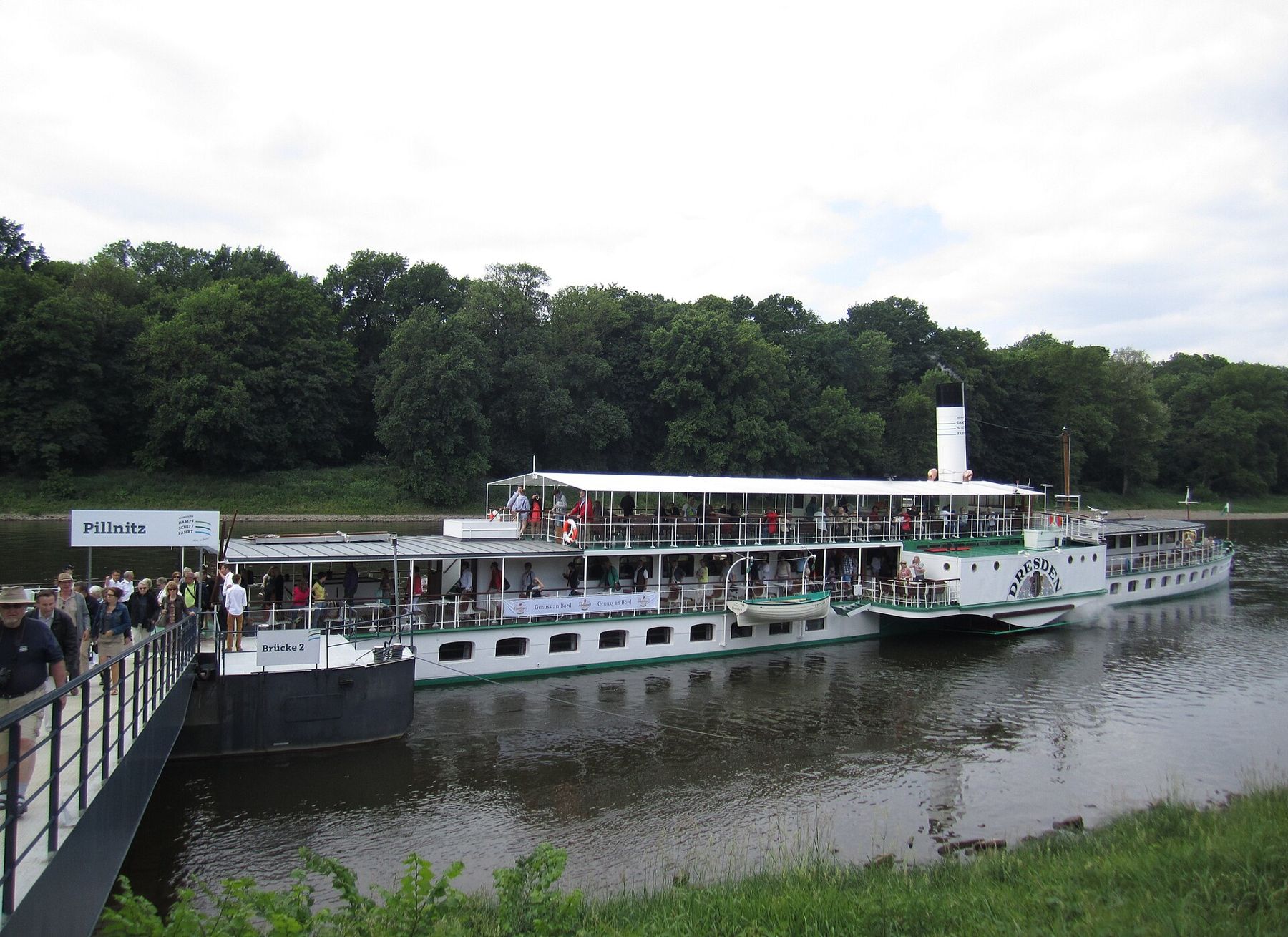
Look out for the landing stages themselves: floating pontoons, each with its name on a board, moored along the bank and connected to the shore by a ramp. The ship comes in sideways, the crew throw lines, a gangway is run out, and in a minute or two it is off again, paddles churning. It is an old routine on this river, and the steamers still keep it. Watch from the bank at Loschwitz or Pillnitz and you see the whole performance from outside: the slowing paddles, the swing of the stern in the current, the brief bustle on the pontoon, and the plume from the funnel as the ship pulls away.