
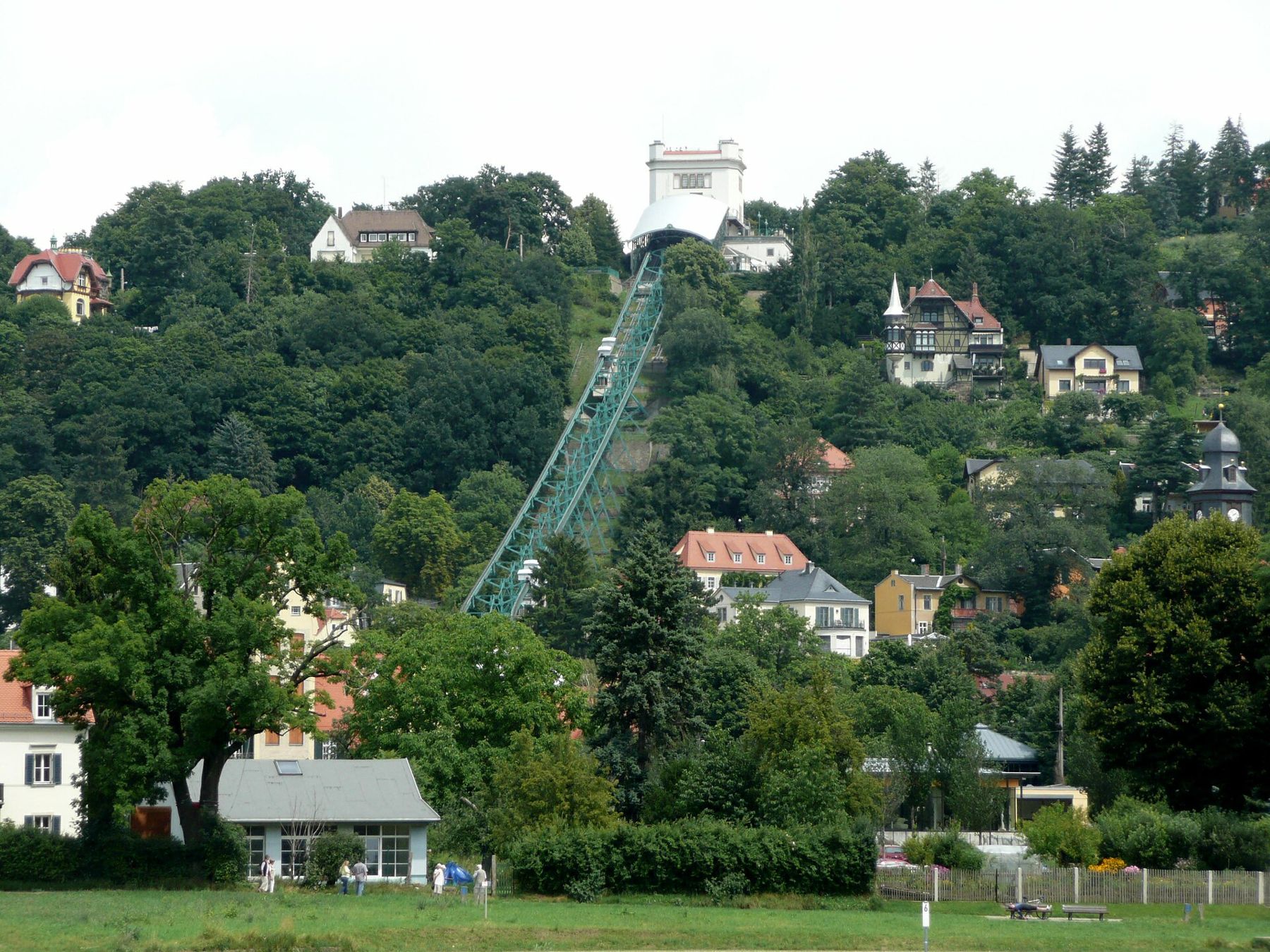
On the river Both railways start a short walk from the Loschwitz end of the Blue Wonder, and both upper stations look straight down the slope onto the bridge and the bend of the Elbe.
The north bank of the Elbe at Loschwitz rises steeply, close to a hundred metres from the river to the plateau above. At the end of the nineteenth century, when villa suburbs and health resorts were spreading across that plateau, the slope was a real obstacle. Two answers were built within six years of each other, and both are still running: the Standseilbahn, a funicular railway, and the Schwebebahn, a suspension railway in which the cars hang from an overhead track.
They start a few hundred metres apart near Körnerplatz, at the Loschwitz end of the Blue Wonder bridge, and they make a short, satisfying outing together: up one, along the top, and down the other.
The funicular to Weisser Hirsch
The Standseilbahn opened in 1895 to link Loschwitz with the Weisser Hirsch quarter on the hill above. Weisser Hirsch, the White Stag, was then becoming a fashionable spa resort, known for its sanatorium and for walks in the woods of the Dresdner Heide, the large forest that stretches north of the city. A railway up the slope made it reachable from the river and the trams.
A funicular works with two cars tied to the same cable, one going up as the other comes down, and passing each other at a loop halfway. The route climbs through gardens and woodland, passes through two short tunnels and crosses a viaduct, and the whole ride takes only a few minutes. The cars have large windows at the ends, and the front seats look straight down the track. Going up, sit at the back of the car facing downhill: the valley opens out behind you as you climb, and the river appears between the trees.
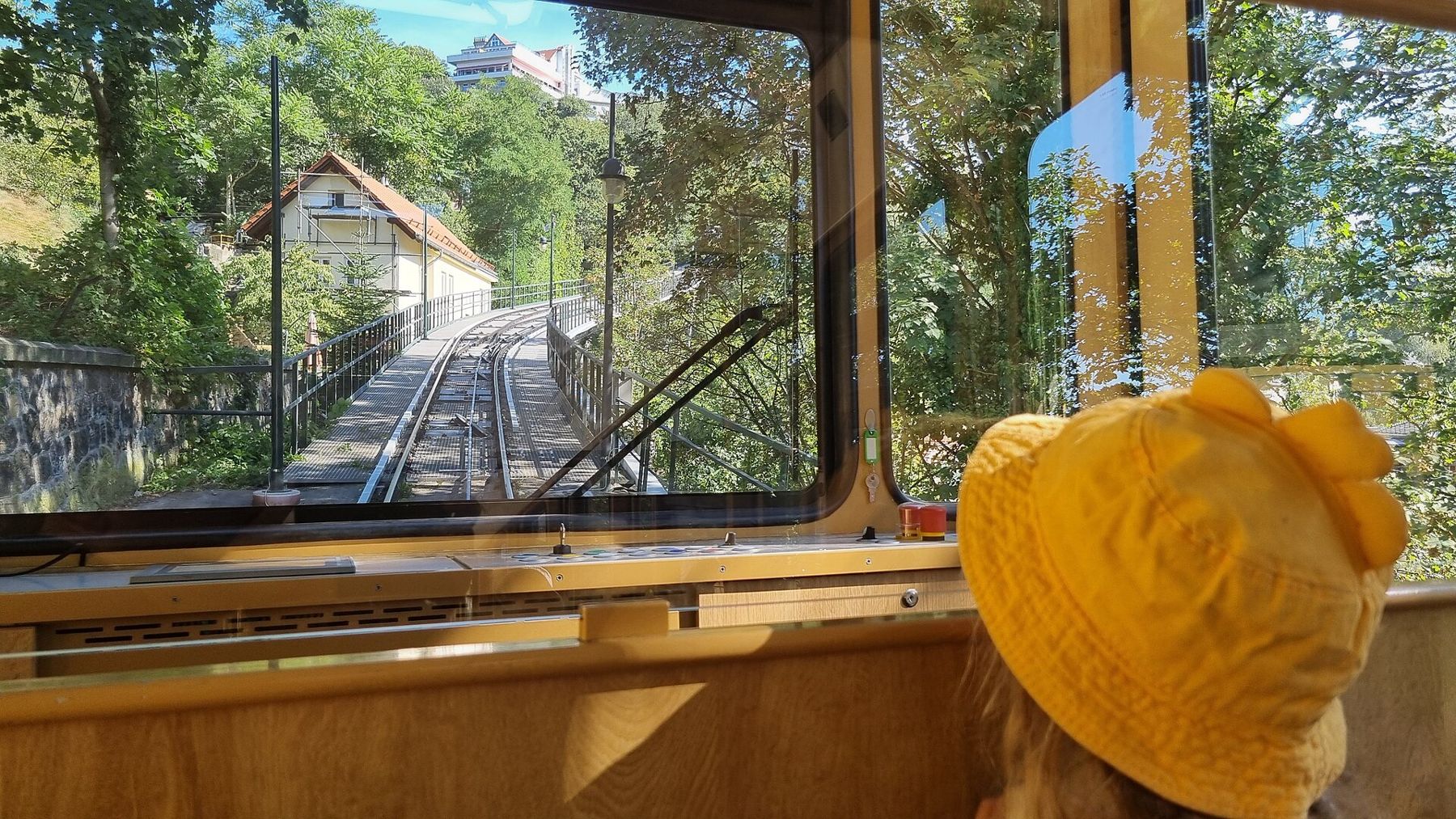
The upper station sits just below the main street of Weisser Hirsch. From the terrace near the top, the view opens over Loschwitz, the Blue Wonder and the Elbe valley. On a clear day you can see the towers of the old town downstream and the table mountains of Saxon Switzerland far upstream.
The Schwebebahn to Oberloschwitz
The second railway is stranger. The Schwebebahn opened in 1901 and is a suspension railway: the cars hang below a steel track carried on a row of trestles that march up the hillside. It was built on the same principle as the better-known suspension line in Wuppertal, and it is often described as the oldest suspension mountain railway in the world; it is certainly among the oldest of its kind.
The trestles are its most striking feature. They stand in a long line up the slope, each one a riveted frame of green-painted steel, getting shorter as the ground rises beneath them. From the lower station the line climbs steeply over gardens and stairways to Oberloschwitz, and the ride, like the funicular's, lasts only a few minutes.
Saxony · and nearbyThe Bastei and Saxon Switzerland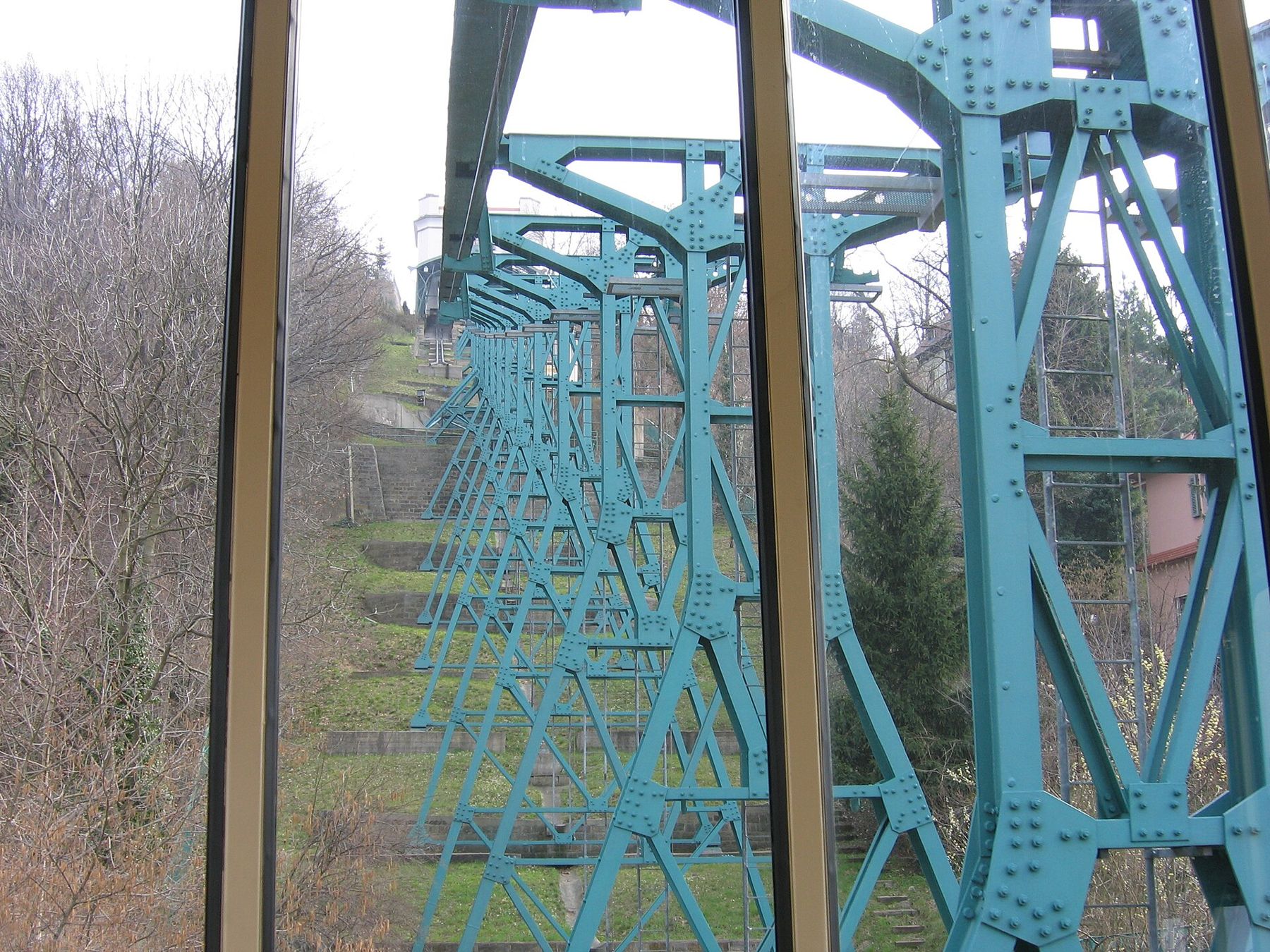
Like the funicular, it runs with two cars on a single cable, balancing each other. The upper station houses the winding machinery, and the white engine house on top of the hill can be seen from the meadows on the far bank. A viewing platform at the top looks out over the slope, the river and the city.
The view from the top platform
The two upper stations give slightly different views. From Weisser Hirsch the river is further below, and the view is longer and wider. From Oberloschwitz you are closer to the edge of the slope, and the Blue Wonder lies almost directly below, with the meadows of Blasewitz spreading out on the far bank and the old town skyline to the west. In the evening the light comes along the valley from downstream, and the trestles and villas glow.
Both upper stations are a short walk from each other along the streets at the top, through a quiet district of large houses and gardens. If you plan to walk between them, allow twenty minutes or so and expect some ups and downs.
Walking down instead
If you prefer, ride up one railway and walk down. Stone stairways run beside both lines, and lanes wind down through the old village of Loschwitz to Körnerplatz. The steps beside the Schwebebahn are steep and numerous but give a fine close look at the trestles from below. The descent takes a fraction of the effort of the climb, and you pass vineyards, garden walls and villas on the way. For the history of the village below, see our guide to the Blue Wonder and Loschwitz.
Practical matters
Both railways are run by the city's public transport operator but have their own fares, so check which tickets are accepted before you go. Operating times change through the year and the lines are closed for maintenance for several weeks at a time, sometimes for longer; the Schwebebahn in particular has had long closures for renovation. Check that the railway you want is running before you set out.
To get there, take the tram to Schillerplatz in Blasewitz and walk across the bridge to Körnerplatz, or take a bus that crosses the river. On summer days the paddle steamers also stop at the landing stage below the bridge, which makes a pleasant way to arrive from the old town; see our guide to paddle steamers on the Elbe.
Combine the railways with a walk along the Elbe meadows back towards the centre, or with a trip further upstream to Pillnitz Palace. Both cars are small, and on fine weekends there can be queues at the bottom; go early or on a weekday if you can.