
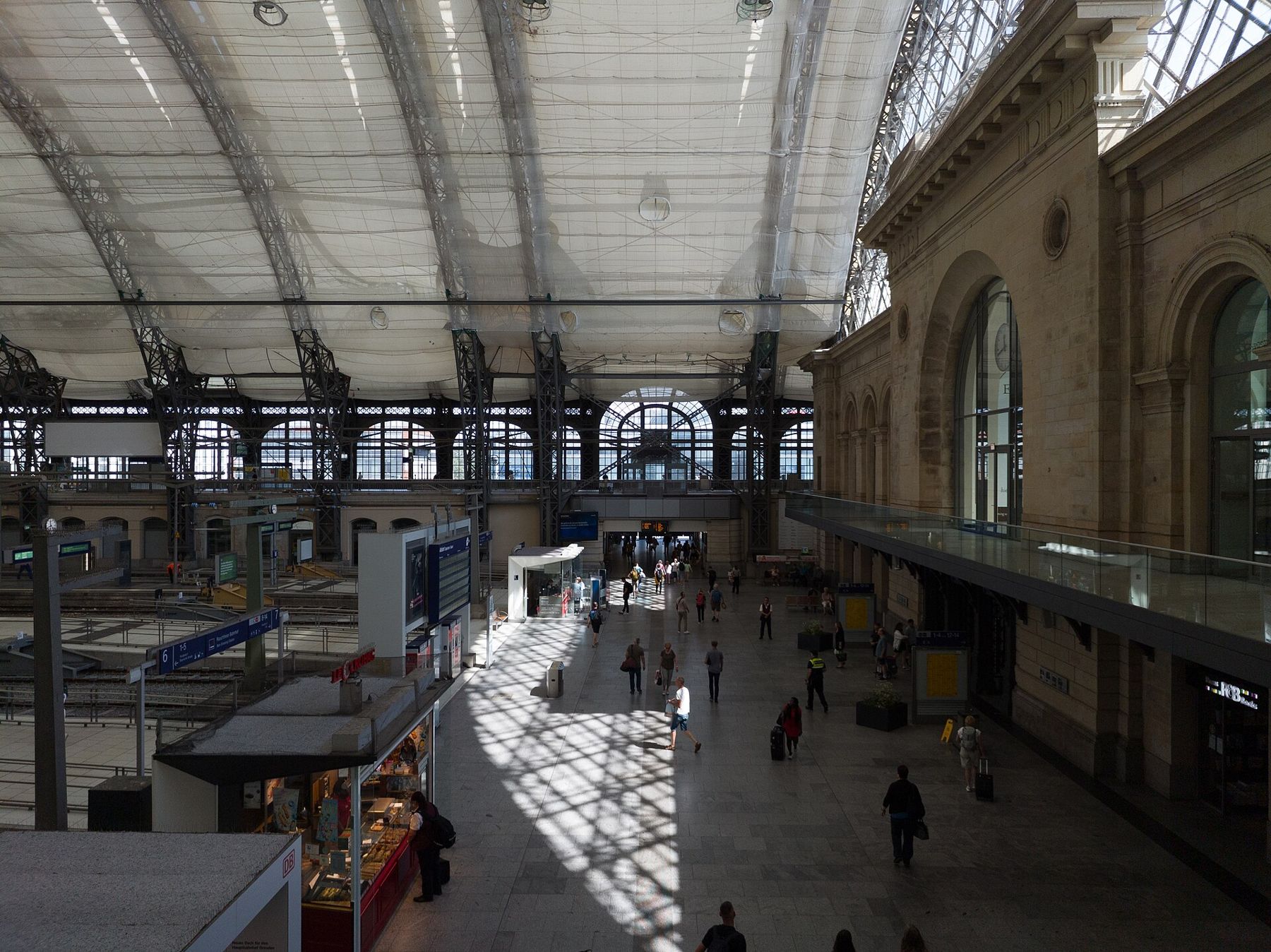
On the river The main station stands well back from the Elbe on the south side; Prager Strasse leads north towards the river, and Neustadt station waits across the water on the other bank.
The main station, Dresden Hauptbahnhof, stands at the southern edge of the city centre, and for most people arriving by rail it is the first view of the city. It is a good introduction. The building is old, much repaired and partly new, and it shows those layers plainly, much as the rest of Dresden does.
A nineteenth-century station under a new roof
The station was built at the end of the nineteenth century, when the railways from Leipzig, Berlin and Prague were brought together at a single main station. It was laid out as three great halls side by side, with heavy stone buildings and an iron framework holding up the roofs. The station was badly damaged in the air raids of February 1945, patched up afterwards and run for decades in a worn state.
After reunification it was thoroughly restored. The most striking change was the new roof. Norman Foster's practice designed a covering of translucent membrane, a coated glass-fibre fabric stretched over the old iron arches, and the work was completed around 2006. By day the fabric lets through a soft, even light, so the concourse feels bright without the glare of glass; at night it glows from inside. The old stone walls and the iron ribs were kept, so the station still reads as a nineteenth-century building with a new skin.
The station has also had its share of trouble from the river. In the great flood of August 2002 water rose into the station from the Weisseritz, the small river that runs into the Elbe nearby, and the building had to be cleared and repaired. You would not guess it now.
Finding your way in the station
Long-distance and regional trains, the S-Bahn and trains to Prague and the Czech border all use the station. The central hall holds the main concourse, with tracks on either side, and the ticket hall and shops are along the sides. Departure boards and signs are clear, and the walk from the platforms to the exits is short.
The main exit to the north, towards the city centre, leads out onto Wiener Platz, a broad open square. Across it, Prager Strasse begins. If you are heading on by tram, the stops for the Hauptbahnhof are on the north side and along the streets around it.
The memorial to October 1989
Inside the station, on a stone wall, a bronze plaque recalls a few days in October 1989 that mattered a great deal to Dresden. That autumn thousands of East Germans had taken refuge in the West German embassy in Prague, and the trains that finally carried them to the West were routed through East German territory, passing through Dresden. From 3 October 1989 people who wanted to leave gathered at the Hauptbahnhof, hoping to board.
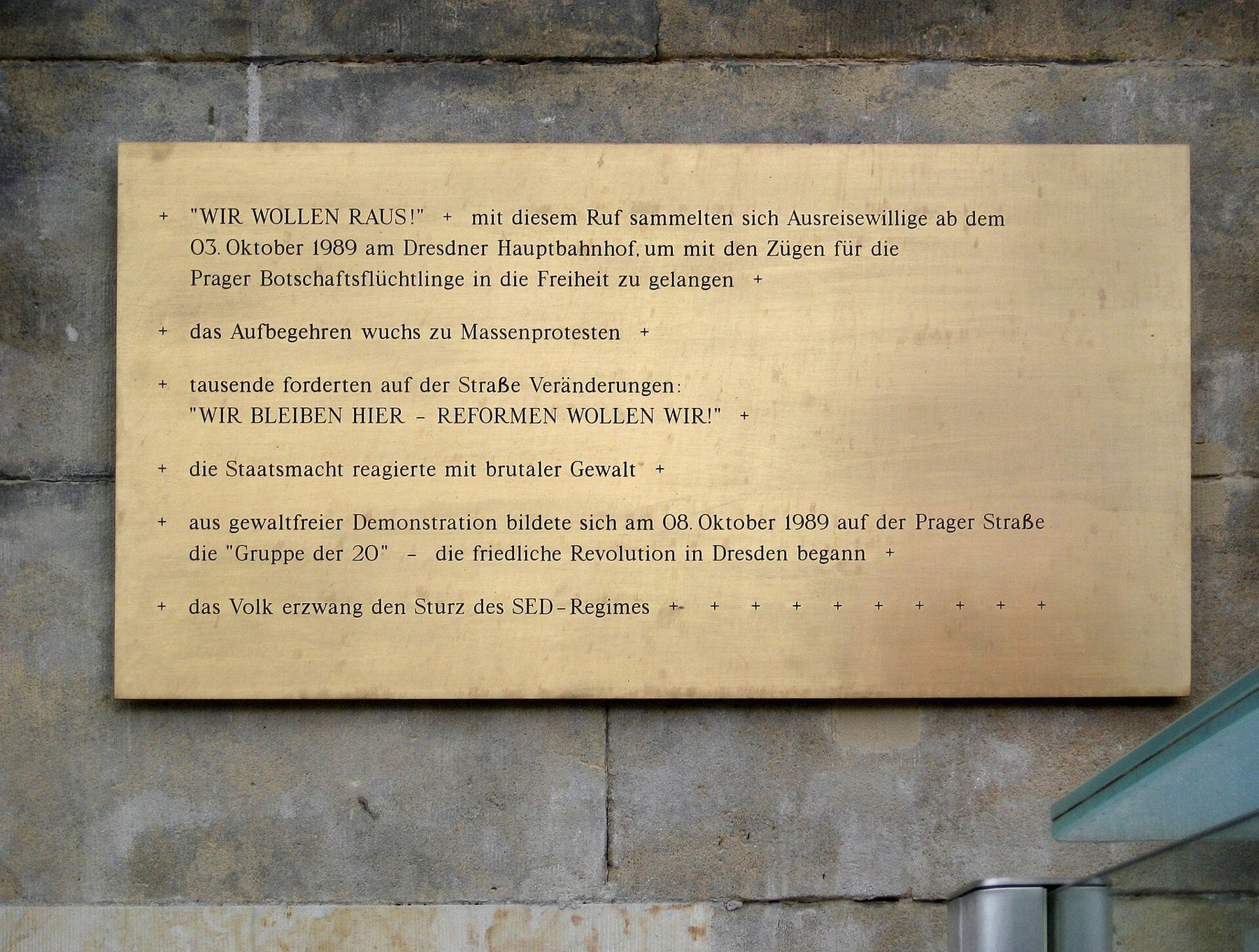
The gathering grew into mass protest, and the state responded with force. A few days later, on 8 October, a peaceful demonstration on Prager Strasse produced a group of twenty citizens who were chosen to speak for the crowd and opened talks with the city authorities. The plaque calls it the beginning of the peaceful revolution in Dresden, which ended with the fall of the ruling party. It is a short text and easy to miss; look for it on the way through the halls.
Arriving · and nearbyFebruary 1945 and the rebuildingWalking up Prager Strasse
Prager Strasse runs north from the station to the old town, a pedestrian boulevard of roughly a kilometre. Before 1945 it was a busy shopping street lined with tall nineteenth-century buildings. After the raids almost nothing was left, and in the 1960s and 1970s the GDR rebuilt it as a showpiece of modern planning: a very wide pedestrian street with fountains and flower beds, long blocks of flats on one side and hotels and department stores on the other.
Some of that modernist street survives, including a very long apartment block and a round cinema building that has become a well-loved landmark. Since reunification, newer shopping buildings have filled the gaps, so the street is now a mix of GDR modernism and recent glass and stone. It is busy, wide and easy to walk, and it delivers you to the Altmarkt, where the Striezelmarkt is held at Christmas. From there the Frauenkirche is a few minutes further on.
Trams and getting around
Dresden's tram network is extensive and frequent, and several lines stop around the Hauptbahnhof. Trams run north through the centre and over the river to the Neustadt, and out to the suburbs. Tickets are sold at machines at the stops and on trams, and through the transport operator's own channels; day tickets are good value if you plan several trips. Fares and ticket types change, so check before you travel. Validate paper tickets where required.
Walking, though, is often the best way to reach the centre from the station. Prager Strasse leads you to the Altmarkt, and from there the main sights of the Altstadt are close together.
Neustadt station, the other way in
Many trains also call at Dresden-Neustadt, the second main station, on the north bank of the Elbe. If you are staying in the Neustadt or heading for the courtyards of the Äußere Neustadt, it can be more convenient to get off there. It is a large nineteenth-century station building of its own, connected to the centre by tram, and from it a walk down the tree-lined Antonstrasse and along Hauptstrasse brings you to the Golden Rider and the Augustus Bridge. Check which station your train serves before you book ahead, since not every train stops at both.
More from arriving, history and the year · all five quarters